
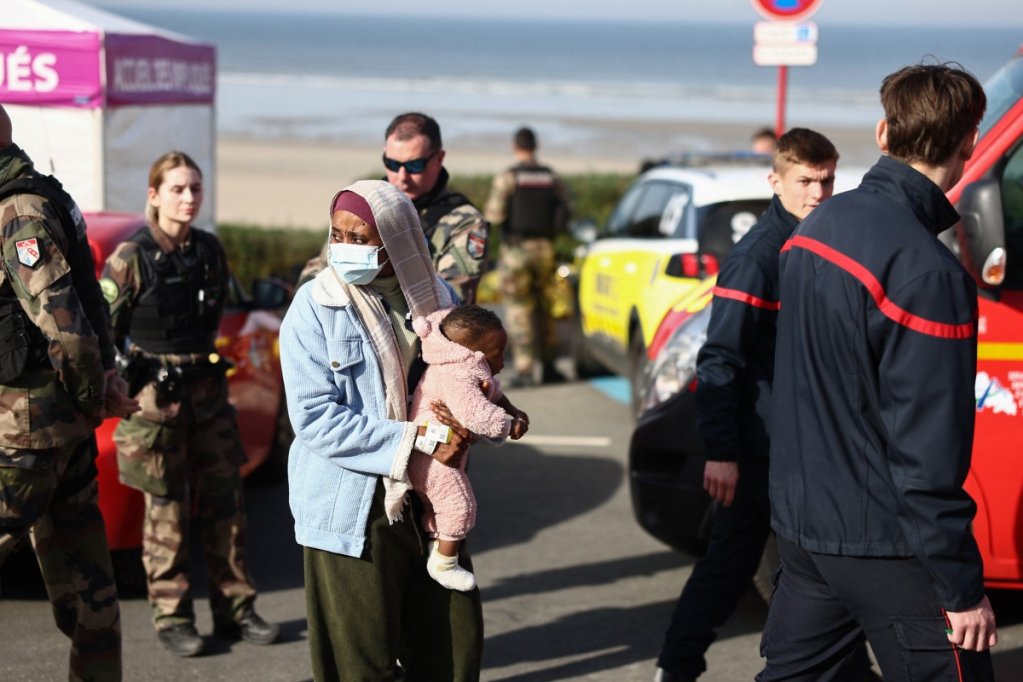
A renewed wave of attempted crossings of the English Channel has resulted in the death of one migrant and the rescue of 81 others after several small boats were detected off the northern coast of France.
The French Maritime Prefecture for the Channel and North Sea said the rescue operations took place between August 26 and 28 as migrants attempted to reach the United Kingdom from the French coastline.
French authorities recorded several boat departures during the 48-hour period, including one vessel believed to have been carrying more than 110 people.
Four migrants were rescued and taken ashore at Boulogne-sur-Mer during the night of August 26-27.
The following night, shortly after midnight, the patrol vessel Cormoran was deployed and rescued five people, including a child. Another rescue vessel, Ridens, was sent to monitor a larger boat carrying more than 110 passengers.
Early on August 28, Ridens rescued 72 people from the vessel. One passenger was found in cardiac arrest and received cardiopulmonary resuscitation while a rescue helicopter was dispatched to the scene.
The migrant was later pronounced dead.
Three other people were injured during the operation, with one requiring urgent medical treatment, according to French maritime authorities.
The latest rescues came shortly after hundreds of migrants successfully crossed the Channel to Britain.
British authorities said 494 migrants arrived in the UK aboard seven small boats on Thursday, marking the first successful Channel crossings recorded in 10 days. Earlier, on August 17, about 250 people had reached Britain.
Despite the latest arrivals, British authorities say small-boat crossing incidents have fallen considerably this year.
Under the current UK-France cooperation agreement, which has been extended until October 1, British authorities said 185 boats had been intercepted and about 4,300 crossing attempts prevented between April 27 and August 2.
Officials estimate that the measures contributed to a 61 percent reduction in small-boat incidents during the period.
A UK Home Office spokesperson said the government believed the measures were delivering results, citing July’s figures as the lowest number of crossings recorded for that month since 2020.
Britain has also agreed to increase the number of personnel deployed along French beaches by 40 percent under a payment-by-results arrangement with France.
The measures are intended to disrupt smuggling networks and prevent migrants from making dangerous journeys across the Channel.
The UK has additionally introduced a new offence targeting people whose actions endanger others during sea crossings. Created under the Border Security, Asylum and Immigration Act 2025, the offence applies to journeys beginning in France, Belgium or the Netherlands where an individual’s conduct creates a risk of death or serious injury to another person.
British authorities said 10 small-boat pilots had been convicted under the new offence in less than two months.
One of those convicted was a 34-year-old Afghan national who arrived in Britain on June 23 with 95 other people. He pleaded guilty and was sentenced to 24 months in prison.
Another convicted pilot, an 18-year-old Sudanese national, arrived in Britain on June 21 aboard a boat carrying 82 people, including 13 children. He also pleaded guilty and received an 18-month prison sentence.
Humanitarian organisations have criticised the increasingly intensive security measures along the French coast.
French association Utopia56 accused the British government’s approach of placing too much emphasis on reducing crossing numbers while failing to sufficiently address the humanitarian consequences.
The organisation said it had recorded 2,720 reports of police violence during 2026, compared with 1,954 during the same period last year.
Utopia56 also expressed concern about families being separated during attempts to board boats.
According to the organisation, it had encountered at least 10 families separated on beaches since the beginning of the year. It alleged that, in some cases, children were taken onto boats while their parents were detained by police.
The group also criticised what it described as heavily militarised policing along the coastline and alleged that officers sometimes use dangerous tactics during enforcement operations.
Meanwhile, the overall decline in the number of boats crossing the Channel has been accompanied by a rise in the number of passengers carried by individual vessels.
One of the most notable recent examples occurred last month when a boat measuring about 13 metres carried a record 165 people across the Channel. The vessel, described in media reports as a “mega dinghy”, demonstrated how smuggling networks are placing increasingly large numbers of people on individual boats.
A 19-year-old Sudanese national is facing charges over allegations that he piloted the vessel from France to Dover.
Official data also shows how significantly the average number of passengers per boat has increased. In 2018, a small boat carried an average of about seven people. By the year ending March 2026, that figure had risen to 63.
Some recent crossings have involved more than 100 passengers, while exceptional cases have approached 200 people.
Experts say the trend could suggest that smuggling groups are changing their methods in response to tighter enforcement.
One reported tactic involves launching multiple boats at roughly the same time, potentially drawing French authorities towards smaller vessels while a larger boat continues towards Britain.
French authorities generally avoid intervening once boats are at sea because attempts to stop them can create additional dangers and increase the risk of accidents.
The English Channel is one of the world’s busiest shipping routes and is characterised by powerful tides, strong currents, cold water and heavy commercial traffic.
Authorities and humanitarian organisations have repeatedly warned that attempting the crossing in overcrowded and often unsuitable vessels can have fatal consequences.
The latest death shows the continuing dangers faced by migrants attempting to reach Britain, even as the UK and France intensify efforts to prevent crossings and disrupt the smuggling networks facilitating them.