
A court in Turin has sentenced the former director of a repatriation detention center (CPR) to a one-year suspended prison term over the suicide of a young migrant in custody, ruling that she failed to address clear signs of psychological vulnerability. The decision marks a rare criminal conviction linked to conditions inside Italy’s migrant detention system.
The ruling concerns the death of Moussa Balde, a 23-year-old man from Guinea who took his own life in May 2021 while being held at the CPR in Turin. Balde had been transferred to the facility after he was violently assaulted by three Italian men in Ventimiglia, near the French border. Despite being the victim of an attack and requiring hospital treatment, he was later identified as lacking valid residence documents and placed in administrative detention pending deportation.
The court sentenced Annalisa S., who directed the Turin CPR on behalf of the managing company Gepsa, to one year in prison, suspended. Judges concluded that she failed to take adequate measures to respond to Balde’s psychological distress. The center’s medical director was acquitted in the same trial.
Balde’s family was awarded provisional compensation of approximately €400,000, to be paid jointly by the defendant and Gepsa. His relatives traveled repeatedly from abroad to attend hearings during the proceedings. Additional damages were granted to civil parties in the case, including the Association for Legal Studies on Immigration (ASGI), the Frantz Fanon Association — which focuses on mental health protection — and the Turin municipal ombudsman for detainees.
The case sparked widespread outrage in Italy and internationally when details first emerged. In May 2021, Balde was attacked on the street in Ventimiglia by three men. Video footage of the assault circulated widely. While hospitalized, authorities discovered that he did not have legal residence status in Italy. He was subsequently transferred to the Turin CPR, a pre-deportation detention center used to hold migrants pending removal.
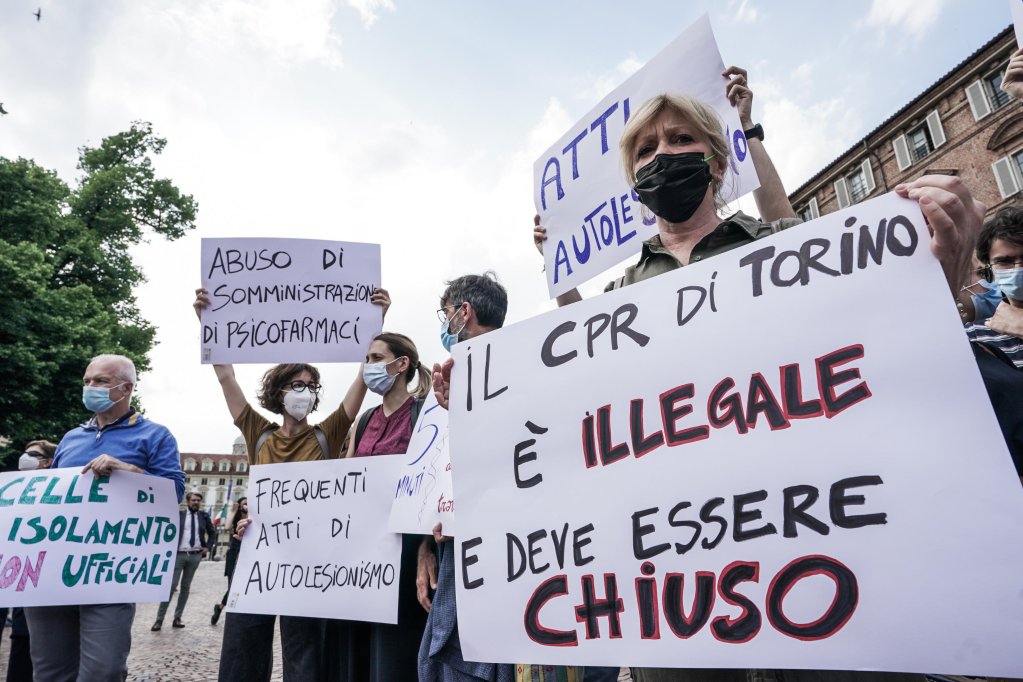
According to testimonies presented in court, Balde repeatedly expressed that detention felt like imprisonment and exhibited signs of psychological distress. At the center, he was placed in isolation in an area known as the infirmary. During the trial, differing accounts were given as to why he had been isolated.
One version suggested that other detainees believed Balde might have scabies because of a visible skin condition. It was later confirmed that he suffered from psoriasis, which is not contagious. Despite this, he remained in isolation. Another account indicated that concerns about “public order” may have contributed to the decision to separate him from other detainees, though details were limited.
Reports from non-governmental organizations have long criticized conditions inside CPR facilities, alleging inadequate infrastructure, limited mental health support and the use of isolation for disciplinary or behavioral reasons. Mauro Palma, the former national ombudsman for detainees, testified during the trial that the Turin facility “looked like an old zoo.”
Two weeks after his transfer to the center, Balde was found dead. His death prompted protests, riots and fires at the Turin CPR. The facility was eventually closed in 2023 following months of unrest, but resumed operations under new management in May 2025.
In a statement reacting to the verdict, the political alliance Alliance of Greens and Left (AVS) described the CPR system and administrative detention of migrants as “a national disgrace.” Gianluca Vitale, the lawyer representing Balde’s family, welcomed the ruling as significant. He said he hoped it would serve as a warning to those managing such facilities, while noting that the Italian state had been excluded from the proceedings despite what he described as minimal oversight by competent authorities.
The judgment highlights ongoing debates in Italy over the use of administrative detention for migrants and the responsibility of authorities to safeguard the physical and mental well-being of detainees. While the sentence is suspended, the conviction signals judicial recognition of failures in care within the detention system.
If you are experiencing severe emotional distress or suicidal thoughts, professional help is available. In Italy, the suicide prevention hotline can be reached at 800 860 022 in emergencies. International resources can be found at Befrienders Worldwide.