
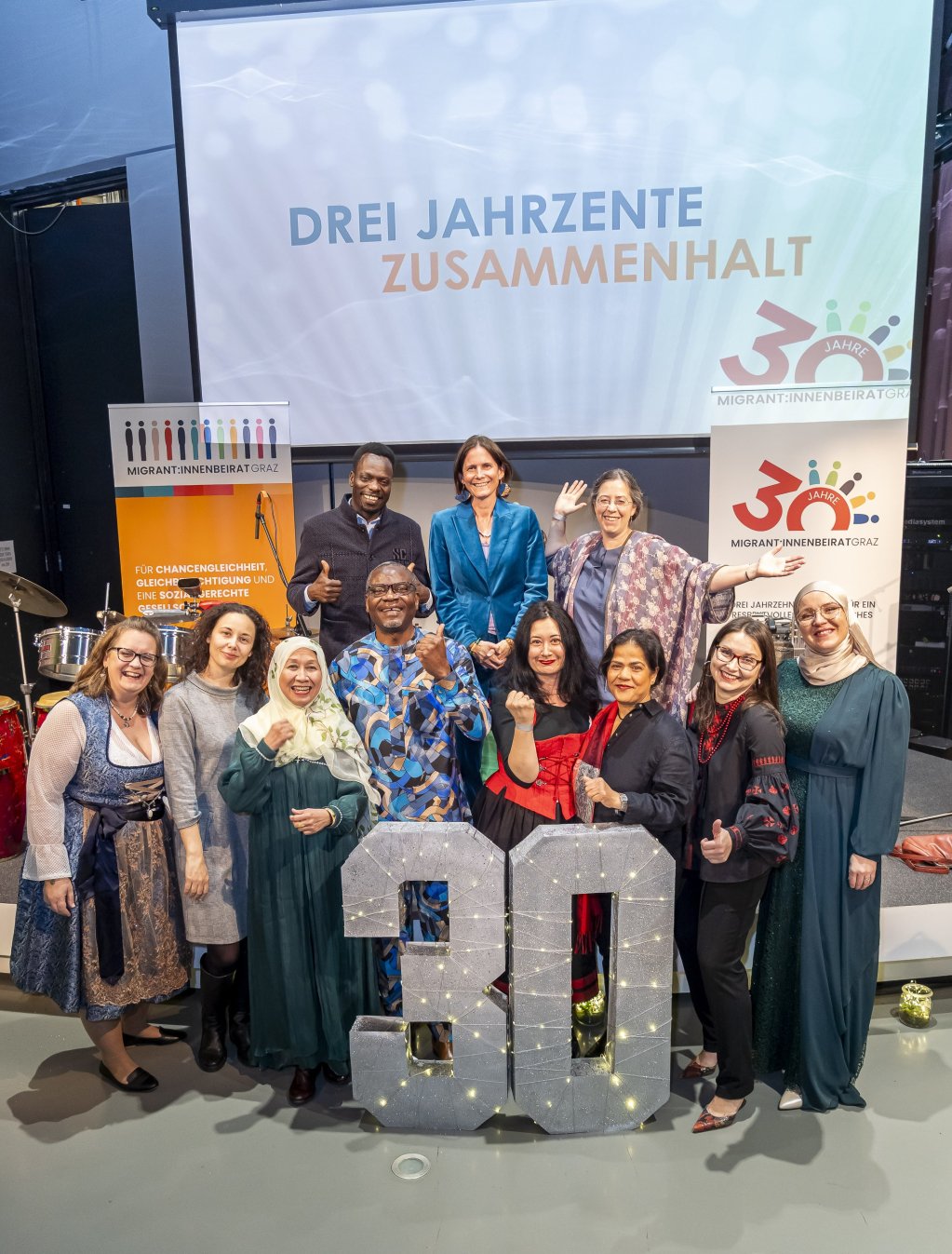
In the southern Austrian city of Graz, a migrant advisory body is marking three decades of advocacy by intensifying its campaign to secure local voting rights for foreign residents who live and work in the city but remain excluded from the ballot box.
The Migrant Advisory Council of Graz was established in 1995 to represent the interests of migrants and advise the municipal administration on integration, social inclusion, and policy concerns affecting foreign communities. Thirty years later, the council says its next goal is to tackle what it describes as a democratic deficit in Austria by pushing for non-EU residents to be granted the right to vote in local elections.
“We have momentum on our side,” said Godswill Eyawo, director of the council, during the body’s 30th anniversary celebration at the Kunsthaus Graz, the city’s contemporary art museum. The event brought together city officials, civil society representatives, and members of Graz’s diverse communities, reflecting the demographic transformation the city has undergone over the past three decades.
Graz, the capital of the province of Styria, has long been shaped by immigration. Major geopolitical events in the 1990s — including the fall of the Iron Curtain, the violent breakup of Yugoslavia, and the genocide in Rwanda — triggered significant displacement across Europe. Due to its location and policy of neutrality, Austria became a destination for many refugees and migrants.
Today, out of Graz’s population of approximately 307,000 residents, around 47,000 people — or roughly 16 percent — are non-EU citizens. The largest diasporas originate from Bosnia and Herzegovina, Turkey, Ukraine, Syria, Afghanistan, Russia, Serbia, and Kosovo. Austria generally restricts dual and multiple citizenship, prompting some long-term residents to retain their original nationality for personal or practical reasons, even after years in the country.
Under Austria’s constitution, non-EU residents are not permitted to vote in state or national elections. Local voting rights are also tied to citizenship status. Eyawo noted that this legal framework effectively excludes a significant portion of the population from participating in decisions that directly affect their daily lives.
“Our politicians noticed in the nineties that only Austrians were allowed to vote in state and national elections,” he said. “According to the constitution, non-EU residents are not allowed to vote in elections or participate in the democratic process.”
The Migrant Advisory Council was created to provide an indirect channel of representation. The nine-member board is elected every five years on the same day as municipal elections. While foreign residents cannot vote for the city government, they can vote for council members who then advocate on their behalf before local authorities.
Irina Karamarkovic, chairwoman of the council, said participation in civic life is essential for integration and social cohesion. “Participation means that you feel included and recognized as part of the community,” she said. “It reduces isolation, builds trust, and strengthens social cohesion between different cultural groups.”
Support for inclusion varies across the political spectrum. Graz’s mayor, Elke Kahr of the Communist Party of Austria, has been described by council members as viewing all residents as “bürger,” or citizens, regardless of passport status. However, other political actors take a more restrictive stance. The Freedom Party of Austria, a far-right party, has campaigned on reducing social benefits for irregular migrants and asylum seekers and limiting family reunification. The governor of Styria has also called for cutting benefits for what he described in campaign material as “illegal foreigners.”
Eyawo acknowledged that while racism may not be pervasive, discrimination based on ethnic or religious background persists. “The presence of migrants affects some people’s whole feeling of identity and sense of belonging in society,” he said.
Council member Sara Crockett, who has lived in Graz for 24 years, said some residents fear economic competition or insecurity. “I’ve had encounters with people who are scared that their job is going to get taken away, or that their bicycle will get stolen,” she said. “It’s all about resources.”
Beyond advocacy, the council serves as a mediator between migrant communities and municipal authorities. It gathers concerns from residents on temporary work visas, asylum statuses or other precarious legal arrangements and brings these issues to the city’s integration department. In 2005, the council successfully lobbied for the establishment of an integration office within city hall to institutionalize dialogue and support services.
Eyawo emphasized that encouraging political mobilization among migrants remains central to the council’s mission. Ahead of municipal elections, the board sends information letters to eligible foreign residents, informing them that they can vote for Migrant Advisory Council representatives. Outreach efforts extend through community associations representing various diaspora groups. However, barriers such as language proficiency and political disengagement remain challenges.
The debate over extending local voting rights to migrants is not confined to Graz. Across Europe, questions about citizenship, national identity, length of residency requirements, and language proficiency are central to broader discussions about democratic inclusion. Political theorists and public intellectuals have linked the issue to Enlightenment-era ideas of universal citizenship and the principle that those subject to laws should have a say in shaping them.
For Eyawo, the matter is pragmatic as much as philosophical. “If leaders don’t feel responsible for you, your interests are not important to them,” he said. The council’s members argue that granting local voting rights would formalize the contributions that thousands of foreign residents already make to Graz’s economy, culture, and social life.
As the city continues to diversify, the outcome of this debate could shape not only Graz’s political landscape but also Austria’s evolving approach to citizenship and democratic participation in an era of sustained migration.