
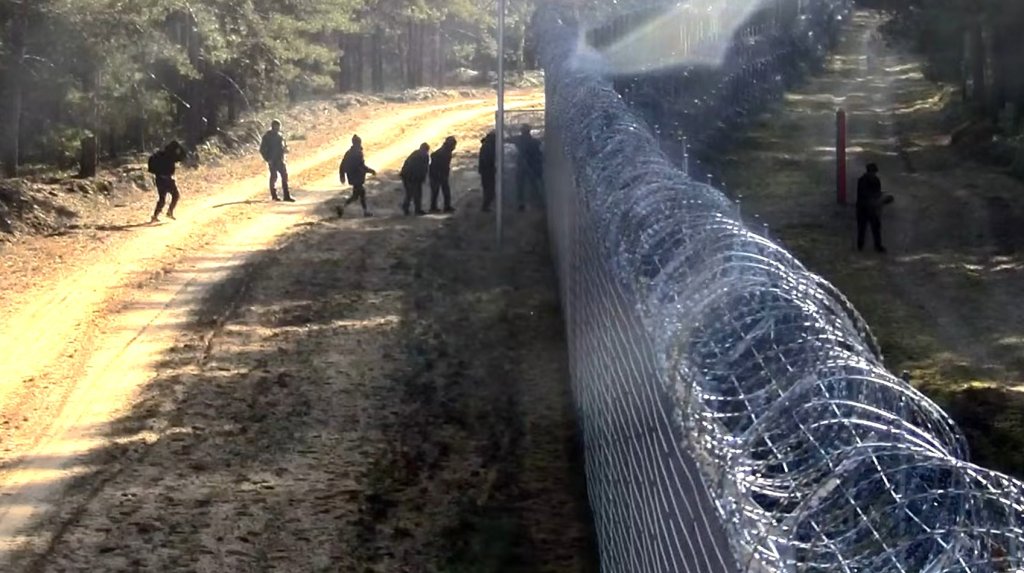
Authorities in Lithuania have launched a major security operation after a group of migrants attempted to enter the country from Belarus through an underground passage.
Border guards said around 30 migrants crossed illegally near the village of Baravykinès using a tunnel-like hole dug beneath the border. Surveillance cameras captured the group emerging one after another from the passage in what officials described as an “unusual” border breach.
The migrants were mainly from Afghanistan, Iraq, and Pakistan. In response, Lithuanian authorities deployed border guards, police officers, drones, helicopters, and dog units to track and detain those involved.
Most of the group was quickly apprehended after splitting into smaller units. By midweek, 27 migrants had been detained, with 24 already returned to Belarus and others receiving medical attention. A search is ongoing for the remaining individuals.
Investigators also arrested several suspects believed to be part of a smuggling network. These included drivers from Ukraine and Georgia, who were allegedly waiting to transport the migrants onward to Poland, with Germany believed to be the final destination.
Authorities said the drivers had received instructions in advance, and their vehicles were registered in Poland. Additional suspects were later arrested in Vilnius and Klaipėda, suggesting a wider organized smuggling network.
Officials confirmed that this is not the first time migrants have used underground routes to cross into the EU, with similar tunnels discovered previously in Lithuania and neighboring Poland.
Why are migrants crossing through Belarus into Lithuania?
Many migrants use Belarus as a transit route to reach Western Europe, often with the help of smuggling networks that exploit weak border points and new methods like tunnels.
Lithuanian authorities say attempts to cross the border have increased recently, with hundreds of migrants being turned back this year alone. The government, along with other EU countries, has accused Belarus of encouraging migration flows to put pressure on European borders.
Despite tighter security measures, including fences and surveillance systems, irregular crossings continue — showing how migration routes are constantly evolving.