
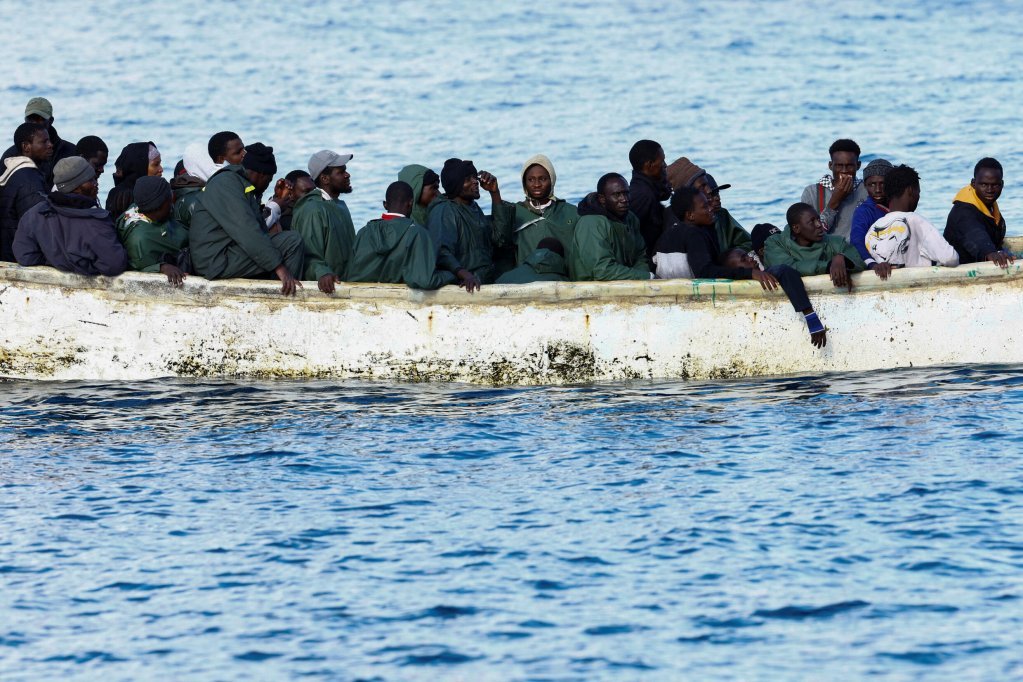
An aviation-based humanitarian group has stepped up efforts to monitor the perilous Atlantic migration route to Spain’s Canary Islands from the sky, citing a lack of civilian rescue ships and growing risks for migrant boats navigating one of the world’s deadliest sea crossings.
The Humanitarian Pilots Initiative (HPI) has been conducting monitoring flights over the Atlantic Ocean since mid-January as part of the latest phase of a pilot surveillance project. The initiative, led by volunteer professional pilots, aims to detect migrant vessels in distress in an operational zone roughly the size of Switzerland — an area marked by violent winds, powerful ocean currents and vast search distances.
The Atlantic route between West Africa and the Canary Islands stretches more than 2,000 kilometers, from coastal areas in countries such as Guinea and The Gambia to the Spanish archipelago off northwest Africa. The journey can take up to seven days or longer, depending on weather conditions and departure points. Boats frequently vanish without a trace.
Although migrant arrivals to the Canary Islands fell by more than 60 percent in 2025, departures continue. According to the Spanish NGO Caminando Fronteras, more than 3,000 migrants died in 2025 attempting to reach Spain, with most fatalities occurring along the Atlantic route. The decline in arrivals has not eliminated the dangers of the crossing.
Unlike the central Mediterranean, where multiple humanitarian vessels patrol international waters, there are no civilian rescue ships permanently operating along the Atlantic corridor to the Canary Islands. Rescue operations are largely handled by Spanish maritime rescue services and the Moroccan coast guard. In emergencies far from shore, cargo ships, fishing vessels or private sailors may be called upon to assist, even though they are not specifically trained or equipped for large-scale rescues.
In response to what it describes as a rescue vacuum, Humanitarian Pilots Initiative launched its third Atlantic monitoring mission in nine months. Initially started last spring, the effort remains a pilot project, but organizers say they hope to transition to long-term, structured operations by the summer.
“Until now, these have just been reconnaissance flights. We would like to be able to begin a coherent project and long-term operations this summer,” said Pascal Stadelmann, one of approximately 20 volunteer pilots working with HPI.
The group’s experience in the Mediterranean has informed its Atlantic operations, but key differences between the two maritime zones have required a shift in strategy. Cat Spangehl, a tactical coordinator with HPI, noted that the scale of the Atlantic search area presents a major operational challenge. While the distance between Libya and Lampedusa in the Mediterranean is around 140 nautical miles, distances in the Atlantic can reach up to 1,300 nautical miles.
Another significant difference is infrastructure. In the Mediterranean, civilian rescue vessels operate alongside national coast guards, and aerial reconnaissance often coordinates directly with ships in proximity. In the Atlantic, the absence of a consistent rescue fleet means that even when a distressed vessel is located, response options may be limited.
HPI has adapted by operating in a standby mode. Its crew is based in mainland Europe but can deploy within 24 hours to the Canary Islands if credible information emerges about a boat in distress. The Beechcraft 58 Baron aircraft used for Atlantic missions is stationed on Gran Canaria, allowing rapid takeoff when needed.
Early reconnaissance flights revealed that random patrols over such a vast area were inefficient. “One of the lessons we learned was that flying without any information didn’t make much sense,” Stadelmann said. Instead, the NGO now relies on intelligence from grassroots networks and migrant support organizations to narrow down potential search zones.
HPI collaborates closely with groups such as Alarm Phone and Caminando Fronteras, which receive calls from migrants at sea or from their relatives. Families typically begin seeking information after a week or more without contact. By analyzing departure points, weather conditions and estimated travel times, HPI’s coordinators assess probable positions before deciding whether to launch a flight.
Departures toward the Canary Islands now originate from locations much farther south than in previous years, including Guinea and The Gambia. In some cases, voyages last up to two weeks, further complicating search calculations and increasing exposure to dehydration, fuel shortages and mechanical failure.
The Atlantic route’s deadly reputation contrasts with the central Mediterranean corridor, which also remained dangerous in 2025. According to the International Organization for Migration, more than 1,870 people lost their lives along the central Mediterranean route last year. However, humanitarian ships in that region — often supported by aircraft such as HPI’s Sea-Bird and Albatross Uno in cooperation with Sea-Watch and SOS Méditerranée — continue to carry out coordinated rescue operations.
For HPI, the goal of its Atlantic missions is both preventive and operational: to locate boats before tragedies occur and to alert competent authorities as quickly as possible. As European states tighten visa policies and reinforce land borders, migration experts say more people are turning to longer and riskier maritime routes, including the Atlantic corridor to the Canary Islands.
With limited rescue infrastructure and thousands of kilometers of open ocean, the NGO argues that aerial monitoring is currently one of the few ways to improve early detection of boats in distress. Whether the pilot project evolves into a permanent operation may depend on funding, political support and the persistence of migration flows along one of Europe’s most hazardous sea routes.