
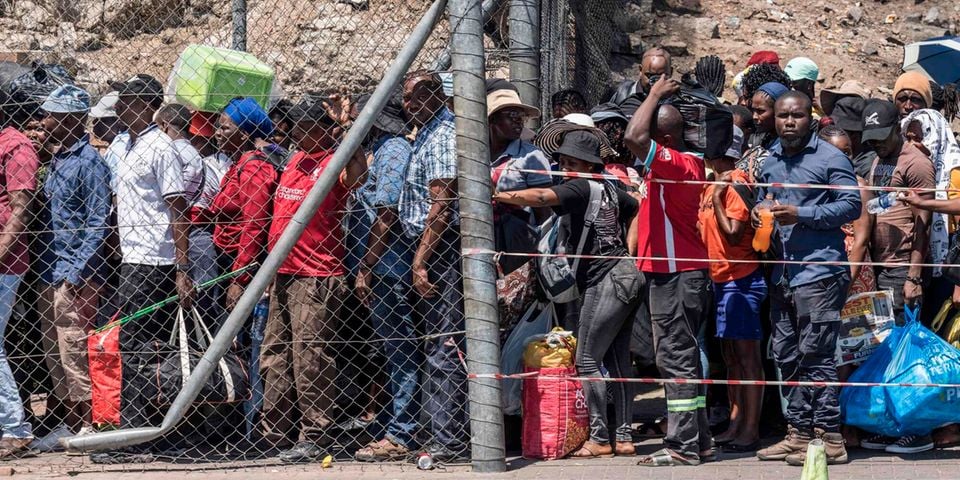
South Africa is taking a bold high-tech step to address its long-standing issue of illegal migration. With thousands of undocumented people crossing into the country each month, the government has now turned to drones and surveillance equipment to monitor border areas more effectively and crack down on human trafficking networks.
Over the Easter holiday, the country’s Border Management Authority (BMA) reported intercepting over 1,000 illegal immigrants at the Beitbridge border post with Zimbabwe. Officials said that this success was largely due to the deployment of drones and body-worn cameras, which allowed border agents to detect and track people trying to cross through unauthorized points, including the dangerous Limpopo River, known for crocodile attacks and strong currents.
South Africa shares borders with six neighboring countries, including Zimbabwe, Botswana, and Mozambique, and has become a major destination for migrants from across Africa seeking better economic opportunities. According to the 2022 South African census, the country is home to about 2.4 million migrants, with Zimbabweans making up more than one million of that number — the largest migrant group in South Africa.
A survey by the International Organisation for Migration (IOM) revealed that there are at least 22 illegal crossing points along the 200-kilometer stretch of border between South Africa and Zimbabwe. This makes the Beitbridge corridor one of the busiest and most difficult migration routes in Africa. Attempts in the past to secure the border included building a 40-kilometer fence, but it was soon vandalized and rendered ineffective.
The BMA, created just two years ago, now believes that modern surveillance technology could be the game-changer. “Without drones, our patrols would be blind and inefficient,” said Dr. Michael Masiapato, BMA Commissioner. “Now, we can track activity in real-time and direct our teams to intercept migrants, even in rough terrain like riverbanks and bushland.”
Dr. Masiapato added that drones have helped expose migrants using makeshift boats to cross the Limpopo River. The drones send live GPS coordinates to border guards, allowing them to reach the exact location and stop illegal crossings quickly. The new focus is not only on stopping migrants but also on targeting the human trafficking networks that smuggle people and goods across borders.
“We are now identifying and arresting the facilitators behind these illegal entries,” he said. “Once arrested, they face criminal charges under South Africa’s Immigration Act for aiding and abetting.”
South African Home Affairs Minister Leon Schreiber recently revealed that the BMA had acquired four high-tech drones and 40 body-worn cameras to strengthen border security. These drones have thermal imaging and long-range zoom lenses that can detect human movement up to two kilometers away — even in the dark or through vegetation.
“These drones launch within 15 seconds and immediately respond to disturbances,” Minister Schreiber said. “They’re equipped with advanced surveillance features, making it almost impossible for anyone to sneak past undetected.”
Once captured, undocumented migrants are usually deported to their home countries. In March alone, 165,308 people crossed into Zimbabwe from South Africa, according to IOM. However, officials believe the actual number of illegal crossings is much higher.
South Africa has a long history of deporting thousands of Zimbabweans each month. In 2010, deportations were temporarily paused when the government introduced special permits to regularize undocumented Zimbabweans. But with rising concerns about crime, economic pressure, and human trafficking, enforcement has become stricter in recent years.