
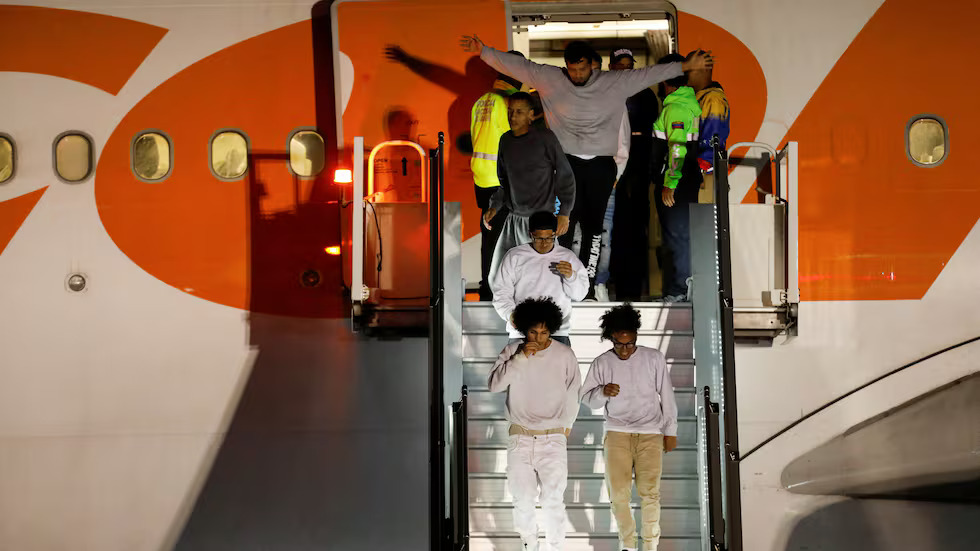
The government of the United States deported migrants to both Iran and Venezuela even as Washington prepared military actions against the governments of those countries, according to reports that have raised concerns among migration experts and human rights advocates.
Under the administration of Donald Trump, authorities launched an aggressive deportation campaign aimed at removing large numbers of migrants from the country. As part of that effort, deportation flights continued to both Iran and Venezuela despite escalating political and military tensions.
In Iran’s case, the United States ended a long-standing policy that had generally avoided deporting Iranian nationals due to the country’s human rights record. Instead, several deportation flights carrying Iranian migrants were organized in recent months.
The first flight took place on September 28 and transported around 120 deportees to Tehran via Qatar. Two additional flights followed in December and January, routing through Kuwait.
These deportations occurred amid escalating conflict in the region. Earlier strikes had targeted Iranian nuclear facilities, including the Fordow uranium enrichment site and the Natanz complex. The situation intensified further after joint military operations by the United States and Israel against Iranian targets triggered a broader regional conflict.
Migration experts questioned the logic of sending people back to a country the United States itself considers politically repressive and dangerous. Lawyers representing some of the deportees warned that certain individuals could face severe persecution upon return.
One case involved two Iranian migrants who fled their country due to persecution linked to their sexual orientation. According to their lawyer, returning to Iran could expose them to imprisonment or even execution because same-sex relationships are criminalized under Iranian law.
Both individuals were temporarily spared deportation after legal challenges and public pressure. Their cases remain under review while they are held in detention facilities run by U.S. Immigration and Customs Enforcement.
Meanwhile, deportations to Venezuela also continued despite rising tensions between Washington and the government led by Nicolás Maduro. According to migration advocacy groups, the United States carried out dozens of deportation flights returning thousands of Venezuelan migrants.
Many of these flights arrived at Simón Bolívar International Airport near Caracas. In some cases, deportation flights were routed through the U.S. military base at Soto Cano Air Base before reaching Venezuela.
The deportations continued even after the U.S. government ended Temporary Protected Status for Venezuelan migrants, a program that had previously allowed hundreds of thousands of Venezuelans to live and work legally in the United States due to instability in their home country.
Critics say the policy exposes migrants to significant danger. Lawmakers such as Cory Booker have argued that deporting people to countries facing political instability or repression contradicts warnings issued by the U.S. government to its own citizens about travel risks in those same countries.
Human rights advocates warn that continuing deportations to unstable or conflict-affected states could leave migrants vulnerable to persecution, detention, or violence once they return.