
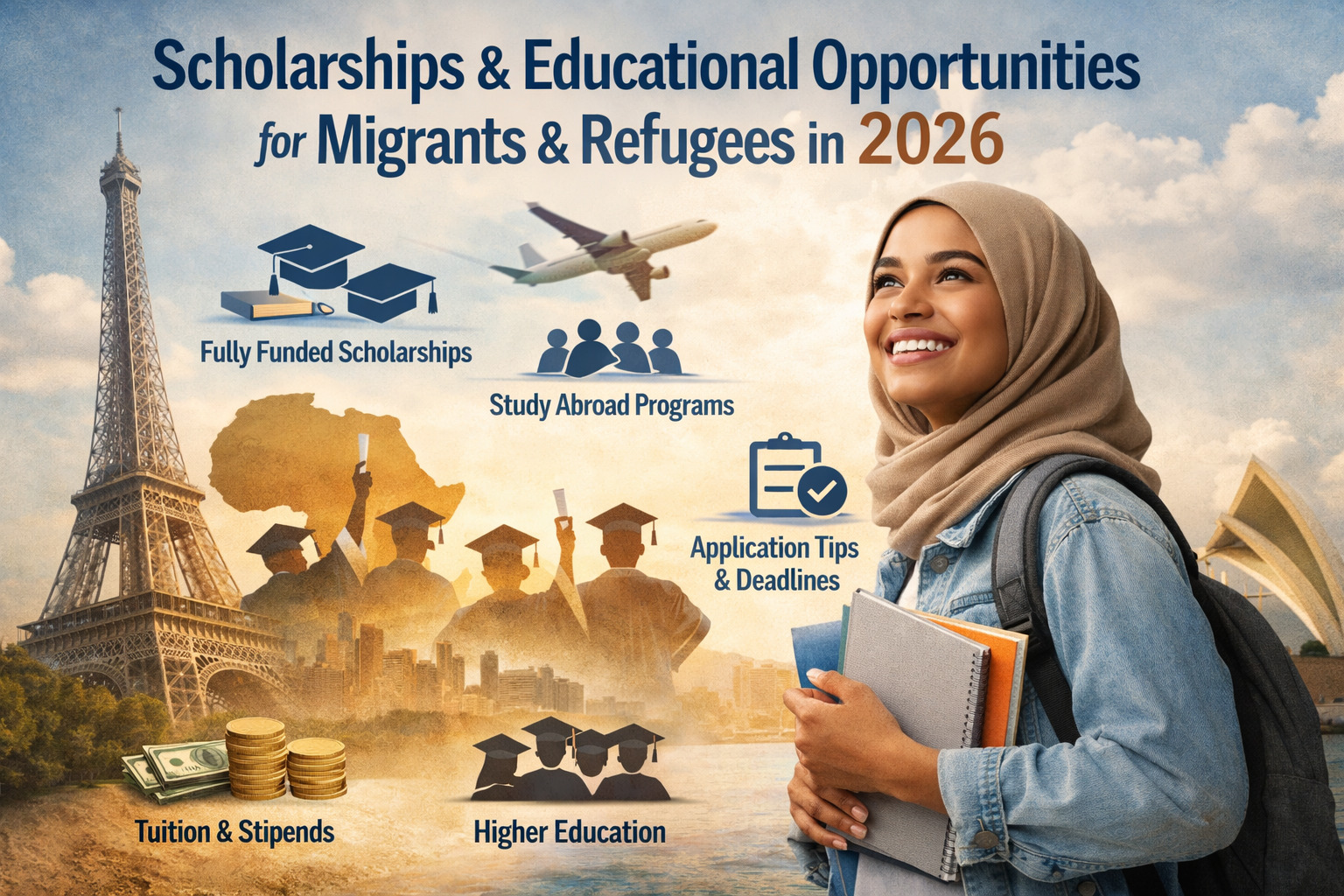
Education opens doors to opportunity, empowerment, and long‑term success — especially for migrants and refugees who face financial and social barriers. In 2026, a growing number of organisations, universities, and international agencies are offering scholarships and educational programs specifically designed to support displaced learners. These opportunities range from fully funded master’s degrees at world‑class universities to regional scholarships for vocational training and secondary education.
One of the most notable opportunities is the UNIV’R Scholarship Program 2026, a fully funded initiative in partnership with UNHCR and Sciences Po University in Paris. This scholarship is reserved for refugees residing outside the European Union and provides comprehensive support — including tuition fees, living stipends, health insurance, visa and travel costs, and settlement assistance — for a two‑year master’s degree. The deadline for applications is February 1, 2026, making it a high‑priority opportunity for refugees seeking advanced education.
In Australia, the SSI Allianz Refugee Education Scholarships offer significant support to migrants and refugees in New South Wales, Queensland, and Victoria. Designed to help learners at all stages — from secondary school to vocational training and university — this program awards scholarships across multiple streams, including VET and skills recognition. Applications open in October 2025 and close on November 21, 2025, with successful candidates receiving funding into 2026.
For students from East Africa, the Windle Trust International Scholarships provide another path to higher education. While the application window for the 2026 academic year has closed, this long‑standing program offers postgraduate scholarships for refugees and internally displaced persons, and future cycles are expected to open again.
Other targeted opportunities include conference scholarships such as those offered for the International Refugee and Migration Health Conference, which help refugee health professionals and students cover registration fees for participation — a valuable chance to network, learn, and build careers in migration health and related fields.
Many general international scholarships are also relevant for migrant and refugee students, even if not refugee‑specific. For example, Erasmus Mundus EMMIR Scholarships 2026 support master’s studies in Migration and Intercultural Relations across European universities, providing full coverage of tuition, travel, and living expenses for eligible international applicants.
In the UK, programmes like the Article 26 Sanctuary Scholarships at Keele University offer tuition fee waivers and living cost awards for asylum seekers and forced migrants, helping them pursue undergraduate degrees with financial support.
Across the globe, additional options such as university‑based international scholarships in the Netherlands, UAE, Germany, Chile, and Portugal also remain open into 2026, providing important alternatives for migrants seeking funded education abroad. These include fully funded opportunities at institutions like Maastricht University, Canadian University Dubai, and German universities offering DAAD funding — all of which are open for international students and can benefit migrants depending on eligibility criteria.
Tips for Migrants Applying in 2026:
- Begin preparation early — many deadlines fall in late 2025 and early 2026.
- Gather official documentation, including proof of refugee or asylum status, transcripts, and identification.
- Consider language support and preparatory courses if studying in a new language.
- Apply to multiple scholarships to increase chances of success.
- Seek help from local migrant support organisations or UNHCR offices to clarify eligibility and application requirements.
By taking advantage of these scholarships and educational opportunities in 2026, migrants and refugees can access pathways to higher education, build professional skills, and create lasting positive change for themselves and their communities.