
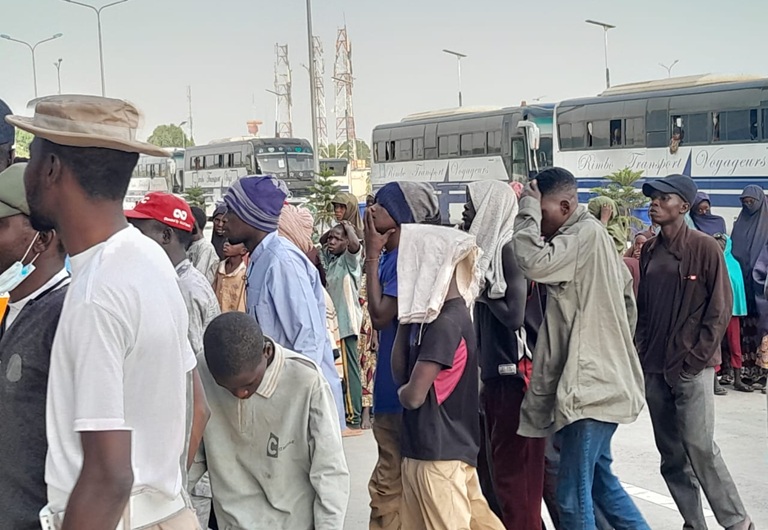
The National Emergency Management Agency has repatriated about 1,230 stranded Nigerian migrants from Niamey in Niger back to Nigeria, as part of ongoing efforts to address migration challenges in the region.
The returnees were transported to Kano through a coordinated operation involving multiple government agencies. According to officials, the evacuation was carried out using vehicles operated by Rimbo Transport Voyageurs, with a team of 12 drivers and attendants assigned to ensure the safe movement of the migrants.
In a formal communication, the Nigerian Embassy in Niger called on immigration, customs, and police authorities in both countries to support the operation. The convoy travelled through the Maradi–Katsina border route, with authorities urged to provide smooth passage and necessary assistance throughout the journey.
Officials confirmed that the migrants were received in batches at the border. At Magama Jibia, a total of 345 males and 185 females were documented upon arrival. The operation forms part of a wider repatriation effort aimed at safely returning Nigerians stranded abroad.
According to Nura Abdullahi, head of operations in Kano, the agency has so far received 1,230 returnees in collaboration with the National Commission for Refugees, Migrants and Internally Displaced Persons and other stakeholders. He explained that 708 migrants were received earlier, while an additional 522 arrived in a second batch.
The returnees come from different parts of Nigeria, including Kano, Jigawa, Katsina, Niger, Taraba, Adamawa, Enugu, Sokoto, Ebonyi, Gombe, Plateau, Delta, Lagos, and the Federal Capital Territory. Authorities are currently carrying out profiling and documentation to ensure proper reintegration into their communities.
The repatriation highlights ongoing migration pressures in West Africa, where many citizens travel across borders in search of better opportunities but often face difficult conditions. Government agencies say efforts are being strengthened to improve migrant safety, provide humanitarian support, and address the root causes driving irregular migration.