
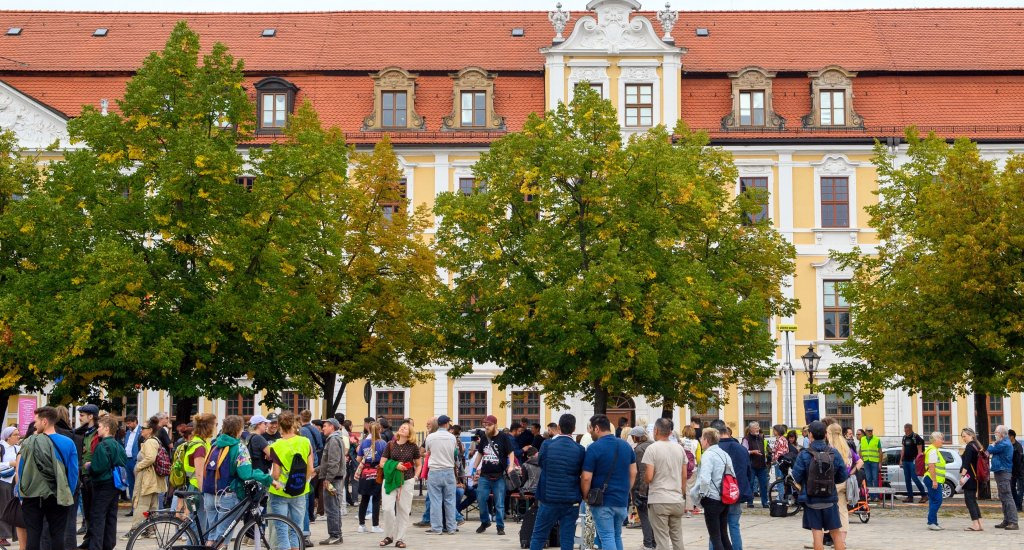
Migrants living in the eastern German state of Saxony-Anhalt say they are increasingly worried about their future as the far-right Alternative for Germany (AfD) prepares for what could be a historic victory in the state election on September 6.
The AfD is polling at around 40 percent ahead of the vote, raising concerns among residents with migrant backgrounds that a government led by the party could result in tougher policies, greater social hostility and increased pressure on foreigners to leave.
For some migrants, the prospect has become serious enough to consider leaving the state.
Ayman Alyoussef, a Syrian-born cardiologist living in Quedlinburg, said he has generally been accepted by patients and colleagues since arriving in Germany in 2024. He and his family, however, have sometimes experienced hostility in public, particularly because family members wear headscarves.
Alyoussef said the contrast between his professional role and how he is perceived outside the hospital illustrates the difficulties faced by some migrants.
He told AFP that patients who meet him during medical emergencies often appreciate the care he provides, but people who encounter him on the street may simply see him as a foreigner dependent on public support.
Alyoussef, who has since become a German citizen, said he had wanted to remain in Germany but was keeping his options open if anti-migrant sentiment continued to grow.
The concerns come as the AfD campaigns on a platform that includes significant changes to Germany’s migration and asylum policies.
The party’s election programme calls for the abolition of asylum on the grounds that people entering Germany would generally have passed through safe third countries. It also proposes removing residence rights from foreigners convicted of crimes, ending church asylum and reviewing citizenship that has already been granted.
The AfD has additionally called for recognised refugees to be assigned certain public-service jobs, including waste collection and outdoor cleaning, while people facing deportation could be detained in prisons.
Ulrich Siegmund, the party’s candidate for state premier, has said foreigners without a legal right to remain should be deported immediately if the AfD takes office.
Siegmund has argued that his party does not oppose all immigration, saying people who enter Germany legally under strict conditions would not necessarily face the same restrictions.
But the election campaign has already contributed to tensions in some communities.
Mamad Mohamad, a Greens candidate and a Yazidi Kurd who came to Germany from Syria as a teenager in 1996, said campaigners have encountered both constructive conversations and verbal abuse while canvassing in Halle.
He said the political climate has made campaigners more cautious, with members of his team avoiding working alone and paying close attention to their surroundings.
The uncertainty extends beyond politics and personal safety. Some migrants say they are concerned that a change in government could undermine the economic stability they have built in the state.
Rezwaan Talash, a 24-year-old Afghan immigrant working at a computer shop in Magdeburg, said he worries about whether he will be able to maintain his current life in Saxony-Anhalt.
He said some people in his support network had already left the state because they feared their stability could disappear.
Last week, about 150 migrant-owned businesses in Magdeburg, including restaurants, kiosks and barber shops, temporarily closed for five hours in protest against what organisers described as growing hostility towards migrants.
The economic implications of the election are also attracting attention because Saxony-Anhalt faces a serious demographic challenge.
The state’s population has fallen by almost a quarter since German reunification in 1990. At the same time, the workforce is ageing rapidly. CDU candidate Sven Schulze said the state currently has roughly one person entering the labour market for every two workers who retire.
Local businesses say attracting young and qualified workers is already difficult.
Matthias Herberg, who employs Talash at his IT store, said Saxony-Anhalt has significant difficulties recruiting young talent and that qualified workers with migration backgrounds could help address the shortage.
A recent study by the German Economic Institute further highlighted the contribution of foreign workers to eastern Germany’s economy.
According to the study, employees without German citizenship generated approximately €68.3 billion in economic value across eastern Germany in 2025. When wider economic effects are included, the contribution rises to about €92.4 billion.
The researchers warned that continued population ageing and workforce shortages could put economic growth and essential public services under pressure if Germany fails to attract sufficient workers from outside Europe.
Healthcare is among the sectors that could be particularly vulnerable.
More than one in four doctors working in hospitals in Saxony-Anhalt do not hold German citizenship, according to research by Germany’s Migration Media Service. Across hospitals, medical practices, public authorities and other areas, foreign citizens account for almost 19 percent of physicians in the state.
That compares with roughly one in six doctors nationwide who do not have German citizenship.
Matthias Voth, director of a clinic in Quedlinburg, said foreign medical professionals had become essential to keeping the local health system operating.
The dependence is even greater in some rural districts. In Altmarkkreis Salzwedel, 67 doctors without German citizenship account for around 29 percent of the medical workforce.
The state’s medical association has warned that adequate healthcare in rural communities can no longer be guaranteed without foreign medical professionals.
Many of the state’s foreign doctors come from countries including Azerbaijan, Ukraine, Russia, Romania and Syria.
At the same time, a separate study has identified another political trend that could influence Germany’s future elections: growing dissatisfaction among voters with migration backgrounds.
Research published by the German Center for Integration and Migration Research (DeZIM) compared surveys conducted during the winters of 2023/24 and 2024/25. It found that voters with immigrant backgrounds were becoming more distant from established political parties at a faster rate than the wider electorate.
The decline in support was particularly pronounced among people with roots in Turkey, the Middle East, North Africa, Afghanistan and Pakistan.
Among these groups, the proportion of respondents who said they could imagine voting for the CDU/CSU fell from 67 percent to 50 percent over one year. For the Social Democratic Party (SPD), the figure dropped from 71 percent to 60 percent.
Researchers said the growing frustration cannot simply be explained by attitudes towards migration policy. Feelings of political exclusion and dissatisfaction with social advancement also appear to play an important role.
Özgür Özvatan, a researcher at Humboldt University, said some voters with immigrant backgrounds who are open to supporting the AfD show strong commitment to the party because of accumulated frustration and anger.
Martin Gerlach, managing director of the Turkish Community in Germany, said many migrants increasingly feel that mainstream political parties do not adequately represent their interests.
People with migration histories make up more than a quarter of Germany’s population, yet only around 12 percent of members of the federal parliament have such a background, according to Migration Media Service data.
More than seven million eligible voters in Germany have an immigration background, making the group an increasingly important electoral constituency.
The DeZIM research also found major differences between migrant communities in their attitudes towards the AfD.
Around 80 percent of respondents with Turkish or Middle Eastern and North African backgrounds categorically rejected the possibility of voting for the far-right party. Among respondents with roots in former Soviet states, however, nearly 45 percent said they could imagine supporting the AfD, compared with 28 percent among people without a migration background.
Despite the decline in support for established parties, the SPD remains the party most frequently considered a potential choice among eligible voters with migration backgrounds, with about two-thirds saying they could imagine voting for it. The CDU/CSU ranked second.
Researchers stressed that factors such as age, gender and income also influence political preferences alongside a person’s country or region of origin.
The definition of an immigrant background also differs between studies. For the DeZIM research, it refers to people who have at least one parent who was born without German citizenship. Germany’s Federal Statistical Office uses a broader definition, which includes people who immigrated themselves or whose parents both immigrated to Germany after 1950.
Under German law, foreign nationals cannot vote in federal or state elections. Only those who have German citizenship can participate in those elections.
As Saxony-Anhalt heads towards the September 6 election, the concerns of migrant communities therefore extend beyond the outcome of a single political contest. For many residents, the vote has become a question of whether they will continue to see the state as a place where they can build secure lives and careers — or whether growing political hostility will eventually push them elsewhere.