
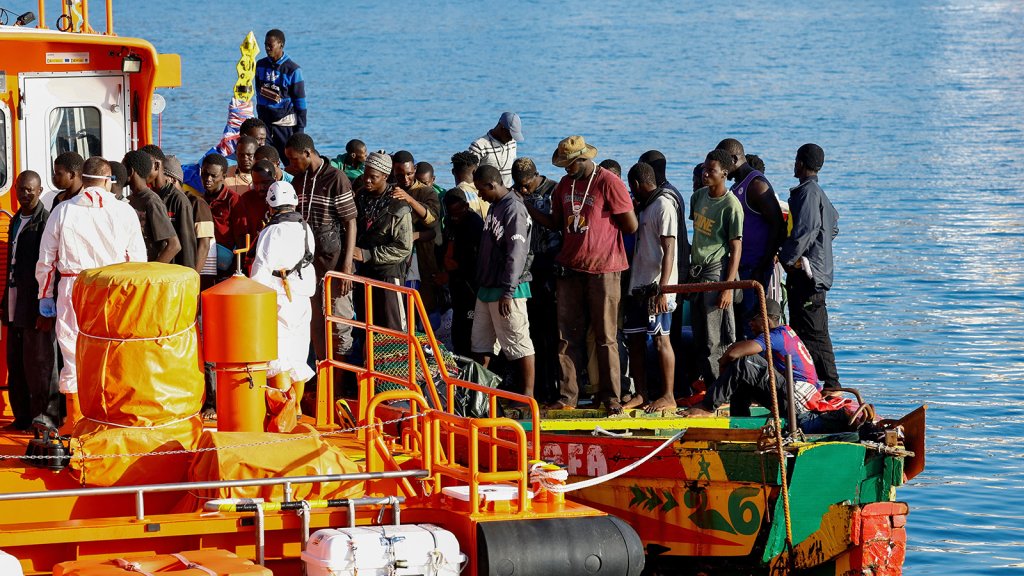
Spanish maritime rescue teams have rescued at least 740 migrants attempting to reach the Canary Islands in fewer than 30 hours, as the regional president accused Spain’s central government of failing to respond adequately to a recent rise in arrivals.
The latest rescue took place early Monday, October 12, when Spain’s maritime rescue service, Salvamento Marítimo, brought 72 people ashore after intercepting their boat near Fuerteventura. The group arrived at the port of Gran Tarajal at around 6 a.m. local time. Spanish media reported that at least one woman and three children were among those rescued.
The operation followed the rescue of 668 migrants from four boats near Gran Canaria, Lanzarote and El Hierro over the weekend.
On Sunday, two wooden boats known locally as cayucos arrived at La Restinga port on El Hierro carrying a total of 356 people, including 19 women and 26 minors. One boat completed the journey from Niodior, Senegal, in six days, while the other was escorted to port after spending seven days at sea after departing from Brufut, The Gambia. Two people were taken to hospital after arriving.
The passengers included nationals of Senegal, Guinea, Mali and The Gambia.
Earlier on Sunday, rescuers brought 216 people to Arguineguín port on Gran Canaria after intercepting their boat approximately 3.7 kilometres offshore. One person was airlifted to hospital in critical condition.
Late on Saturday, another vessel carrying 96 migrants was intercepted about 92 kilometres northeast of Lanzarote. Emergency services provided assistance to nine women and 16 minors. Those aboard came from several African countries, including Burkina Faso, Ivory Coast, Ghana, Guinea, Mali, Morocco and the Democratic Republic of the Congo.
The latest arrivals have renewed concerns about pressure on the Canary Islands’ reception facilities and the response from Spain’s national government.
Fernando Clavijo, president of the Canary Islands, criticised what he described as a lack of action by the central government following the increase in arrivals. Speaking in Madrid on Monday during Spain’s National Day events, he said more than 3,800 migrants had reached the islands since September.
Clavijo also warned that the European Union’s new migration pact could increase pressure on border regions by reinforcing what he called a detention effect. He expressed concern that the islands could experience a situation similar to the end of 2024, when approximately 47,000 migrants arrived in the archipelago.
The Atlantic crossing from western Africa to the Canary Islands remains one of the most dangerous migration routes to Europe. Boats often travel long distances in difficult sea conditions, with journeys increasingly beginning farther south in countries such as The Gambia and Senegal.
Recent incidents have highlighted the risks. In early September, a boat that had departed The Gambia and spent 27 days at sea was found drifting south of Gran Canaria. At least five bodies were recovered, while more than 80 people were feared dead. Three of the 44 survivors were reported to be in critical condition in hospital.
In another incident in mid-September, three people died and another was left in critical condition after a migrant boat encountered difficulties off Lanzarote.
Although arrivals to Spain by sea have declined compared with 2025, the Atlantic route continues to claim lives. Data from the United Nations refugee agency, UNHCR, showed that almost 20,000 people had arrived in Spain by sea between January and September 30, 2026. Around one-third of those arrivals were recorded in the Canary Islands.
The islands also experienced a sharp fall in arrivals during the first quarter of 2026, with numbers down 82 per cent compared with the same period in 2025.
However, fewer arrivals have not eliminated the dangers of the journey. Data cited in the report showed that the death rate on the Atlantic route had risen to 4.5 per cent by July 9. Longer journeys from more southerly departure points increase the time people spend exposed to hunger, exhaustion and dangerous weather.
The International Organization for Migration’s Missing Migrants Project recorded 290 people dead or missing while attempting to reach the Canary Islands from Africa by October 5. The actual toll may be higher because not every shipwreck or disappearance is reported.
The latest rescues underline the continuing challenge facing Spanish authorities as they respond to sudden increases in arrivals while migrants continue to risk dangerous journeys across the Atlantic.