
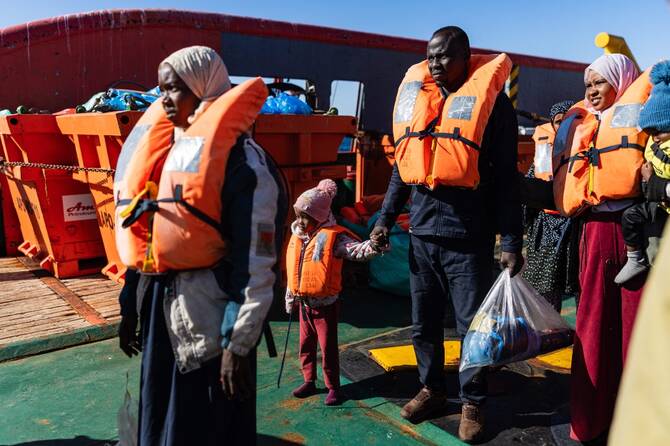
The Greek government is moving to impose much tougher penalties on migrant smuggling, with a new bill that could see convicted traffickers face sentences of up to life imprisonment. The proposed law comes at a time when dangerous sea crossings toward Greece are still claiming lives, highlighting the ongoing risks faced by people trying to reach Europe.
Officials from Greece’s migration ministry submitted the bill to parliament to strengthen the country’s response to irregular migration networks. The government says the changes are designed to disrupt the business model of smuggling groups that organize risky boat journeys across the Aegean Sea, often using overcrowded, unsafe vessels.
Under the proposed legislation, penalties for organizing or assisting in migrant smuggling would be increased significantly. The government has also warned that migrants convicted of certain offences could face direct expulsion. Another controversial part of the bill would make it a criminal offence for migrants with legal status to help those without proper documents if authorities believe that support encourages irregular migration.
The bill also affects humanitarian groups. According to the migration ministry, aid workers or NGO staff accused of facilitating irregular entry could face stricter sentences if found guilty. The government argues that the measures are necessary to prevent abuse of humanitarian work as a cover for smuggling, but critics fear the law could make legitimate rescue and aid efforts more difficult.
A coalition of 56 non-governmental organizations, including Doctors of the World and Doctors Without Borders, has strongly criticized parts of the bill. In a joint statement, they called for several articles to be withdrawn, warning that some provisions could criminalize humanitarian assistance and expose aid workers to heavy fines or prison terms. They also raised concerns about a clause that could allow authorities to suspend an NGO’s activities based on charges against a staff member, even before a court decision.
These concerns come shortly after a high-profile court case in Greece in which 24 aid workers were acquitted of charges linked to migrant assistance. Among them was Syrian swimmer Sarah Mardini, who had helped guide a damaged migrant boat to shore years earlier and later volunteered with support groups on the island of Lesbos. The case drew international attention and raised questions about the line between rescue work and alleged facilitation of irregular migration.
While tightening sanctions, the Greek government says it also wants to improve legal migration channels. Officials have announced plans to simplify hiring procedures for foreign workers and introduce new visas for highly skilled employees, especially in the technology sector. Students from non-EU countries may also receive residence permits for the duration of their studies, and asylum seekers could be offered vocational training in sectors facing labour shortages, such as agriculture, construction, and tourism.
Even as lawmakers debate the bill, tragic incidents continue at sea. In recent days, several migrants died while attempting to cross from Turkey to the Greek islands. Near Ikaria, a boat reportedly struck rocks, causing passengers to fall into the water. A woman and a young boy were confirmed dead, while others were reported missing. Search operations involving the Greek coast guard, aircraft, local fishermen, and a vessel from the European border agency Frontex were launched to find survivors.
Survivors said the group had left the Turkish coast on a speedboat before the accident. Authorities believe the boat’s driver fled after the crash. In a separate incident near the island of Chios, Greek patrol boats chased another vessel carrying migrants. Dozens of people managed to reach shore, and one man was arrested on suspicion of acting as a smuggler after being identified by other passengers.
Greece remains one of the main entry points into the European Union for people traveling along the eastern Mediterranean route. Many are fleeing war, persecution, or economic hardship. International organizations say thousands have died or gone missing in the Mediterranean over the past decade, making it one of the world’s deadliest migration routes. As Greece debates tougher laws, the challenge of balancing border control, human rights, and humanitarian protection remains at the center of the migration debate.