
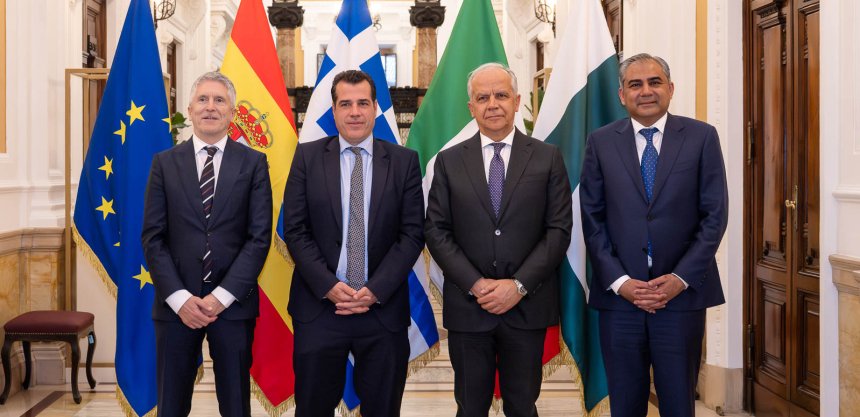
Interior ministers from Italy, Spain, Greece, and Pakistan have agreed to strengthen cooperation in tackling irregular migration flows during a high-level meeting held in Rome. The talks were convened on February 24 by Italy’s Interior Minister Matteo Piantedosi and marked an unprecedented format bringing together European Union member states with Pakistan, described as a key strategic partner in migration dynamics.
The meeting, hosted at Italy’s Interior Ministry, included Athanasios Plevris, Greece’s Minister for Migration and Asylum, Fernando Grande-Marlaska, Spain’s Interior Minister, and Mohsin Naqvi, Pakistan’s Interior Minister. According to Italian officials, the gathering builds on longstanding cooperation between Rome and Islamabad, which has already produced operational results.
During the discussions, ministers acknowledged that Europe remains a major destination for many Pakistani nationals. They stressed the need for stronger and more coordinated action to disrupt human trafficking groups and transnational criminal networks that facilitate irregular migration. A key focus of the talks was combating document forgery, described as one of the main tools used by traffickers to move migrants across borders.
Piantedosi praised Pakistan’s “zero tolerance” stance on illegal immigration and said the cooperation model developed between Italy and Pakistan could be replicated with other countries of origin. He emphasized that European nations must act in unity to dismantle criminal networks and strengthen collective migration management efforts.
The ministers agreed on a new partnership model structured around four main pillars of security and migration control. One priority is improving identification procedures to allow faster and more effective returns of migrants who do not qualify to stay. The plan also includes launching joint programmes specifically targeting forged travel documents.
In addition, the countries are committed to strengthening border controls and deepening operational cooperation between their police forces. This will involve more systematic information sharing and closer technical collaboration to monitor migration routes across the Mediterranean and beyond.
Piantedosi described the meeting as the beginning of a longer process rather than a one-time event. The ministers are expected to meet again in the coming months to review progress and ensure continuity in their joint actions.
Italian officials said the initiative signals a shift in how migration routes are managed, placing technical and police cooperation at the center of Europe’s Mediterranean migration strategy.