
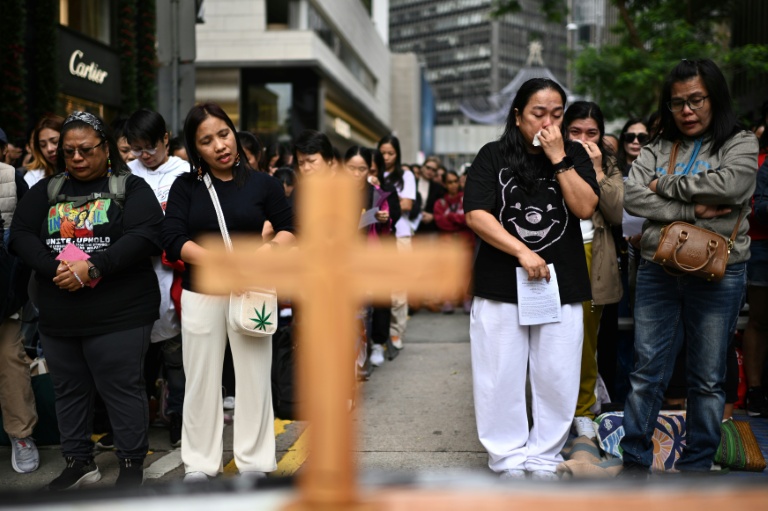
Tears filled Hong Kong’s Victoria Park as hundreds of migrant domestic workers gathered to mourn the victims of the deadly Wang Fuk Court fire, the worst blaze the city has experienced in more than a century. Women from the Philippines and Indonesia prayed for their missing friends and tried to comfort each other, as many still had no updates about loved ones following the tragedy. The sadness across the park showed how deeply the migrant community was affected.
The fire killed 146 people, and at least 10 migrant domestic workers were among the dead. Many more remain missing, according to information collected from different consulates. Hong Kong hosts nearly 370,000 migrant domestic workers, most of them women who care for children, older people, and families. Their usual Sunday rest day turned into a painful gathering as workers shared their fears and stories about missing friends. Some told AFP that support for survivors has not been enough, leaving them unsure about the future.
One Indonesian worker named Sudarsih said she had not heard from two of her friends and prayed they would be found alive. Workers at the park sang hymns and gathered around a banner honoring the loyalty and bravery of migrant domestic workers. Another worker, Dwi Sayekti, said she hoped such a fire would never happen again, adding that the pain of the missing and the dead was very hard to accept.
Across the city, about 100 Filipino women gathered for prayers at their usual Sunday meeting area. Dolores Balladares, leader of United Filipinos in Hong Kong, said they prayed that there would be no more casualties. Many of their prayers were directed toward Rhodora Alcaraz, a young Filipina who had just started working in Hong Kong days before the tragedy. A widely shared story said she protected her employer’s three-month-old baby with her body during the fire, and firefighters found her still holding the child. She was taken to intensive care, but AFP could not confirm her current condition.
Many fellow workers said they were heartbroken after hearing what happened to Alcaraz. One worker, Michelle Magcale, said her sadness was too deep to express. She said Alcaraz saved a life because she took her duty seriously. Balladares also praised her bravery. The Philippine Consulate in Hong Kong confirmed that another Filipina, Maryan Pascual Esteban, died in the fire, leaving behind a 10-year-old son. The consulate added that one Filipino was injured and seven others had not yet been confirmed safe.
The Indonesian Consulate in Hong Kong reported that nine Indonesians were killed, one was injured, and 42 others were still unaccounted for. More than 50 survivors have asked the Asian Migrants’ Coordinating Body for help. Spokeswoman Shiela Tebia said many women urgently needed clothes and underwear because their passports and ID cards were burned during the fire. She added that some survivors cannot sleep well and feel traumatised, but they continue helping their employers, who are also grieving.
Many people asked the same question during the gatherings: Why are migrant domestic workers affected so deeply during such tragedies?
Most migrant workers live in high-rise buildings provided by employers, and these buildings become very dangerous during fires. They also live far from their families and depend heavily on consulates and support groups, which increases their vulnerability.
Tebia said consulates had promised support, but details were still unclear. Sringatin, chairwoman of the Indonesian Migrant Workers Union, said many workers were panicking because information from the consulate was slow. She explained that her group tried to calm the situation and provide updates. The Hong Kong government said families of the deceased would receive HK$200,000, or around $25,700, but Edwina Antonio, the executive director of Bethune House, said this was only a first step.
Antonio asked what support would be given to survivors who lost everything in the fire. She urged the government to include migrant workers in financial assistance programs because many are the main income earners for their families. She added that survivors need more than emergency payments—they need emotional, mental, and long-term financial support to rebuild their lives.