
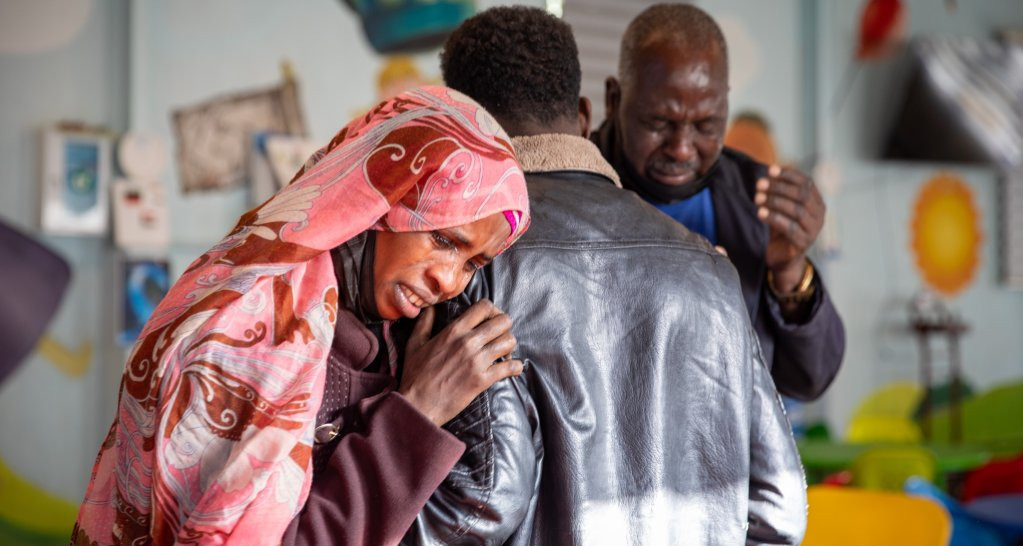
The United Nations has urged governments and political leaders to stop using refugees and migrants as political tools, warning that rising anti-migrant rhetoric is placing millions of vulnerable people at greater risk and undermining the international right to seek asylum.
The warning was issued during events marking the 75th anniversary of the 1951 Refugee Convention, where the UN refugee agency (UNHCR) called for renewed global commitment to protecting people fleeing war, persecution and violence.
Speaking at the commemoration in Geneva, Barham Salih said refugees are increasingly becoming “scapegoats” for broader social, economic and political challenges facing many countries.
“We gather at a time of increasingly politicized debates about refugees and asylum,” Salih said. “Too often, people forced to flee become scapegoats for wider social, economic and political anxieties.”
He warned that refugees are frequently portrayed as burdens or security threats rather than individuals seeking protection from conflict and persecution.
Salih stressed that while governments have the legitimate right to secure and manage their borders, refugees represent a unique category of people who are escaping violence, war and persecution—not simply migrating in search of better economic opportunities.
He called on governments to strengthen asylum systems while ensuring they are protected from abuse, adding that international efforts should focus not only on managing displacement but also on addressing the root causes that force people to flee their homes.
According to the United Nations High Commissioner for Refugees (UNHCR), approximately 117.8 million people worldwide were forcibly displaced by the end of 2025. Although this represents a decline from the 123.2 million recorded in 2024, global displacement remains at historically high levels.
Of those displaced, 35.6 million were recognised as refugees under UNHCR’s mandate, with nearly two-thirds originating from Venezuela, Ukraine, Syria, Afghanistan and Sudan.
UNHCR said the decline in displacement figures was largely driven by refugees returning from Iran and Lebanon to countries such as Syria and Afghanistan, despite ongoing political instability and economic uncertainty in those nations.
Reflecting on the Syrian conflict, Salih said earlier international action to end the country’s civil war could have prevented millions of people from being displaced and seeking refuge in neighbouring countries and Europe.
In a recorded message, António Guterres described the 1951 Refugee Convention as a landmark agreement that has saved millions of lives since its adoption following the Second World War.
However, he warned that its principles are facing increasing pressure.
“Today, that promise is under strain. Conflicts are multiplying, persecution persists, and growing numbers are forced to flee. Meanwhile, the right to seek asylum is too often questioned, restricted, or denied,” Guterres said.
The UN also highlighted the growing financial challenges facing humanitarian organisations. UNHCR’s funding reportedly fell by approximately 35 percent last year, forcing the agency to eliminate nearly 5,000 jobs—more than a quarter of its global workforce.
Salih said the funding cuts have significantly affected the agency’s ability to deliver humanitarian assistance to displaced populations and appealed for greater international support to sustain refugee protection programmes.
Also speaking during the anniversary event was Yusra Mardini, who fled Syria during the country’s civil war before competing for the Refugee Olympic Team at the 2016 and 2020 Olympic Games.
Mardini said she recently returned to Syria for the first time since leaving the country and witnessed families returning home only to find widespread destruction of homes, schools, roads and hospitals.
She is among the first 75 signatories of the “Promise” initiative, a global campaign advocating for the rights of people fleeing persecution to seek safety in other countries. Other signatories include humanitarian advocates and public figures such as Angelina Jolie, Cate Blanchett, Ben Stiller, Malala Yousafzai and Nadia Murad.
Meanwhile, Mark Ankerstein, head of UNHCR’s German partner organisation, urged Germany to uphold its humanitarian obligations and avoid turning refugee policy into an election campaign issue.
He said public debates on migration should be based on facts rather than fear or political rhetoric, warning that using refugees as campaign tools unfairly stigmatises people with legitimate claims to international protection.
UN officials concluded by calling on governments worldwide to reaffirm their commitment to international refugee law, strengthen asylum systems and ensure that refugees are treated with dignity rather than becoming targets of political campaigns.