
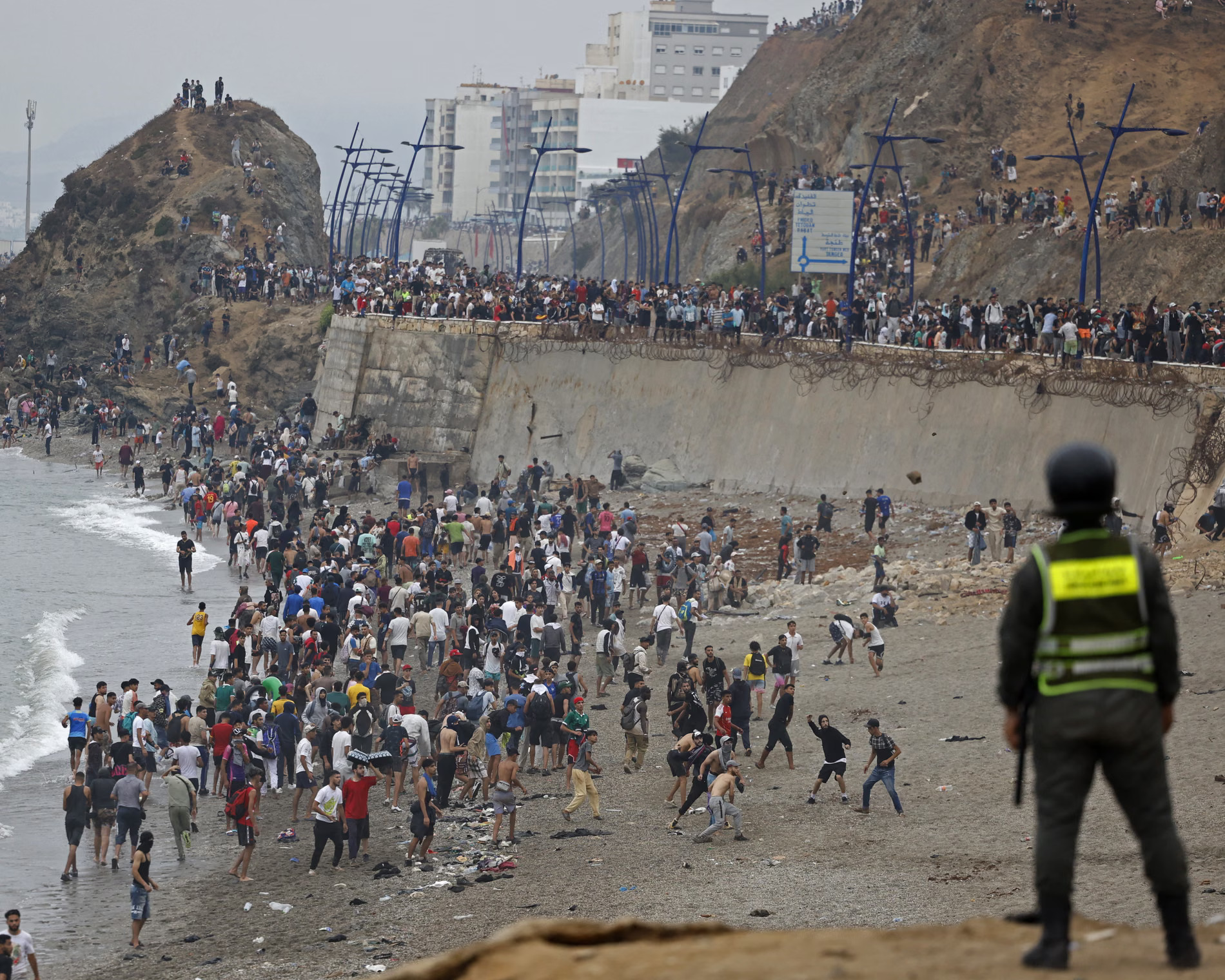
Spain has rejected suggestions that Morocco’s government was behind the mass movement of migrants into the Spanish enclave of Ceuta last month, saying European intelligence found no evidence that Rabat deliberately facilitated the unprecedented border rush.
Spanish Prime Minister Pedro Sánchez said European Union intelligence had ruled out Moroccan government involvement in the arrival of more than 70,000 people who crossed from Morocco into Ceuta, a Spanish-administered territory on the North African coast.
“There was no information on the magnitude of what happened and obviously no one predicted that avalanche of people on such a scale,” Sánchez said in an interview with Cadena SER Radio on Monday.
Around 72,000 people entered Ceuta during the mass movement in July. Most were subsequently returned to Morocco or went back voluntarily, while about 5,000 remain in the territory, including approximately 1,200 children, according to the Spanish government.
The incident prompted speculation that Morocco, which disputes Spanish sovereignty over Ceuta and the neighbouring enclave of Melilla, may have deliberately allowed the movement to develop as a way of exerting political pressure on Madrid.
Sánchez dismissed those suggestions.
Instead, the Spanish prime minister accused Russia and Israel of spreading or amplifying disinformation surrounding the crisis. He said European research indicated that both countries had used the incident to criticise the Spanish government.
Madrid’s relations with both Moscow and Tel Aviv have been strained by Spain’s positions on the wars in Ukraine and Gaza. Spain was among the European countries that recognised a Palestinian state and has repeatedly criticised the humanitarian situation in Gaza.
Sánchez said the majority of those who entered Ceuta had been motivated by economic considerations and would eventually return to Morocco.
He also ruled out transferring those migrants to mainland Spain. The Spanish government plans to provide about 6,000 additional accommodation places in Ceuta in the coming days, while resolving the situation of children who crossed the border remains a priority.
The crisis has also generated tensions between Spain and several European governments, including Italy.
Rome introduced temporary restrictions on visa-free movement for Spanish citizens on July 31, shortly after the mass arrival. Italy announced on Monday that the measure would be extended for another 15 days.
Spain has meanwhile appealed to the European Border and Coast Guard Agency, Frontex, for assistance in dealing with the approximately 5,000 migrants who remain in Ceuta.
Interior Minister Fernando Grande-Marlaska formally requested European assistance from Beate Gminder, the European Commission’s director general for migration and home affairs, on Friday.
Sánchez is also facing growing political pressure at home over his government’s handling of the crisis.
A Sigma Dos opinion poll published by El Mundo showed declining support for Sánchez’s Socialist Party, known as PSOE, in the run-up to next year’s expected general election.
According to the poll, PSOE would receive 25.4 percent of the vote and win 101 parliamentary seats if an election were held at the time of the survey. That would represent a loss of 20 seats compared with its current position.
The conservative People’s Party was projected to increase its representation from the 137 seats it won in 2023 to 143, while the far-right Vox was projected to rise from 33 seats to 61.
Sánchez has been Spain’s prime minister since 2018 and leads a minority coalition government. He is expected to seek another term in office next year.
The situation in Ceuta has remained unsettled since the mass crossings, with repeated border tensions and protests involving some migrants who have remained in the enclave.
Ceuta’s president-mayor, Juan Jesús Vivas, has also threatened legal action against the national government if the situation is not resolved.
Questions have also been raised about whether Spanish authorities were adequately prepared for the influx.
Border officials said they had warned Madrid in early July that increasing numbers of people were arriving by sea, but claimed their concerns were not acted upon.
The warnings came shortly after a Spanish court ruling issued on June 29 concerning the immediate prevention of migrant entry.
The ruling stated that migrants could be immediately stopped from entering Ceuta only if they had crossed a physical border barrier. The decision did not apply to people who reached the territory by swimming.
News of the ruling, combined with videos showing migrants successfully reaching Ceuta, is believed to have encouraged more people to attempt the journey.
The mass crossing also resulted in a significant loss of life.
Spanish authorities have reported 80 deaths linked to the incident, while Moroccan authorities said they recovered 14 bodies on their side of the border. The combined confirmed death toll stands at 94.
Human rights organisations have warned that the actual number of people who died or remain missing could be higher.
The episode has left Spain facing a complex challenge involving border management, migrant protection, relations with Morocco and growing domestic political pressure, while Madrid continues efforts to determine the fate of thousands of people still in Ceuta.