
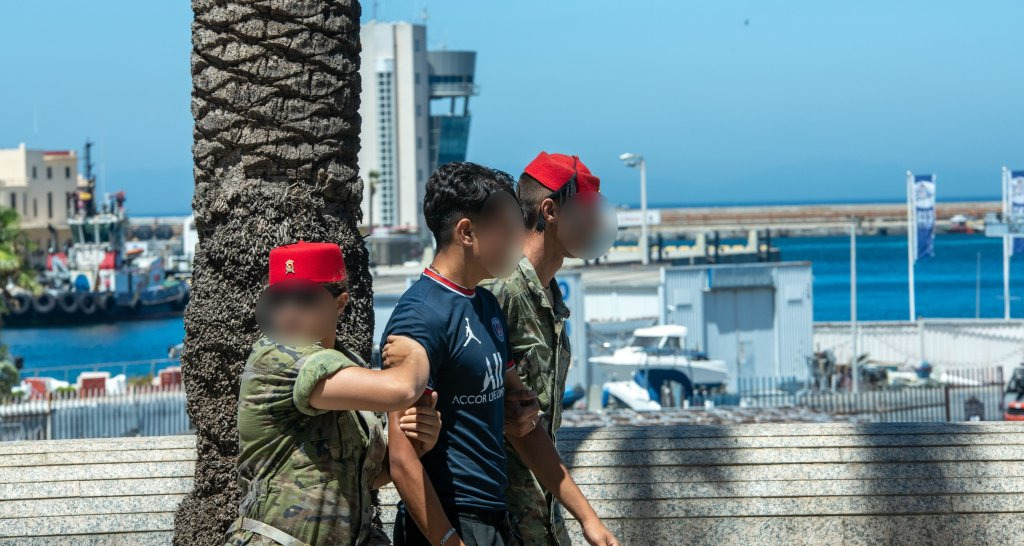
Twenty-one Moroccan migrants have been returned to Morocco after allegedly throwing stones at Spanish security personnel during an incident at El Trampolín beach in Ceuta.
Spanish authorities said the men were detained after a joint patrol involving the Spanish army and Guardia Civil came under attack on Saturday night, September 5. No injuries or significant property damage were reported.
The incident occurred along the Ceuta coastline where an informal migrant settlement emerged following the arrival of tens of thousands of people from Morocco in late July. Authorities identified the 21 men before they were returned to Morocco after reportedly agreeing to leave voluntarily.
The latest incident follows another stone-throwing case in Ceuta in which 11 Moroccan nationals were sentenced after an attack on a military patrol in the Benzú area. Four soldiers were injured in that incident. The defendants admitted involvement, and their prison terms were replaced with deportation under a plea agreement.
The two cases have renewed attention on tensions between migrants and Spanish security forces as authorities continue dealing with the consequences of the large-scale arrivals into the Spanish enclave.
Spanish officials have described the latest departures as voluntary returns. Such returns are legally distinct from forced deportations because they are based on an individual’s agreement to leave.
However, the circumstances surrounding returns from Ceuta remain politically and legally sensitive. Many migrants who remain in the enclave have spent weeks in overcrowded and precarious conditions, with uncertainty over their legal status and future prospects. Human rights organisations have also raised concerns about whether people may feel pressured to accept return when their alternatives are limited.
Spanish authorities have said that approximately 69,500 migrants have returned to Morocco since the mass arrivals, describing the returns as voluntary. At the same time, legal restrictions continue to affect Spain’s ability to remove migrants from the enclave.
Spain’s Supreme Court has ruled that migrants intercepted at sea while attempting to reach Ceuta or Melilla cannot simply be sent back to Morocco without following the required legal procedures. The ruling has become part of the wider political dispute over how Spain should manage migration at its North African borders.
The situation is particularly difficult for unaccompanied migrant children still in Ceuta. The territory’s child protection system has registered 1,478 unaccompanied migrant minors, while authorities and organisations estimate that many more are still waiting to be identified.
Save the Children Spain has said the Interior Ministry has recorded about 2,500 children and adolescents in Ceuta. Local organisations and community groups have suggested that the actual number of minors still awaiting identification and referral to protection services could be considerably higher.
Many of the children are reportedly sleeping in public spaces, including beaches and mountainous areas, as authorities struggle to provide sufficient accommodation and protection. Ceuta’s normal reception capacity for unaccompanied foreign minors is only 29 places, leaving the territory heavily reliant on emergency measures and support from NGOs and volunteers.
The Spanish government has announced plans to relocate around 500 unaccompanied minors to mainland Spain, with priority expected to be given to girls and children under the age of 13.
Family reunification in Morocco remains one of the authorities’ stated priorities, but officials have acknowledged that returning many of the children may not be realistically possible. International law requires authorities to take the best interests of unaccompanied children into account before any removal decision is made.
The continuing migration crisis has also become a battleground over information and political narratives. Prime Minister Pedro Sánchez has repeatedly rejected claims that Moroccan authorities orchestrated the mass arrivals into Ceuta, saying Spanish intelligence and security services have not provided evidence of direct involvement by the Moroccan state.
Sánchez has instead pointed to the spread of misinformation online, accusing networks allegedly associated with Russia, Israel and far-right groups of contributing to misleading narratives about the crisis.
The Spanish prime minister has said false social media accounts distorted information surrounding a Supreme Court ruling on migrant returns, allegedly giving some people the impression that anyone who reached Ceuta by swimming could not be deported. He also accused trafficking networks and political actors of exploiting the issue to attack Spain and European institutions.
The allegations have been disputed. Israel’s Foreign Minister Gideon Saar rejected Sánchez’s comments, while the Kremlin denied involvement in the migration crisis. Analysts have nevertheless reported activity by Russia-linked accounts promoting far-right narratives online, although the extent of their influence remains contested.
Meanwhile, migration-related incidents in Ceuta continue to attract intense attention on social media. The recent death of a bottlenose dolphin calf on Trampolín beach, where migrants have been staying, generated widespread online discussion after a local environmental group alleged that the animal had been attacked.
No perpetrator has been formally identified. Animal welfare groups have warned that unverified incidents can quickly become part of broader narratives that portray migrants in a dehumanising manner.
The Ceuta crisis has also taken on an international dimension, particularly because of Morocco’s growing relationship with the United States. US President Donald Trump has criticised Spain’s handling of its borders while linking the issue to his broader disagreements with Madrid over defence spending and NATO.
At the same time, Rabat has been strengthening its relationship with Washington. Morocco has reportedly hired US public relations firm Qorvis for a six-month communications campaign worth $210,000 as it seeks to deepen bilateral ties.
The developments have added another layer to Spain’s concerns over Ceuta and Melilla, two Spanish territories on Morocco’s northern coast that Rabat claims. Spanish officials are closely watching Morocco’s expanding diplomatic relationship with Washington and its possible implications for migration, security and the status of the enclaves.
For now, the return of the 21 Moroccan migrants following the stone-throwing incident remains a relatively contained enforcement case. But it has emerged against the backdrop of a much wider dispute involving border security, migrant protection, Spanish domestic politics, Morocco’s regional influence and the increasingly powerful role of social media in shaping public perceptions of migration.