
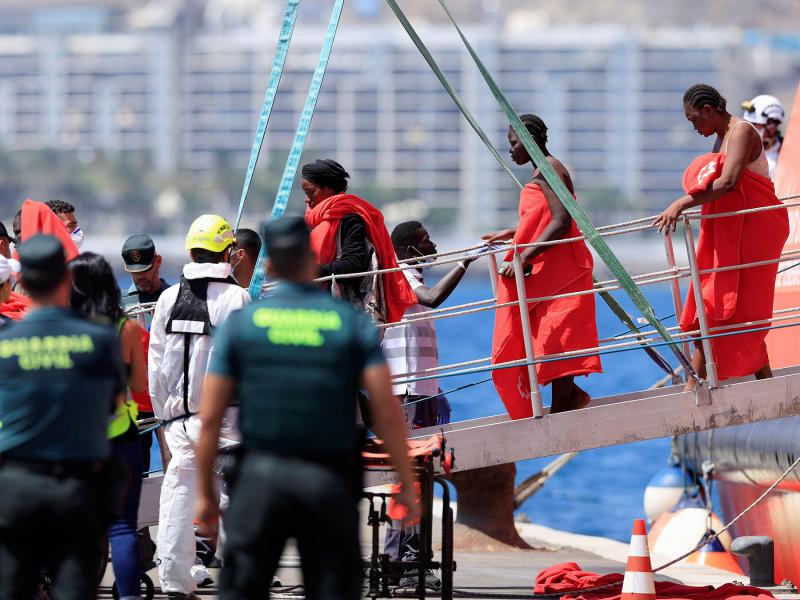
Spain is stepping up cooperation with Morocco and Mauritania to curb irregular migration as arrivals to the Canary Islands increase and renewed pressure emerges along its southern border with North Africa.
More than 6,000 migrants reached the Canary Islands in October 2026, while over 13,000 have arrived since the beginning of the year, according to figures cited in the report.
The rising numbers have placed Prime Minister Pedro Sánchez under renewed pressure from opposition parties, members of his government and other European countries to strengthen controls on irregular migration routes leading from North Africa to Spain.
The situation has also been complicated by mass crossings into Ceuta, a Spanish enclave in North Africa, during the summer. The arrivals exposed continuing tensions along Spain’s border with Morocco and raised questions about the management of migration routes into European territory.
With national elections approaching at the end of November, Sánchez’s government is under pressure to demonstrate greater control over its territories in North Africa while strengthening partnerships with neighbouring countries to prevent irregular departures.
Morocco reports more than 58,000 blocked migration attempts
Morocco has reported significant efforts to prevent irregular migration during the first eight months of 2026.
According to figures released by its Interior Ministry, Moroccan security services thwarted 58,153 attempted irregular crossings between January and the end of August. Authorities also dismantled 148 migrant smuggling networks and rescued 8,288 migrants during the same period.
The figures follow the mass crossings into Ceuta in late July, when tens of thousands of people attempted to enter the Spanish enclave. Although many reportedly returned voluntarily or were deported, thousands remained in the territory into October as Spanish authorities struggled to manage the arrivals.
Moroccan authorities attributed part of the mass movement to misleading information circulated on social media, which allegedly encouraged people to believe they could enter Spanish territory.
Despite its security partnership with Spain, Morocco’s King Mohammed VI said in October that the existing migration cooperation model between the two countries had reached its limits and was outdated.
Spain seeks stronger migration partnership with Mauritania
Spain is also working to deepen its relationship with Mauritania, particularly to prevent migrant departures along the Atlantic route towards the Canary Islands.
During a visit to Nouakchott on November 3, Spanish Interior Minister Fernando Grande-Marlaska praised Mauritania’s efforts to combat irregular migration and called for broader cooperation between the two countries.
According to Agence France-Presse (AFP), the minister described bilateral relations as exceptional and argued that cooperation should extend beyond security to include economic and social development.
Spanish Guardia Civil officers are already stationed in Nouadhibou, Mauritania, where they assist with maritime surveillance, rescue operations and training for local security forces.
The partnership builds on a €210 million agreement signed between Mauritania and the European Union in 2024 to strengthen cooperation, including on migration management.
Dangerous Atlantic migration route
The Atlantic route connecting the western coast of Africa to Spain’s Canary Islands remains one of the most dangerous migration journeys towards Europe.
According to Spain’s Interior Ministry figures reported by Teneriffa News, 6,194 migrants reached the Canary Islands aboard 65 boats in October. This was the highest number recorded for the month of October since 2023.
Across Spain, irregular arrivals reached 32,942 between January and October 2026, representing an 8.9 per cent increase compared with the same period in 2025.
However, figures from the International Organization for Migration (IOM) show that arrivals through the West African Atlantic route declined during the first half of the year.
A total of 3,708 migrants reached the Canary Islands through the route between January and June 2026, representing a 67 per cent decrease compared with the same period in 2025.
Despite the decline in arrivals, the journey continued to claim lives. The IOM recorded 168 people dead or missing during attempted crossings in the first six months of 2026, while 59 boats failed to reach the islands.
The actual death toll is believed to be considerably higher because many boats depart without being detected or registered by authorities. Some disappear at sea without survivors, making it impossible to establish how many people were on board.
Survivors have also reported travelling on overcrowded vessels where people died during the journey and their bodies were thrown overboard. Such accounts highlight the difficulties of determining the true number of deaths along the route.
Rescue operations continue off the coasts of Mauritania, Senegal, The Gambia and Guinea-Bissau.
On September 27, the Mauritanian coast guard rescued 260 migrants, including 17 children, from two boats off Nouakchott, according to the country’s Fisheries Ministry.
Earlier in the week, Mauritanian authorities reported rescuing another 130 migrants off the country’s coast. Those rescued included 118 men, 14 women and two children of different nationalities.
UNHCR raises concerns over treatment of migrants in Mauritania
Alongside efforts to prevent irregular departures, migrant protection organisations have raised concerns about increasingly strict immigration enforcement in Mauritania.
The United Nations refugee agency (UNHCR) told InfoMigrants that refugees and asylum seekers, particularly in Nouakchott and Nouadhibou, have faced increased immigration enforcement since late 2024.
The measures include arrests, detention and deportations, raising concerns about whether vulnerable people can access asylum procedures and receive adequate protection.
UNHCR warned that some enforcement practices could expose refugees and asylum seekers to refoulement, which refers to the forced return of individuals to countries where they risk persecution.
The agency said it continues to engage with Mauritanian authorities to promote compliance with international refugee and human rights obligations. It also intervenes in individual cases where protection concerns arise.
As Spain expands its migration cooperation with Morocco and Mauritania, the developments underline the growing role of North African countries in European efforts to control irregular migration. However, concerns remain over the safety of migrants, the dangers of Atlantic crossings and the protection of refugees and asylum seekers facing stricter immigration measures.