
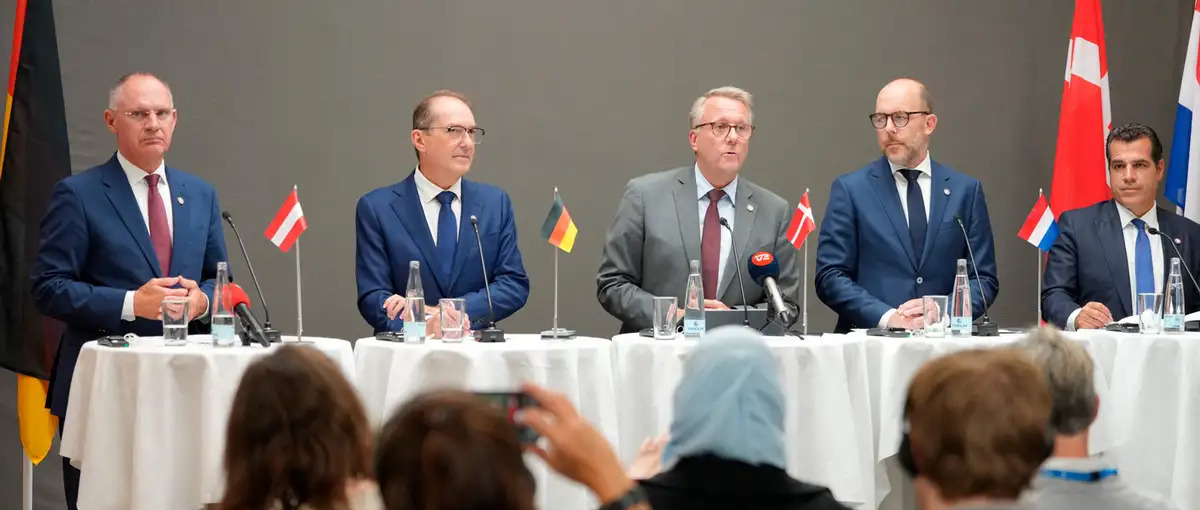
Germany and four other European Union countries are working to reach agreements with non-EU countries to establish migrant return hubs by the end of 2026. The proposed centres would hold migrants whose asylum applications have been rejected while arrangements are made for their removal from Europe.
German Interior Minister Alexander Dobrindt announced the target after meeting migration ministers from Denmark, Greece, Austria and the Netherlands in Copenhagen on Friday. He said technical discussions were already underway with potential partner countries, although he did not identify them.
The five countries want to secure agreements with governments outside the EU before the end of the year. Danish Migration Minister Morten Bødskov said they expected to reach a common understanding with a partner country around the beginning of 2027.
Uganda and Rwanda have been mentioned as possible host countries. Both have attracted attention as potential destinations for the proposed facilities, although no agreement has been publicly confirmed.
The ministers hope the return hubs will become operational in 2027. Bødskov argued that migrants who have no legal right to remain in Denmark should not be allowed to stay simply because authorities face difficulties arranging their return.
The plans follow the European Parliament’s approval in June of stricter migration rules that provide a framework for establishing return hubs outside the bloc.
Similar arrangements have been attempted elsewhere in Europe. The United Kingdom’s previous Conservative government pursued a plan to transfer some asylum seekers to Rwanda, but the scheme was abandoned after Labour took office. Italy has also reached an agreement with Albania to host facilities for migrants, although the arrangement has faced legal challenges.
Questions remain about how the proposed EU return hubs would operate and whether they would comply with European human rights standards. An assessment by the European Court of Justice in April concluded that Italy’s deportation centres in Albania did not, in principle, violate EU law. European rules nevertheless require migrants held in such facilities to retain access to legal assistance, interpretation services, family contact and relevant authorities.
Migration expert Andreas Grünewald of the German charity Brot für die Welt questioned whether the plans could work in practice. He described the proposal as difficult to implement and highly problematic from a human rights perspective, warning that participating governments could encounter political obstacles.
Human rights and humanitarian organisations have also criticised the initiative, arguing that it could lead to prolonged detention and weaken protections for people seeking safety.
Marta Welander of the International Rescue Committee warned that the centres could normalise detention in prison-like conditions. She also raised concerns that migrants transferred to third countries could face persecution, torture or other serious harm.
Caritas warned that people held in the facilities could become trapped in a legal grey area, particularly if they were detained arbitrarily or for an indefinite period.
Children’s rights groups have expressed particular concern about the impact on minors. Florian Westphal, chief executive of Save the Children Germany, said transferring children to countries with which they have no connection could expose them to serious violations of their rights.
He stressed that children should not be separated from important people in their lives or placed in detention without proper consideration of their best interests.
As Germany and its partners continue discussions with potential host countries, questions over legal safeguards, detention conditions and the protection of vulnerable migrants are likely to remain central to the debate.