
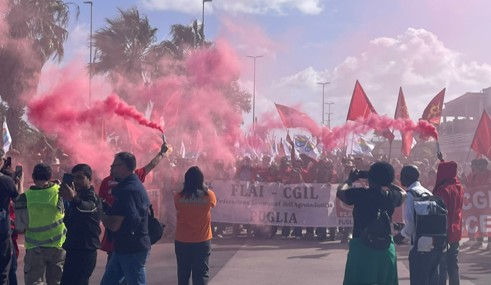
Thousands of people marched in Castel Volturno, southern Italy, on October 24, 2026, to oppose plans for a new migrant detention and repatriation centre, calling instead for greater investment in jobs, housing and public services.
Under the slogan “Build the Country, Not Cages,” the peaceful demonstration brought together students, trade unionists, lawyers, religious leaders, civil society organisations and migrant communities to protest the proposed facility, known as a Centro di Permanenza per il Rimpatrio (CPR).
Estimates of the crowd varied, with reports ranging from around 2,000 to between 10,000 and 20,000 participants. Police monitored the march as demonstrators called on the government to abandon the project.
Cardinal Domenico Battaglia, Archbishop of Naples, joined other religious leaders and regional president Roberto Fico in opposing the planned centre. Battaglia urged the government to listen to local communities and reconsider its reliance on migrant detention.
“The problem is not immigrants,” the cardinal said, pointing instead to inequality and organised crime as wider challenges facing society.
He also questioned the treatment of migrant workers who contribute to Italy’s economy but struggle to secure stable legal status. Many migrants undertake demanding jobs while facing administrative barriers that can threaten their ability to remain and work legally.
The proposed facility, reportedly valued at €43 million, has become a focal point for concerns over government spending priorities. Opponents argue that the money would be better spent improving employment opportunities, housing, infrastructure and essential public services.
For demonstrators, the issue extends beyond immigration enforcement to the economic difficulties facing communities and workers. They called for investment that improves living conditions rather than expanding facilities used to detain people awaiting deportation.
Migrant participants also raised concerns about residence permits and access to legal employment. In particular, they criticised restrictions introduced under Italy’s 2023 immigration legislation that limited the conversion of certain special protection residence permits into work permits.
These restrictions can leave some migrants facing uncertainty about their legal status despite having jobs and established community ties. Protesters called for greater opportunities for eligible migrants to convert their permits, maintain lawful employment and support their families.
The demonstration took place amid wider protests in Italian cities, including Rome, Milan, Turin and Naples, where people have raised concerns about living costs, housing, public spending and government policies. While the Castel Volturno march remained peaceful, other demonstrations reportedly saw clashes, arrests and incidents of vandalism.
Prime Minister Giorgia Meloni condemned violence linked to the wider protests, arguing that the right to demonstrate should not be used to justify disorder or damage to public property.
In Castel Volturno, organisers focused on opposing the detention centre and demanding changes to immigration and social policies.
The march brought together religious leaders, unions, civil society groups and migrant communities around calls for improved pathways to legal residence and employment, better public services and greater economic investment.
For the demonstrators, the proposed centre represents a wider debate over Italy’s approach to migration, the contribution of foreign workers and the balance between deportation policies and migrants’ rights.
Their central demand was for the government to prioritise jobs, housing and community services instead of building another migrant detention facility.