
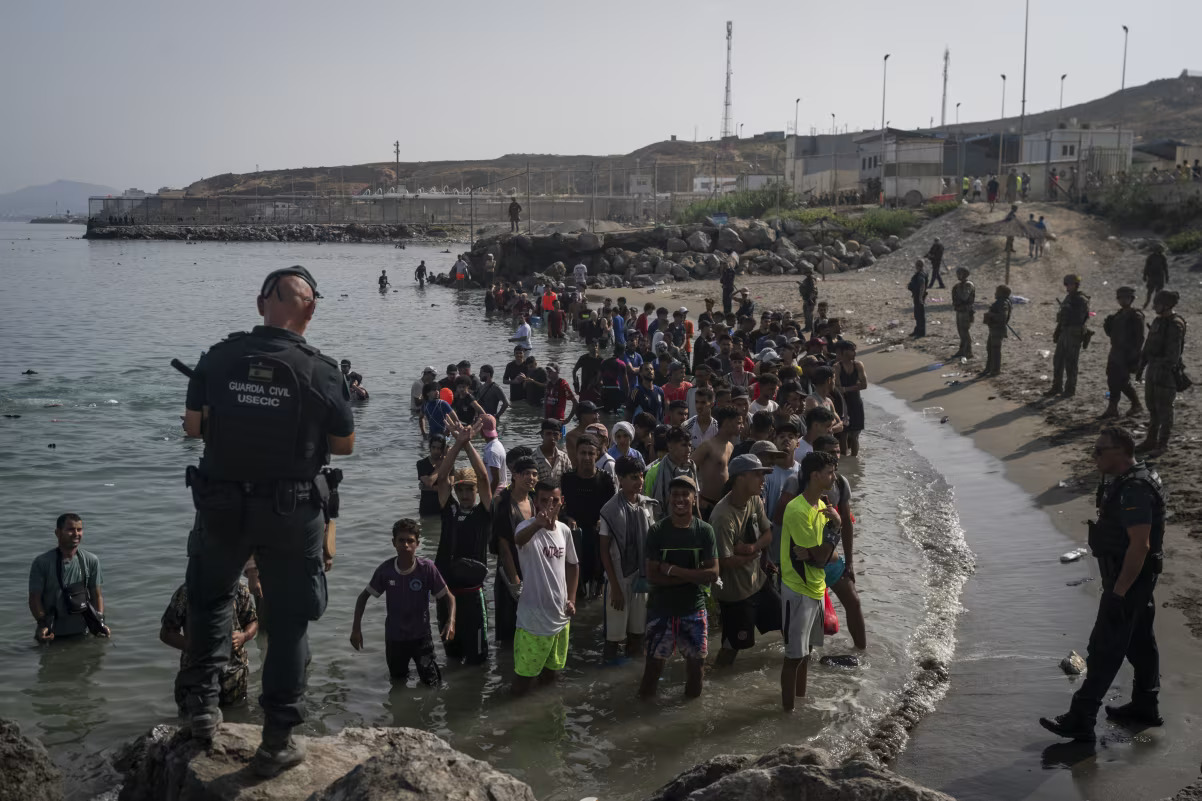
Authorities in Ceuta are considering urgent infrastructure works to strengthen security along the Spanish enclave’s border with Morocco following the mass arrival of migrants at the end of July.
Ceuta President Juan Jesús Vivas announced the proposed measures after a meeting of a government committee established to monitor the migration situation in the city.
The meeting was chaired by Spain’s Minister of Territorial Policy, Ángel Víctor Torres, and involved up to 10 ministers participating remotely.
The committee agreed that Spain should increase the presence and capacity of state security forces along the border to prevent a repeat of the events of July 30 and 31, when tens of thousands of migrants attempted to enter Ceuta from Morocco.
Vivas said additional security measures were also necessary to address what he described as a growing public “perception of insecurity”, which he argued was preventing the city from returning to normality.
He welcomed the government’s decision to establish a single command structure to coordinate the response, describing it as an effective system for assigning responsibilities and improving cooperation between government departments.
According to Vivas, the system has helped streamline the authorities’ response to the crisis and is intended to accelerate efforts to restore normal conditions in Ceuta.
The situation involving unaccompanied migrant children was also discussed during the meeting.
Vivas said it was impossible for Ceuta, which has a population of around 84,000, to manage the current pressure alone. He called for an exceptional intervention by Spain’s central government, arguing that the enclave lacks adequate facilities, financial resources and personnel to accommodate the number of children under its care.
He also called for family reunification to be prioritised where it is considered to be in the best interests of the children.
According to Vivas, Morocco has repeatedly indicated that it is prepared to receive Moroccan children currently staying in Ceuta, potentially allowing some of them to be reunited with their families.
The Ceuta president said the wider government response should continue to focus on returning migrants who entered the enclave during the July crisis and remain there.
The latest measures come as Spanish authorities continue to deal with the aftermath of one of the largest migration surges experienced by Ceuta.
The enclave, together with Spain’s other North African territory, Melilla, represents one of the European Union’s few land borders with Africa and has frequently been a focal point for irregular migration into the bloc.