
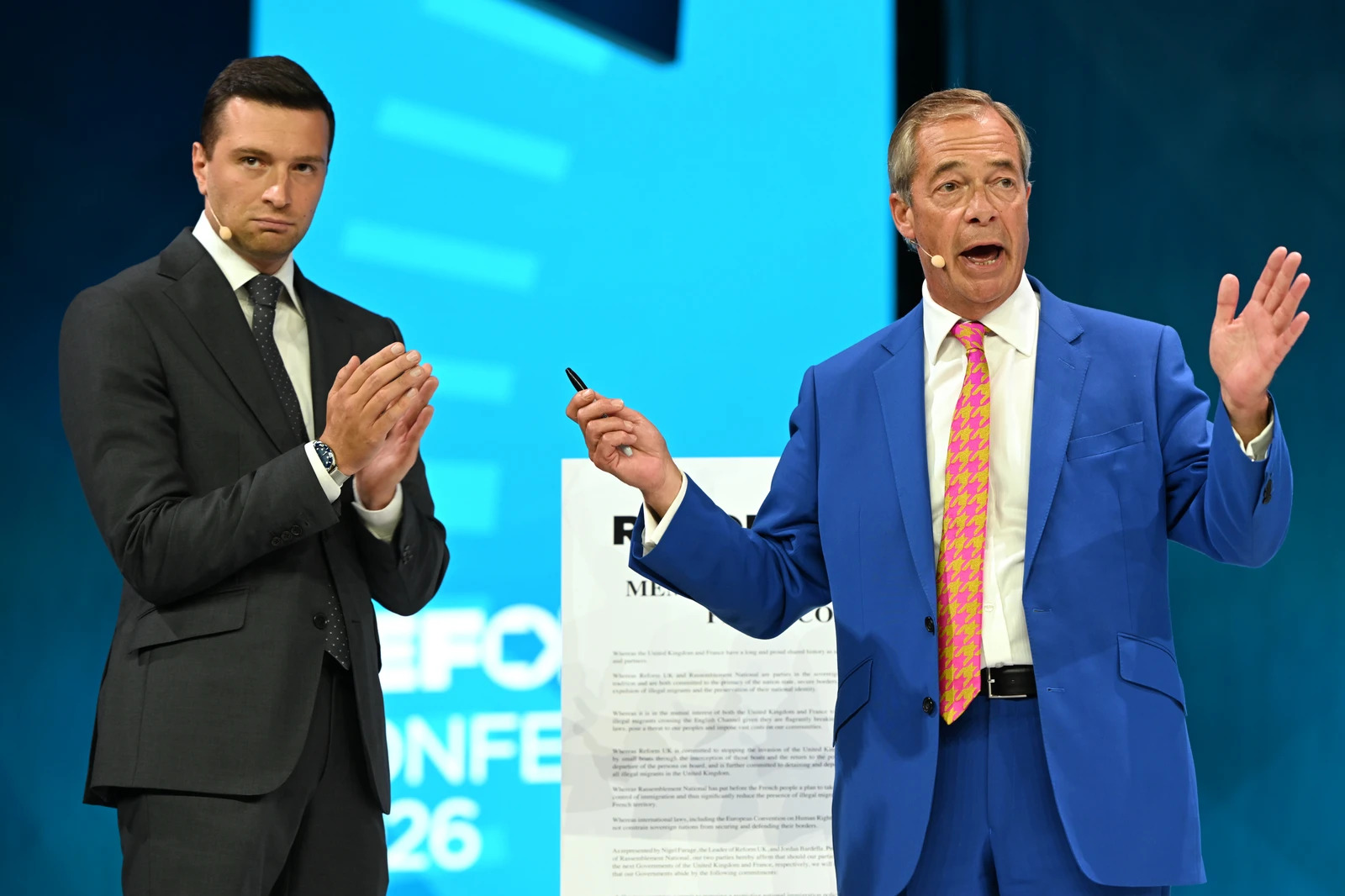
British Reform UK leader Nigel Farage and Jordan Bardella, president of France’s National Rally, have agreed to strengthen cooperation between their parties on tackling irregular migration across the English Channel.
The two politicians signed a memorandum of understanding during Reform UK’s annual conference in Birmingham on Friday, presenting the agreement as the beginning of closer political cooperation between Britain and France if their respective parties gain power.
Farage said the agreement marked the start of a renewed partnership between the two countries, focused in particular on stopping small boats carrying migrants and asylum seekers from crossing the Channel.
Bardella, who is positioning himself for a senior government role should National Rally perform strongly in France’s next national elections, told the conference that his party would seek to prevent France from being used as a route for irregular migration into the United Kingdom.
Speaking in English, Bardella criticized the administration of French President Emmanuel Macron over its handling of migration and said stronger measures were needed to address Channel crossings.
The agreement comes as migration remains a major political issue in both countries. Reform UK had previously enjoyed strong support in national polling but has seen its position weaken in recent months amid controversies surrounding the party, including allegations concerning political funding.
In Britain, the next general election is not expected until 2029, while France is scheduled to hold its next national elections in 2027.
The two parties’ cooperation comes against the backdrop of continued efforts by the British and French governments to reduce irregular Channel crossings.
Britain’s Labour government said this week that the number of migrant boats crossing from France to England during the summer was the lowest recorded for the period since 2019. The government attributed the decline in part to its enforcement cooperation with French authorities.
Farage and Bardella, however, have argued for a tougher approach to irregular migration and presented their agreement as an alternative political strategy for dealing with the Channel crossings.
The partnership is likely to keep migration at the centre of political debate in both countries as European governments face continued pressure to curb irregular arrivals while addressing asylum and border security.