
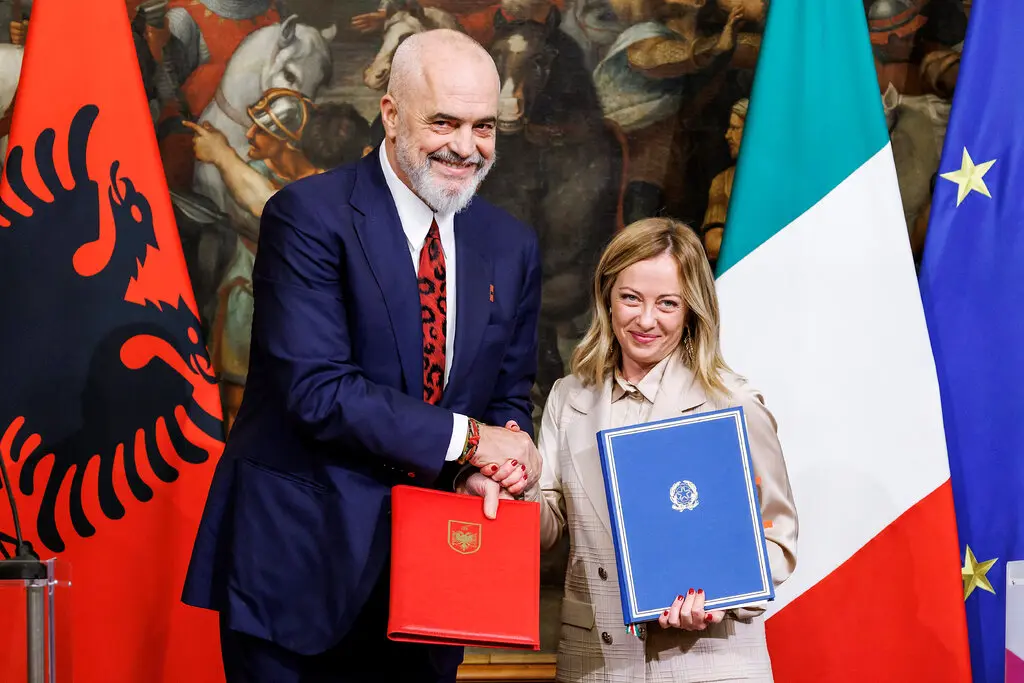
Italy is set to propose the creation of a European Union-wide network of Albania-style migrant return centres in third countries as part of a broader effort to strengthen the bloc’s migration and deportation policies following the recent migration crisis in the Spanish enclave of Ceuta.
The proposal, which has been confirmed by Italian government officials, will be presented by Interior Minister Matteo Piantedosi during an extraordinary meeting of EU interior ministers convened on Tuesday. Italy hopes the initiative will transform its existing Albania model into a common European approach for managing irregular migration and accelerating the return of migrants whose asylum applications are unsuccessful.
Under the proposal, foreign nationals who arrive illegally in the European Union would be transferred to dedicated return centres located in safe third countries while their asylum and immigration cases are processed. If their applications are rejected, they would then be repatriated to their countries of origin.
The emergency meeting was called after an unprecedented surge of migrant arrivals in Ceuta, Spain’s autonomous enclave on Morocco’s northern coast, where an estimated 70,000 migrants crossed into the territory within a matter of days, reigniting debate over the European Union’s migration policy.
Speaking ahead of the meeting, Italian Foreign Minister Antonio Tajani said Europe needed a coordinated migration strategy focused on implementing the EU Pact on Migration and Asylum, particularly measures designed to improve migrant returns.
According to Tajani, Italy and Denmark jointly requested the extraordinary meeting to encourage faster implementation of the new migration framework. He also confirmed that Rome would advocate for the establishment of additional Albania-style migrant centres across Africa and other migrant origin and transit countries.
Italy argues that the proposed network would strengthen cooperation with partner countries while improving the European Union’s ability to process and return irregular migrants outside its territory.
The proposal follows the approval of the European Union’s revised return regulations earlier this year, which provide member states with greater flexibility to establish return hubs in third countries. Italy now wants the initiative formally adopted across all 27 EU member states, with funding expected to come from the European Union.
Several countries have reportedly been identified as possible hosts for the facilities, including Ghana, Senegal, Tunisia, Libya, Mauritania, Egypt, Uganda, Ethiopia, Uzbekistan, Armenia and Montenegro.
Uganda has emerged as one of the strongest candidates, with reports indicating that Germany, Austria and the Netherlands have already expressed interest in supporting projects there. Montenegro has also been mentioned as a possible location, although discussions remain at an early stage.
One of the main issues yet to be resolved is financing, with EU member states expected to negotiate how construction and operational costs would be shared between the European Union and national governments.
Alongside the proposal, Italy plans to call for stricter implementation of the European Union’s Generalised Scheme of Preferences Plus (GSP+) programme, which is scheduled to take effect on 1 January 2027. The programme links trade preferences granted to developing countries with their willingness to cooperate in accepting the return of nationals found to be residing illegally in Europe.
Italian officials believe the mechanism could strengthen cooperation with countries of origin while improving the effectiveness of migrant return procedures.
At the same time, Rome is seeking to restore full operations at its migrant processing centre in Gjader, Albania, before the end of the year. Interior Minister Piantedosi said the government aims to return the facility to full capacity as soon as ongoing legal challenges are resolved.
The Albanian centre was originally designed to process up to 3,000 migrants each month, with an annual capacity of approximately 36,000 people. It was intended to operate under accelerated border procedures for asylum applications submitted by migrants intercepted in the central Mediterranean.
However, the project has encountered repeated legal obstacles. Since April last year, the Gjader facility has functioned primarily as a detention centre for migrants awaiting return rather than as a full asylum processing centre. Only a few hundred migrants have passed through the complex, and the number of completed deportations has remained relatively low.
The Gjader complex consists of three separate facilities, including an 880-bed reception centre for asylum seekers, a 144-capacity repatriation detention unit managed by Italy, and a small detention facility with space for 20 people. In the Albanian port of Shengjin, Italy also operates a reception hotspot where migrants intercepted in the central Mediterranean are initially transferred by Italian naval vessels.
Implementation of the Albania agreement has been slowed by repeated court rulings refusing to validate detention orders issued at the facilities, limiting the government’s ability to operate the centres as originally planned.
Despite those legal setbacks, the Italian government continues to promote the Albania model as the foundation of a future European migration policy, arguing that expanding offshore return centres across Africa and other partner countries would help reduce irregular migration, improve deportation rates and strengthen cooperation with countries of origin and transit.