
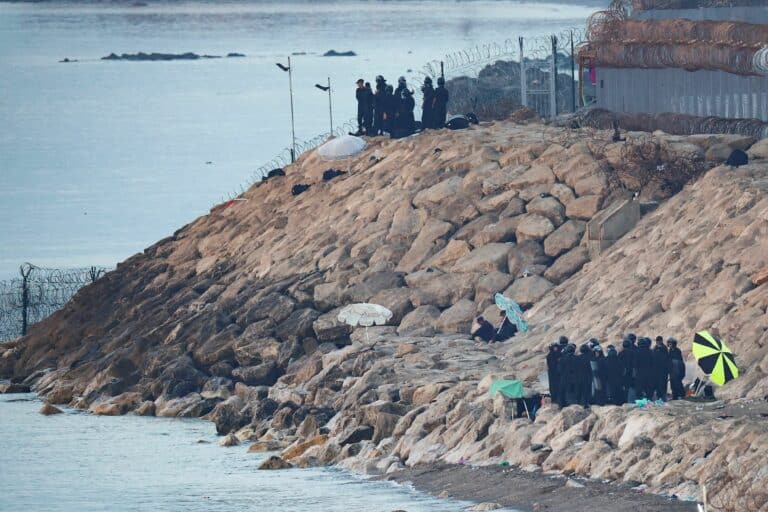
Spanish border workers had warned authorities that migration pressure around Ceuta was increasing weeks before tens of thousands of people attempted to enter the Spanish enclave, according to border unions that say their warnings were not followed by sufficient action.
The claims have raised fresh questions about whether Spain could have done more to prepare for the mass movement that erupted on July 29 and 30, when more than 70,000 migrants attempted to enter Ceuta from Morocco.
The episode became one of Europe’s most dramatic recent migration emergencies, with dozens of people dying during the rush.
Spanish authorities have reported 80 deaths, while Moroccan authorities said 14 bodies were recovered on their side of the frontier. Human rights organisations have warned that the true death toll could be higher because some people remain unaccounted for.
The unions representing Spain’s Civil Guard and police officers say the warning signs became increasingly clear after a court decision published on June 29.
The ruling limited the circumstances in which Spanish authorities could immediately return people who entered Ceuta. According to the unions, the decision created uncertainty over how officers could respond to migrants arriving by sea because the legal provisions governing immediate returns applied differently to people crossing a physical barrier.
That distinction quickly became important.
Border workers said information about the ruling circulated on social media alongside videos showing migrants successfully reaching Ceuta. They feared the combination could encourage additional attempts to cross.
Rachid Sbihi, a representative of the Civil Guard union AUGC in Ceuta, said officers understood that the ruling could lead to increased arrivals, although he acknowledged that the eventual scale of the July mobilisation was impossible to predict.
The unions subsequently issued several warnings to Spanish authorities.
In a statement published in July, AUGC argued that the court decision had created a legal gap that required clear operational instructions for officers working at the border.
Another police union, SUP, warned that organised smuggling networks could exploit changes in immigration procedures by adapting their routes and methods. The organisation called for additional personnel and clearer immigration policies.
By July 23, police representatives had also raised concerns about a continuing increase in arrivals by sea.
In correspondence to Ceuta’s police leadership, the union warned that the growing number of people arriving by boat was putting pressure on officers and that existing police facilities were not designed to manage the situation.
The union also requested a temporary reception facility.
According to union representatives, however, they did not receive an immediate response from the Interior Ministry. A meeting sought with the government representative in Ceuta was also not scheduled until a later date.
Spanish authorities have disputed the suggestion that the government ignored the emerging situation.
The Interior Ministry said officials assessed several possible responses after the court ruling and ultimately decided to install a floating barrier in the waters around Ceuta.
The ministry said the barrier was operational within 48 hours of the decision to deploy it, following the mass influx on July 30.
Officials have also rejected suggestions that the increase in arrivals before the mass crossing was directly connected to the later surge.
The government representative in Ceuta said authorities remained in contact with the police and Civil Guard and disputed claims that earlier arrivals were evidence of a developing operation that could have been prevented.
Police unions, however, maintain that the warnings they issued did not result in new instructions or sufficient preparations.
The dispute also highlights the role of social media in accelerating migration movements.
Spanish authorities have attributed the July rush partly to misinformation and claims circulated online that migrants could enter Ceuta because of the court ruling.
Videos showing successful crossings reportedly reinforced those expectations.
The situation also placed renewed attention on Morocco’s role in controlling migration towards Spain.
Morocco is a key partner of the European Union in efforts to limit irregular migration from North Africa. The EU has provided substantial funding to support Moroccan border management, while Madrid and Rabat have developed extensive cooperation on migration enforcement.
Moroccan authorities have said they spend hundreds of millions of euros each year on controlling their northern borders.
Analysts and local observers reported an increase in attempted crossings from around the middle of July. However, stronger measures inside Morocco, including increased checks at transport hubs, were reportedly introduced only shortly before the mass movement.
Significant security reinforcements were deployed after the number of people attempting to cross began rising dramatically.
Riccardo Fabiani, North Africa project director at the International Crisis Group, questioned whether Moroccan authorities had acted early enough to prevent the situation from escalating.
A senior Moroccan official said Rabat had contacted Spanish counterparts after the Spanish court ruling to ask whether it could create problems at the border. The official did not disclose Spain’s response but argued that responsibility for managing the consequences ultimately rested with Madrid.
The official also suggested that simply increasing the number of Moroccan security personnel would not necessarily have stopped the movement because the motivation to reach Spain had become too strong.
The events have consequently revived a broader European debate over the continent’s dependence on neighbouring countries to control migration routes before migrants reach EU territory.
Spain and Morocco have continued to describe their security cooperation as important, while the European Commission has indicated that further support could be provided to strengthen border management.
At the same time, Morocco has called on European governments to consider whether their migration policies themselves create incentives for people to attempt dangerous journeys.
Moroccan Justice Minister Abdellatif Ouahbi questioned why migrants would risk crossing fences or entering the sea if they believed they would ultimately be allowed to remain in Spain.
His comments reflect a growing argument among some North African officials that European migration policies should focus not only on border enforcement but also on creating clearer and more effective legal pathways.
For Spain, the Ceuta crisis has exposed the difficulty of responding quickly when legal decisions, social media activity, organised migration networks and border enforcement interact.
The warnings from Spanish border unions are likely to fuel further scrutiny of how authorities handled the weeks leading up to the July surge.
The episode has also demonstrated how quickly migration pressure can escalate around Ceuta, a small Spanish territory surrounded by Morocco, and how difficult it can be for authorities on either side of the border to contain a movement once thousands of people begin heading towards the frontier.
As investigations into the deaths and the circumstances surrounding the mass crossing continue, questions over preparedness, border coordination and the impact of online misinformation are likely to remain central to the debate over Europe’s migration policy.