
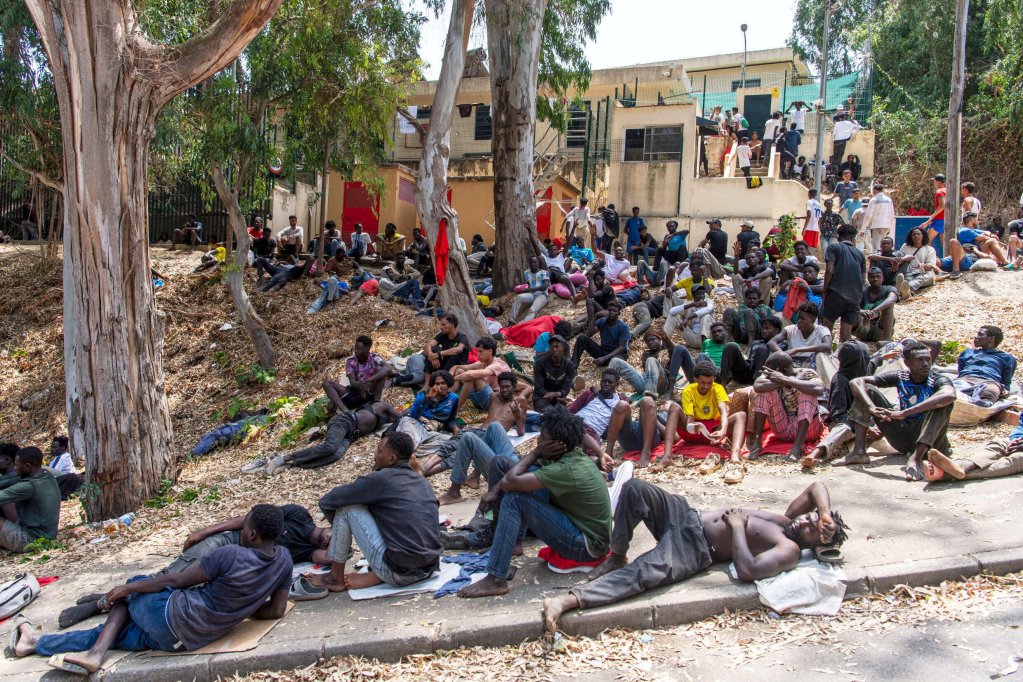
Spain is preparing to return a large number of migrants who remain in Ceuta following the mass influx from Morocco, while authorities increase accommodation and other services for those whose cases have yet to be resolved.
Spanish Territorial Policy Minister Ángel Víctor Torres said the situation in the North African enclave is expected to gradually stabilize as additional resources are deployed.
Miguel Ángel Pérez, the Spanish government’s representative in Ceuta, said most of the migrants still in the territory are unlikely to qualify for international protection. Those whose claims do not meet the required criteria could eventually be returned to Morocco.
Figures from the Ceuta government indicate that between 8,000 and 9,000 migrants remain in the enclave. Spanish authorities previously said approximately 72,000 people entered Ceuta on July 30, although more than 70,000 subsequently departed.
Between Aug. 10 and Aug. 31, about 3,519 people returned voluntarily to Morocco, while another 214 were expelled, according to Spanish government figures.
Officials believe many of those who remain travelled to Ceuta primarily in search of improved economic prospects rather than to request asylum. Some migrants have reportedly been sleeping in public spaces, including streets and beaches, while awaiting decisions on their circumstances.
Spanish authorities have also raised concerns about misleading information shared through social media and messaging applications. Officials say some migrants may have travelled to Ceuta after receiving information suggesting they would eventually be able to move to other parts of Europe.
The presence of unaccompanied children remains one of the most challenging aspects of the situation. Spain’s Interior Ministry has counted 1,129 minors among those who arrived during the mass movement, while Ceuta authorities have recorded 1,612 minors still in the territory. Officials expect the figure could rise as further identification procedures are completed.
Spanish legislation generally restricts the return of unaccompanied minors unless suitable arrangements have been established for their reunification with family members. As a result, authorities are continuing to provide protection and support while assessing the children’s individual circumstances.
Spain is also increasing its staffing levels in Ceuta to accelerate the processing of migrant cases. The Interior Ministry is deploying 50 additional National Police officers and at least 11 civil servants to assist with asylum applications and return procedures.
The Temporary Stay Center for Immigrants has been upgraded, while authorities have introduced video-conference interviews at the Temporary Foreigners’ Assistance Center to help process cases more efficiently.
Additional accommodation is also being planned. A government decree has identified land belonging to the Port of Ceuta, property under the Ministry of Housing and the K-8 military barracks as possible locations for temporary migrant facilities.
Several locations previously considered for the response, including municipal sports centers, a military hospital, a former flour factory and another state-owned sports facility, were excluded from the latest plans following consultations with Ceuta’s authorities.
The proposed sites could provide around 6,000 additional places, although the government has not announced when the facilities are expected to become operational.
Existing accommodation includes about 300 places at the Hipica facility and nearly 500 at the Embolsamiento site. The Ministry of Defence has contributed infrastructure and equipment, including beds and tents, while military facilities have also been made available to police personnel involved in managing the situation.
Humanitarian assistance has continued as authorities deal with the consequences of the mass arrivals. Government figures show that 109,600 food kits have been distributed, alongside 1,396 hygiene kits for women and 2,150 for men.
The Red Cross has also provided thousands of medical treatments and arranged hundreds of transfers to hospitals and health facilities.
Ceuta’s healthcare system remains under pressure but is considered capable of handling the additional demand. At one point, around half of the city’s hospital beds were occupied, with 104 beds in use. Fifteen of those beds were occupied by migrant patients.
Health authorities have also begun a vaccination campaign. Around 300 doses were initially available, with a further 45,000 doses expected to be supplied through donations from Spain’s autonomous communities.
Madrid is providing additional legal and judicial resources as authorities work through the large number of cases generated by the arrivals. New support has been allocated to legal aid services, prosecutors and courts, including the appointment of two additional judges. One of the new judges will focus on cases involving violence against women.
The Spanish government has also approved a €309 million package aimed at supporting Ceuta beyond the immediate migration response. The funding is intended to reinforce public services and security, improve migrant-related infrastructure and provide assistance to self-employed workers and small and medium-sized businesses.
Madrid estimates that the package is equivalent to around 16% of Ceuta’s gross domestic product and expects the funds to be distributed before the end of the year.
A separate decree-law provides further assistance for minors while introducing economic and tax measures intended to support businesses and self-employed workers affected by the crisis.
Spanish authorities say the combination of increased accommodation, additional personnel, humanitarian assistance and faster administrative procedures should help determine the status of migrants who remain in Ceuta.
Torres said the central government would continue working with local authorities to restore stability to the enclave, expressing confidence that the measures being introduced would eventually allow Ceuta to return to normality.