
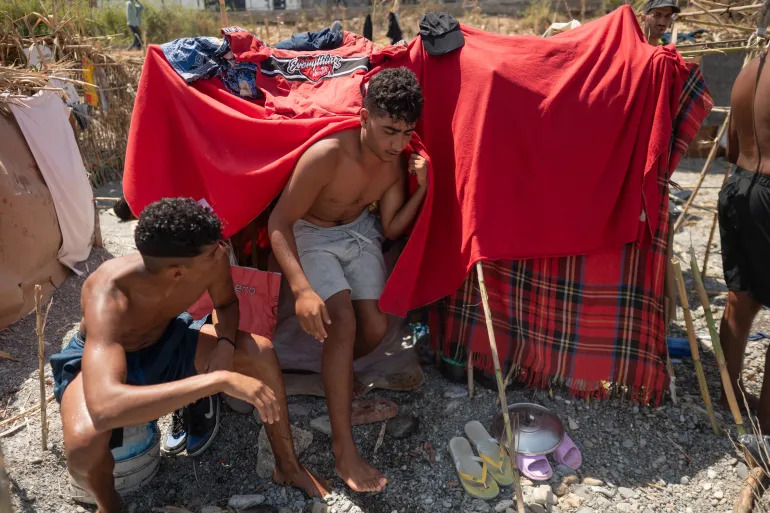
Spain has formally requested emergency funding from the European Union to help manage the migration situation in Ceuta, weeks after more than 70,000 migrants attempted to enter the Spanish North African enclave from Morocco.
The European Commission confirmed on Tuesday that it had received Madrid’s request and said it was assessing the application as a matter of priority.
“We have now, namely yesterday, received a formal request for emergency funding, and we are now working on assessing their request as a priority and with a view to taking a swift decision,” European Commission spokesperson Markus Lammert told reporters in Brussels.
The funding request comes after a mass migration surge into Ceuta in late July that became one of the deadliest border incidents in the region in recent years. More than 70,000 people reportedly attempted to cross into the enclave by land and sea, with many driven by economic hardship and misinformation about the possibility of entering Spanish territory.
At least 90 people died on both sides of the border, according to official figures, although human rights organisations have reported that the actual death toll could be higher.
The crisis has placed significant pressure on Ceuta’s limited reception facilities and local authorities. Most of those who entered the enclave have since returned to Morocco, but Spanish authorities estimate that between 3,500 and 7,000 people remain in Ceuta.
Among those still in the territory are unaccompanied minors who cannot simply be returned and must receive protection under Spanish law.
Spanish authorities are working to identify the migrants who remain in Ceuta and determine whether they qualify for international protection. Those who do not meet the requirements for asylum or other forms of protection may subsequently face return procedures.
The process has faced criticism from Ceuta’s regional government, controlled by Spain’s conservative Popular Party, which has argued that authorities need to respond more quickly to the continuing pressure on the enclave.
In an effort to improve coordination, Spain’s cabinet approved the creation of a single command for Ceuta on Tuesday. The structure will be led by Territorial Policy Minister Ángel Víctor Torres and is intended to coordinate the government’s response to the migration situation.
Torres said the government’s priority was to facilitate the return and repatriation of as many people as possible, including adults and minors, while ensuring that all procedures comply with Spanish law and international human rights obligations.
At the same time, the government said it would continue providing humanitarian assistance to people seeking asylum and unaccompanied children who cannot legally be returned.
The European Commission said it was closely monitoring developments in Ceuta and remained engaged with Spanish authorities to strengthen the security of the European Union’s external borders.
Ceuta and Melilla, Spain’s two North African enclaves, are particularly sensitive migration points because they contain the European Union’s only land borders with Africa. Both territories operate under a special arrangement within the Schengen area, meaning people entering from Morocco must undergo border checks before travelling onward to mainland Spain.
Spain’s request for emergency EU assistance comes as European authorities face renewed pressure to support member states dealing with sudden increases in irregular migration and the humanitarian challenges that follow large-scale border movements.