
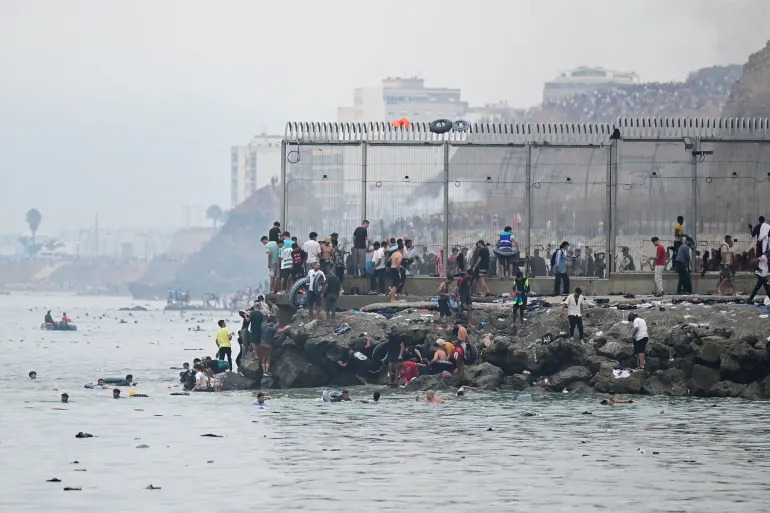
Spanish Prime Minister Pedro Sánchez travelled to the North African enclave of Ceuta on Friday after at least 57 migrants died during a mass attempt to enter the Spanish territory from Morocco, as tens of thousands of people crossed the border by land and sea.
The Spanish government confirmed the death toll on Friday evening, after Ceuta’s regional president, Juan Jesús Vivas, had initially reported that 34 people had died.
Authorities said approximately 60,000 people had entered Ceuta from Morocco within about 24 hours, with many migrants swimming around a border barrier extending into the sea while others attempted to cross by land.
The unprecedented influx overwhelmed parts of the enclave and triggered a major humanitarian and security crisis.
Sánchez said his government was mobilising all available resources to respond to the situation and described the mass crossings as a violation of Spain’s territorial sovereignty.
Spain’s Interior Ministry said approximately 25,000 people who entered Ceuta had already been returned to Morocco by Friday.
The government has faced growing pressure to restore control of the border while dealing with the humanitarian consequences of the mass arrival.
Rachid Sbihi, who heads a local workers’ association representing Civil Guard officers in Ceuta, described the situation as a serious humanitarian crisis. He said thousands of migrants, including unaccompanied children, were sleeping on pavements while others wandered through the streets of the enclave.
Many of those who died were believed to have drowned while attempting to swim from Morocco into Ceuta. Others reportedly died during a stampede as crowds attempted to cross a breakwater fence at Tarajal beach, near one of the main border checkpoints.
The violence and disorder were particularly visible around the border. Moroccan authorities deployed water-cannon vehicles to push back crowds, while the remains of a burned bus and seven cars were reportedly visible near the crossing following clashes.
Footage from Thursday showed large groups of people, most of them reportedly Moroccan nationals, moving along the breakwaters and into roads inside Ceuta. Although many of those arriving were young men, families with women and children were also among the crowds.
Ceuta, together with Melilla, is one of two Spanish autonomous cities in North Africa and contains one of the European Union’s only land borders with Africa. Both territories have experienced repeated attempts by migrants to enter Europe from Morocco.
Migrants seeking to reach Ceuta frequently attempt the dangerous sea journey from the Moroccan town of Fnideq, swimming approximately five kilometres to reach Spanish territory. Others use routes from Belyounech, where the distance to the enclave is shorter.
The latest surge has been linked by Spanish authorities to confusion and misinformation surrounding a recent Supreme Court ruling concerning migrants arriving by sea.
The ruling prevented Spanish authorities from immediately returning migrants who reach Ceuta by sea without following due process. It does not apply in the same way to people who enter Spain by land, including those who cross the border fence.
Sánchez said trafficking networks had exploited the ruling by spreading what he described as a self-serving interpretation of the court’s decision.
According to the Spanish prime minister, discussions with Moroccan authorities indicated that migrant-smuggling networks had circulated rumours about the ruling, which then spread rapidly through communities and social media.
However, activists in Morocco questioned whether the court decision could have been responsible for the scale of the crossings, arguing that most migrants would probably have had little knowledge of the details of a Spanish judicial ruling.
The incident has prompted concern across Europe, with EU leaders warning about the dangers of irregular migration and the role of smuggling networks.
European Commission President Ursula von der Leyen described the scenes from Ceuta as unacceptable and called for dangerous crossings to end immediately.
She also urged authorities to dismantle migrant-smuggling networks and ensure that returns are carried out swiftly where permitted under European law.
Germany’s Chancellor Friedrich Merz welcomed Spain’s position that undocumented migrants arriving in Ceuta should not be allowed to move onward to mainland Europe. Berlin said it was in contact with the Spanish government over the situation.
France also offered support to Spain and said it was coordinating with both Spanish and Moroccan authorities.
French President Emmanuel Macron’s office said Paris was prepared to assist Spain if necessary, including through European border and coast guard resources provided by Frontex.
France had already announced tighter controls along its border with Spain following the mass crossings. French Interior Minister Laurent Nunez said additional checks had been ordered and that a rapid-intervention border force would be deployed to conduct more detailed inspections.
The crisis also generated political repercussions elsewhere in Europe.
Italian Prime Minister Giorgia Meloni threatened to suspend aspects of Italy’s open-border arrangements with Spain under the Schengen system, arguing that stronger measures were necessary to protect national borders and public safety.
The threat came despite Italy and Spain not sharing a direct land border.
Within Ceuta, regional authorities called for the Spanish government to declare an emergency on national security grounds and requested additional police and military personnel to reinforce the frontier.
Vivas said the army should be deployed to help guarantee the security and inviolability of the border and protect residents.
Spain’s Interior Ministry rejected the request for a national emergency declaration, arguing that the country’s existing emergency framework did not cover migration crises in the manner requested. The ministry nevertheless promised additional resources to help authorities manage the unprecedented situation.
The mass crossings have placed renewed attention on Spain’s complicated migration relationship with Morocco and the vulnerability of Ceuta and Melilla to sudden surges in attempted crossings.
The deaths have also highlighted the dangers faced by migrants attempting to reach Europe through increasingly risky land and sea routes, while the political response has once again exposed divisions among European governments over border controls, migrant returns and responsibility for protecting the EU’s external frontier.
Spanish authorities now face the dual challenge of restoring order in Ceuta and responding to the humanitarian needs of thousands of arrivals, while European governments debate how to prevent another crisis of similar magnitude.