
The United Kingdom and Belgium have agreed to strengthen intelligence-sharing in an effort to disrupt criminal networks involved in migrant crossings of the English Channel.
Under the new post-Brexit arrangement, authorities in both countries will be able to exchange information about suspected people-smugglers, boats, equipment and movements more quickly, including in real time.
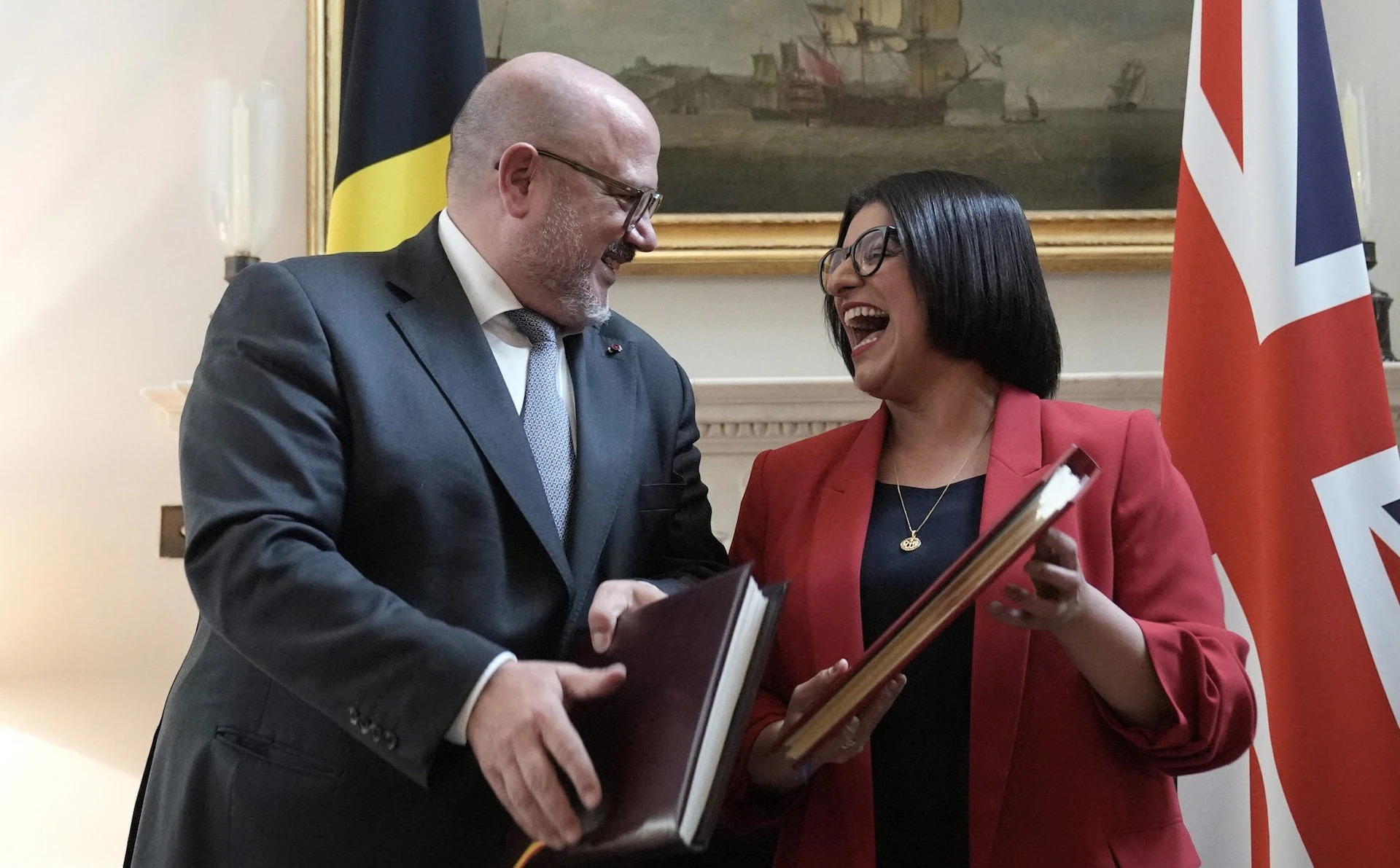
The agreement was signed by UK Home Secretary Shabana Mahmood and Belgian Interior Minister Bernard Quintin as both countries seek to improve cooperation against organised smuggling networks operating across European borders.
The new system is expected to address delays that have affected intelligence-sharing between the two countries. Previously, Belgian authorities generally required judicial approval before certain information could be transferred to the UK, a process that could take weeks or even months.
Mahmood said closer cooperation with Belgium would help law enforcement agencies identify and disrupt the criminal groups behind small boat crossings.
She said people-smuggling networks were not confined to the beaches of northern France and that the UK would continue working with international partners to pursue those involved in the trade.
The agreement comes as smugglers increasingly look for alternative launch points after intensified French policing around the Calais area. Authorities have reported activity shifting further east towards the Belgian and Dutch coastlines, while some crossings have also been launched from areas farther west in France.
The changing routes have raised concerns that smuggling networks are adapting their operations to avoid police patrols and maritime interception efforts.
Last weekend, a large inflatable boat carrying about 120 migrants travelled from Normandy to Portsmouth, covering roughly 70 miles. The unusual route was followed by protests in the southern English city after the migrants were brought ashore.
Belgium has also been used as a transit point by migrant-smuggling networks, including for the movement of boats from stockpiles in Germany.
The latest agreement forms part of wider European efforts to target the criminal organisations facilitating irregular Channel crossings. Germany introduced legislation last year making it an offence to facilitate migrant smuggling to countries outside the European Union, including the UK, with offenders facing up to 10 years in prison.
UK and Belgian law enforcement operations have already resulted in more than 50 arrests linked to migrant smuggling this year, while more than 40 vehicles have been seized.
One major case involved Adem Savas, who was sentenced in Belgium to 11 years in prison and fined €400,000 in January for supplying thousands of boats and engines to criminal networks involved in Channel crossings.
His conviction followed a joint investigation by Britain’s National Crime Agency and Belgian authorities after he was arrested at Amsterdam Schiphol Airport in November 2024.
Will Middleton, international director of the National Crime Agency, said Belgium was an important law enforcement partner and that the new agreement would allow agencies to deepen their cooperation against several forms of organised crime, including migrant smuggling, drug trafficking and firearms offences.
Belgian Interior Minister Quintin said the two countries already had close operational links and that the new arrangement would strengthen their ability to tackle criminal networks operating on both sides of their borders.
As part of the agreement, Belgian officers will also be able to work with the UK-France intelligence cell in northern France. The unit brings together National Crime Agency officers and French investigators to identify and dismantle organised migrant-smuggling networks operating across Europe.
The UK has also recently expanded its cooperation with France. Mahmood signed a £662 million, three-year agreement with the French government aimed at increasing the number of French officers involved in efforts to prevent Channel crossings.
More than 17,000 people have crossed the English Channel in small boats so far this year, according to figures cited in the agreement. Although the number is more than 40 percent lower than at the same point last year, authorities remain concerned about the ability of smuggling gangs to adapt their routes and methods.
The new UK-Belgium arrangement is intended to make it harder for those networks to operate across borders by allowing investigators to exchange information more quickly and coordinate action against suspected smugglers.