
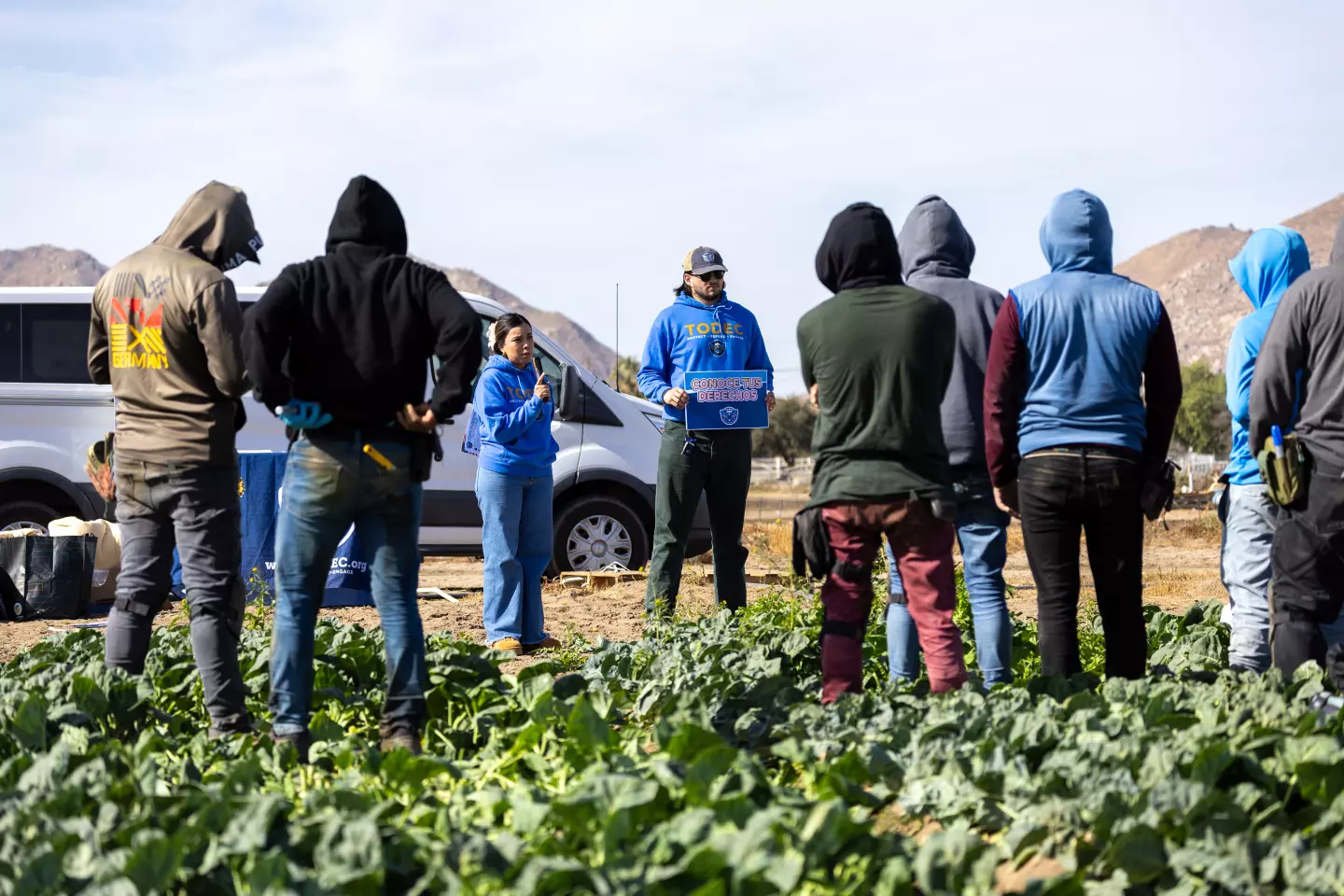
Undocumented migrant farmworkers in California and Oregon say they are living in growing fear as immigration enforcement intensifies under President Donald Trump. Speaking anonymously to Newsweek, three farmworkers described constant anxiety over increased activity by U.S. Immigration and Customs Enforcement (ICE) near their homes, workplaces, and even schools.
According to the U.S. Department of Agriculture (USDA), nearly half of the 2.4 million agricultural workers in the United States lack legal immigration status. The current enforcement push is part of a broader crackdown led by the Department of Homeland Security (DHS), which reports that close to 3 million undocumented immigrants have left the country during the administration’s strategy, including over 713,000 formal deportations.
Farmworkers say the situation has created a climate of fear. One woman in Riverside County, California, explained that she now takes extra precautions when traveling to work, visiting clinics, or caring for children. She described feeling safer because of her lighter skin tone but said the uncertainty of being stopped or targeted remains heavy. She also helps neighbors who are too afraid to leave their homes by delivering groceries and medication, especially to indigenous language speakers.
In Imperial County near the Mexican border, another farmworker working in date palm harvests said even workers with legal status feel stressed. Some workers now ask field supervisors to escort them home after shifts. She said the atmosphere is worse than during the COVID-19 pandemic, when farmworkers were considered essential workers. Now, she added, work hours have decreased and wages have remained frozen for many since early 2025.
The economic impact is also visible. Reuters reported that growers in Ventura County saw absenteeism rates of up to 70 percent after heightened enforcement actions. California farms report about 413,000 full-time-equivalent jobs annually, yet roughly 850,000 different workers are hired throughout the year due to seasonal demands, according to research from the University of California, Davis. A reduction in available labor has led to concerns about unharvested crops and financial losses.
In Oregon, a migrant farmworker described how daily life has changed. She said families now limit outings to essential trips only, constantly scanning roads for unfamiliar vehicles. A recent family visit to a nearby waterfall ended abruptly after they feared a truck might belong to ICE. Although the vehicle was unrelated, she said the experience shows how deep the anxiety runs. “There is no sense of normality anymore,” she said.
Despite fears, migrant communities contribute significantly to state economies. In California, undocumented immigrants paid nearly $8.5 billion in state and local taxes in 2022, according to an analysis by the Institute on Taxation and Economic Policy. In Oregon, immigrants contributed an estimated $5.6 billion in taxes in 2023, based on data cited by the American Immigration Council. Migrant and seasonal farmworkers in Oregon number around 86,400, with total farmworker households reaching approximately 173,000.
Labor shortages have reportedly affected harvests in Oregon, particularly between July and October. Crops such as grapes, blueberries, and peaches have been left partially unharvested due to fewer workers in the fields. Farmworkers say many stayed home to avoid potential encounters with immigration agents.
To respond to labor gaps, the administration updated the H-2A visa program in October. The reform aims to speed up approvals for temporary agricultural guest workers. The Department of Agriculture said the administration is strengthening the farm workforce while streamlining visa processes to support farmers and ranchers.
As immigration enforcement continues, migrant farmworkers in both states say the fear is reshaping daily life, affecting agricultural production, and raising broader questions about labor supply and the future of U.S. farming.