
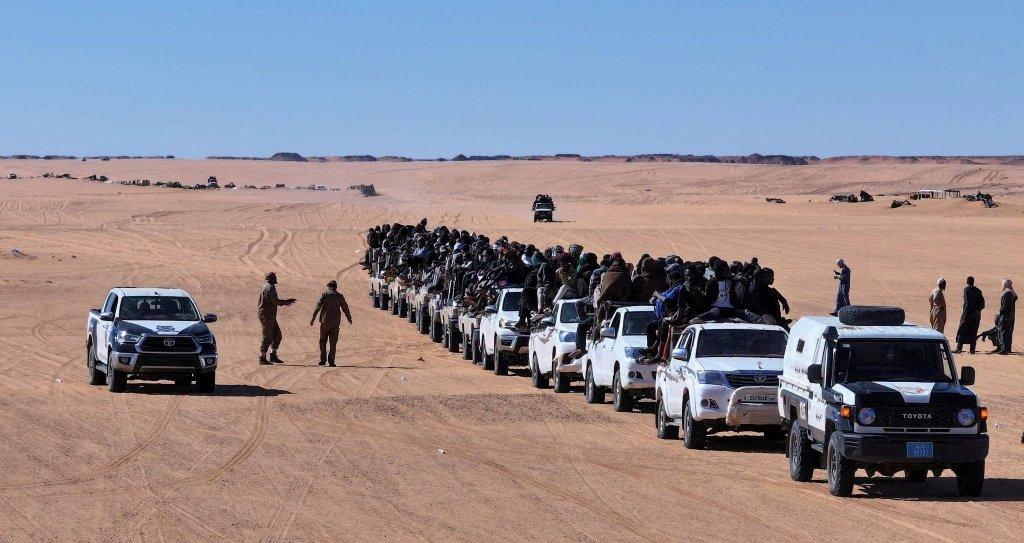
Authorities in eastern Libya have deported 602 Chadian migrants to their home country as security forces intensify operations targeting people living in the country without regular immigration status.
The deportation took place on Thursday, November 12, and was announced by the eastern region’s Anti-Illegal Migration Agency through its official social media channels.
According to the agency, the operation involved migrants with medical conditions, individuals facing security restrictions, people arrested during security raids and others accused of attempting to enter Libya illegally.
Agency officials said the deportees were transported to the Chadian border in an operation that lasted approximately a day and a half. Abdulmenam al-Ghomati, a spokesperson for the agency, confirmed the details in comments to Reuters.
Photographs released by the Libyan authorities showed groups of migrants, mostly men, being gathered and transported in pickup trucks through a remote desert area before being taken towards the border with Chad.
The deportations come as authorities in eastern Libya expand security operations against migrants staying in the country irregularly. The Anti-Illegal Migration Agency said its forces had been conducting daily field campaigns targeting houses and other properties suspected of being used to accommodate migrants without proper authorisation.
The agency described some of the properties as houses and sites rented through what it called random and illegal arrangements. Its published photographs showed security personnel rounding up migrants during the operations.
Libya remains an important destination for migrant workers from neighbouring African countries, while also serving as a major transit route for people attempting to reach Europe across the Mediterranean Sea.
Since the 2011 uprising that toppled former leader Muammar Gaddafi, the country has remained politically divided between rival authorities operating in the east and west, complicating efforts to establish unified migration management and reliable nationwide statistics.
The latest deportations also come amid growing European Union cooperation with authorities in eastern Libya on migration and border security.
In October 2026, the European Union approved an additional €25 million to support border management, search-and-rescue operations and efforts to combat migrant smuggling in eastern Libya.
The EU and several of its member states have also provided training and equipment to the Libyan coastguard. However, the cooperation has attracted criticism from human rights organisations because migrants intercepted at sea are frequently returned to Libya, where serious abuses against migrants and refugees have been documented by United Nations agencies and rights groups.
Meanwhile, Libya continues to host a large migrant population from different parts of Africa and beyond.
According to the International Organization for Migration (IOM), 939,638 migrants were present across 100 Libyan municipalities at the end of 2025. The organisation noted that the actual number could be higher because some migrants are not captured in official assessments and reliable data remain difficult to obtain in parts of the country.
The largest migrant communities in Libya originate from Sudan, Niger, Egypt, Chad and Nigeria.
Most migrants live in urban areas, particularly in major cities such as Tripoli, Benghazi and Misrata, where many seek employment and other opportunities.
The deportation of 602 Chadian nationals highlights the increasingly strict enforcement measures being applied against migrants in eastern Libya, as authorities continue operations targeting irregular migration.