
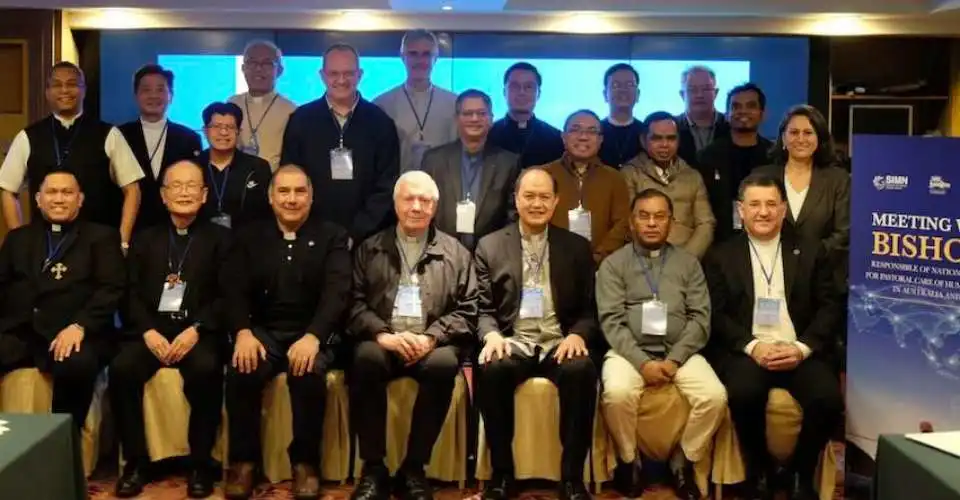
Catholic bishops and Church representatives from Asia and Australia have met in Taiwan to discuss ways to improve cooperation in supporting migrants, refugees, seafarers, fishers and families affected by migration.
The two-day meeting, held in Taipei from November 10 to 11, brought together bishops and representatives of national Catholic commissions responsible for migration and people on the move from Australia, Taiwan, Vietnam, the Philippines, Timor-Leste, Indonesia, Japan and India.
The gathering was jointly organised by the Asia-Australia province of the Scalabrinians, the Vatican’s Dicastery for Promoting Integral Human Development and Taiwan’s Ministry of Foreign Affairs.
Initiated by the Scalabrini Missionaries, a Catholic congregation specialising in working with migrants and refugees, the meeting aimed to strengthen cooperation between local Catholic Churches and missionary organisations in responding to growing migration challenges.
Participants discussed the difficulties facing migrant workers, seafarers and fishers, as well as families separated by migration. They also explored ways to protect migrants’ rights, promote their dignity and encourage their participation in society and Church activities.
One of the keynote speakers was Pascale Debane, the Vatican’s regional coordinator for Asia, the Middle East and Oceania in the Dicastery’s Listening and Dialogue Section.
Debane proposed that each national Bishops’ Conference appoint a dedicated person to coordinate migration issues rather than treating migrant ministry as a temporary project.
She also called for stronger communication and cooperation between Churches in countries of origin, transit and destination, stressing that collaboration was essential to recognising migration ministry as an important part of the Church’s pastoral responsibilities.
The Vatican representative also highlighted changes in global migration patterns, explaining that movement between countries had become more complicated, involving several destinations, transit points and influencing factors simultaneously.
She argued that the Church’s pastoral response should extend beyond its traditional structures and reach migrants where they live and work, including those who may not regularly visit churches.
Among the senior Church leaders attending were Cardinal Pablo Virgilio David of Kalookan in the Philippines, who serves as vice president of the Federation of Asian Bishops’ Conferences, and Bishop Martin Su Yao-Wen of Taichung, chairman of the Taiwan Bishops’ Conference Commission for Migrants and Itinerant People.
Scalabrinian Superior General Father Leonir Mario Chiarello and Australia and Asia Provincial Superior Father Martin Ignacio Gutierrez also participated.
Taiwanese government representatives included Virginia Y.C. Chen, deputy secretary-general of the Ministry of Foreign Affairs’ Department of European Affairs, and Amy Wang, an assistant director-general.
The discussions provided an opportunity for Church leaders and government officials to identify common challenges affecting migrants across the Asia-Pacific region and consider practical ways to improve support.
Among the proposals were the development of mobile phone applications to improve communication with migrants, stronger coordination of Church activities serving migrant communities and the establishment of a dedicated data centre to collect and manage information on migrants.
The meeting also reflected on the legacy of St. John Baptist Scalabrini, founder of the Scalabrinian congregation, who is widely known as the Father of Migrants because of his work supporting people who had left their home countries.
Participants emphasised that migration should not be viewed only as a humanitarian or social issue but also as an important pastoral and missionary responsibility for the Catholic Church.
Father Gutierrez said supporting migrants and refugees was central to the Church’s missionary identity.
He explained that accompanying people on the move allowed the Church to demonstrate the values of fraternity, hospitality and hope promoted by the Gospel.
The meeting ended with renewed calls for closer cooperation between Catholic communities, missionary organisations and governments to ensure that migrants, refugees and their families receive greater protection, recognition and support across the region.