

A clear majority of Canadians favor reducing the country’s intake of permanent residents and temporary visa holders next year. According to a recent poll conducted by Nanos Research for CTV News, public sentiment reflects growing concern over how population growth intersects with housing availability, public infrastructure, and broader economic pressures.
The survey revealed that 52.3% of respondents believe Canada should accept fewer immigrants and temporary residents in 2027. Meanwhile, 33.5% prefer maintaining current levels, 8.4% support increasing intake numbers, and 5.9% remain undecided. These figures arrive as federal plans managed through Immigration, Refugees and Citizenship Canada target 380,000 new permanent residents alongside 385,000 temporary workers and international students in 2026. Prime Minister Carney indicated that ongoing discussions with provincial leaders aim to align immigration rates with sustainable long-term capacity.
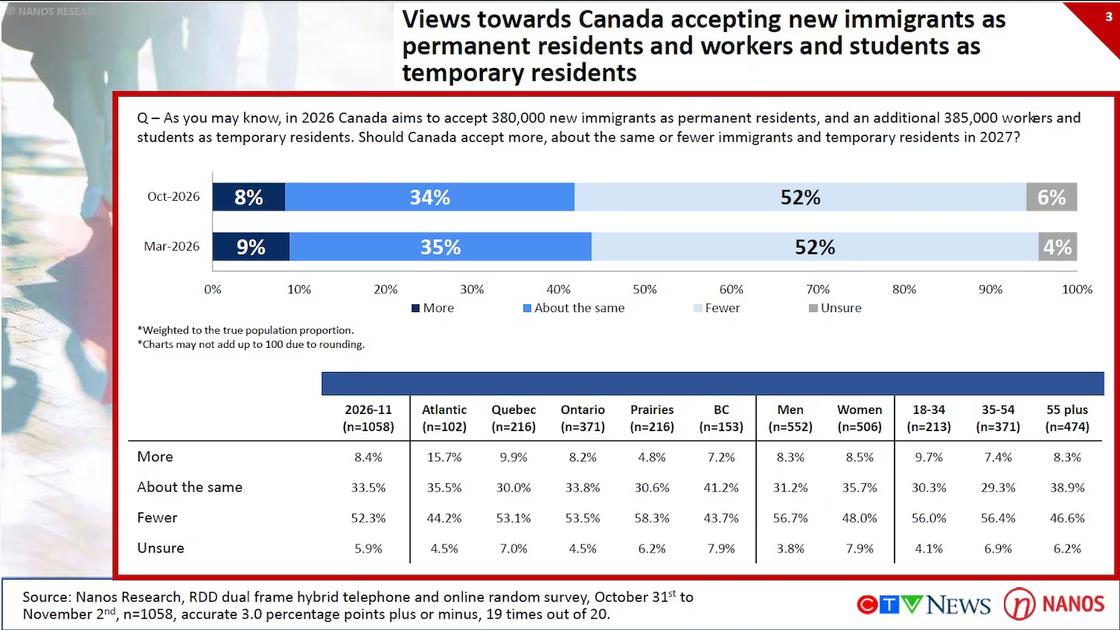
The October findings demonstrate notable stability in public attitudes over recent months. In a similar survey conducted in March, 52% of respondents called for lower immigration and temporary resident figures in the coming year.
During the same period, support for keeping intake rates unchanged shifted slightly from 35% in March to nearly 34% in October. The proportion of Canadians advocating for higher immigration numbers dropped from 9% to 8%, while the percentage of undecided respondents rose from 4.5% to almost 6%.
Geographic and demographic analysis underscores distinct variations in opinion across the provinces:
The Prairies: Recorded the strongest demand for reduced intake, with 58.3% supporting lower numbers.
Ontario and Quebec: Expressed similar views, with 53.5% and 53.1% of residents favoring reductions, respectively.
Atlantic Canada and British Columbia: Showed lower support for cuts, at 44.2% and 43.7% respectively. British Columbia recorded the highest support for maintaining current targets at 41.2%.
Age also played a significant role in shaping perspectives. Working-age adults aged 35 to 54 were the most likely to advocate for lower intake numbers at 56.4%, closely followed by younger adults aged 18 to 34 at 56%. Among Canadians aged 55 and older, 46.6% favored reductions, while 38.9% preferred keeping intake levels stable—the highest level of support for current targets across any demographic group.
Survey Methodology and Population Representation
The hybrid telephone and online survey gathered responses from 1,058 adult Canadians between October 31 and November 2, 2026. Data were weighted to reflect Canada’s national demographic balance. The poll carries a margin of error of plus or minus 3.0 percentage points, 19 times out of 20.