
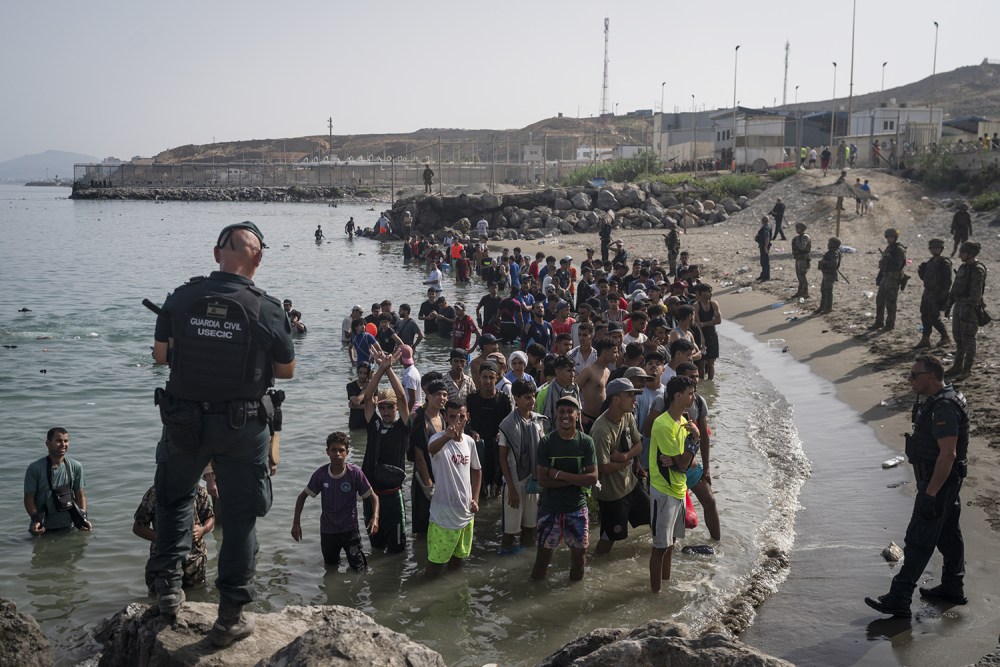
Thousands of migrants remain stranded in Spain’s North African enclave of Ceuta nearly three weeks after tens of thousands crossed from Morocco in one of the largest migration surges the territory has experienced, according to aid workers.
Maria Jimenez, spokesperson for the NGO Elin, told RFI that many of those still in Ceuta are living without adequate shelter, regular food or sufficient medical assistance. She said the situation was becoming increasingly urgent as authorities struggle to determine how to manage the remaining migrants.
An estimated 70,000 to 80,000 people entered Ceuta from Morocco at the end of July. Most have since left the enclave, but thousands remain, including significant numbers of children and people seeking international protection.
Jimenez said NGOs working on the ground estimate that about 7,000 migrants are still in Ceuta, although the figure does not include people staying in wooded or other isolated areas.
She estimated that approximately 4,000 children are among those remaining. Many are reportedly staying in and around parts of the city, while some local residents have stepped in to provide food and temporary assistance.
According to Jimenez, residents have also made use of a football pitch to provide somewhere for women and girls to sleep because formal accommodation has not been made available to them.
She said police had registered about 300 unaccompanied girls, adding to concerns about the protection of children who arrived without parents or other relatives.
The situation is particularly complicated because not everyone who entered Ceuta is in the same legal or humanitarian position.
Jimenez estimated that around 3,500 adults remaining in the enclave are asylum seekers from countries including Sudan, Yemen, Chad, Mali and Egypt. Some have reportedly travelled for months or years before reaching the Spanish territory.
Aid organisations say these migrants cannot simply be treated in the same way as people who entered Spain irregularly from Morocco but have no protection claim.
Some of those seeking asylum have told aid workers that returning to Morocco would put their lives at risk. Jimenez said several migrants had expressed a willingness to remain in Ceuta rather than be sent back.
She argued that Spanish authorities should assess each person’s circumstances individually and ensure that people who may qualify for international protection have access to the asylum system.
The humanitarian situation has also become increasingly difficult.
According to Jimenez, people remaining outside formal accommodation have struggled to obtain basic necessities, including food, shelter and medical care. Spanish Red Cross volunteers have reportedly been distributing meals on the beach, with the number of meals helping aid groups estimate the remaining population.
The lack of adequate facilities has placed significant pressure on local residents and humanitarian organisations.
Jimenez said local communities initially reacted with fear when tens of thousands of people entered Ceuta within a short period. The enclave has an area of roughly 20 square kilometres and a population of about 80,000, meaning the sudden arrival of tens of thousands of migrants placed enormous pressure on local infrastructure.
However, she said some residents subsequently began helping migrants, particularly children and vulnerable people.
Tensions have nevertheless emerged.
Jimenez acknowledged that incidents of violence have occurred but argued that they should be viewed in the context of the migrants’ living conditions. When people lack access to food, showers, accommodation and basic services, she said, disputes and confrontations can become more likely.
The Spanish government has meanwhile increased security around Ceuta amid concerns that another large-scale crossing could occur.
Authorities have also sought to return migrants to Morocco, while maintaining that immigration controls must be enforced.
For humanitarian organisations, however, the immediate priority is ensuring that vulnerable people are identified and protected before any removals take place.
Jimenez said the government needs to establish clear procedures for registering migrants, identifying minors, providing interpreters and allowing people with potential asylum claims to access the appropriate legal process.
Children require particular safeguards because many arrived without parents or guardians.
The uncertainty surrounding the number of people remaining in Ceuta has also become a source of concern. Spanish officials have provided different estimates, with the Interior Ministry putting the number at about 5,000 while Ceuta’s regional authorities have suggested that at least 8,000 could remain.
Aid groups say the absence of a comprehensive official count makes it more difficult to plan accommodation, food distribution, healthcare and protection services.
The situation comes as Spain and Morocco maintain heightened security along their shared border following the unprecedented July crossings.
Moroccan authorities have increased security measures and arrested migrants in areas near Ceuta amid fears that another mass movement could develop.
The latest developments have therefore created a difficult balancing act for Spain.
Authorities face pressure to prevent another uncontrolled border crossing while also responding to thousands of people already inside the territory, including children and individuals who may have legitimate claims for asylum.
For the migrants who remain, the uncertainty is compounded by difficult living conditions and fears about being returned to Morocco.
Humanitarian organisations are calling for urgent action to provide dignified accommodation, food, healthcare, child protection and access to legal procedures.
The continuing crisis also highlights the broader challenge facing Europe when large numbers of migrants arrive suddenly at its external borders: securing the frontier while ensuring that people who may need international protection are not denied the opportunity to have their claims properly assessed.