
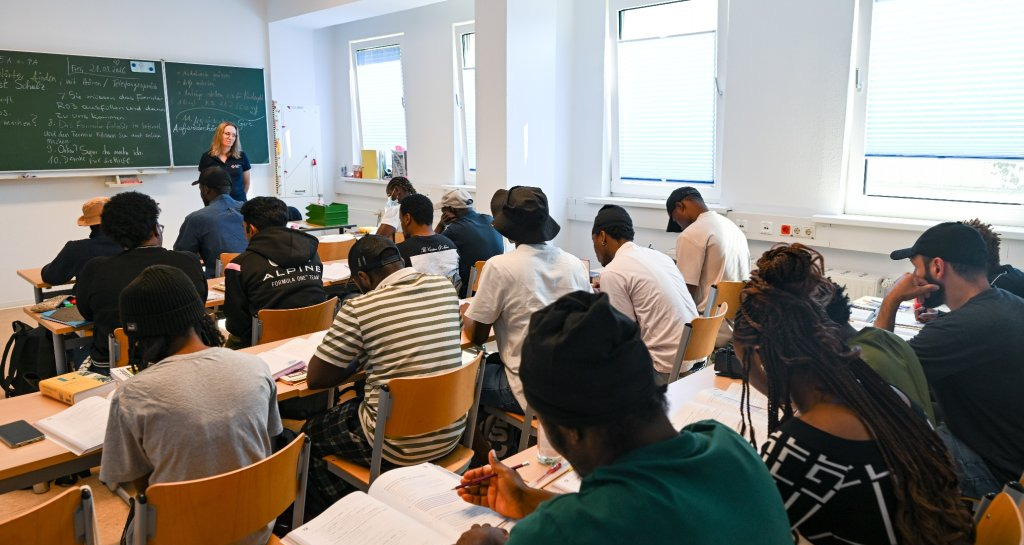
Germany has opened a new Opportunity Center in the eastern state of Brandenburg to help migrants whose legal status remains unresolved gain access to education, vocational training and employment.
The pilot project, launched on June 1, is designed for people who have limited prospects of remaining in Germany but cannot currently leave the country. This includes migrants with tolerated-stay status, individuals awaiting legal clarification of their immigration cases, and rejected asylum seekers who cannot be returned because of issues such as missing identity documents or the absence of readmission agreements.
The center, located at the Brandenburg Central Foreigners Authority’s facility in Frankfurt (Oder), is expected to support between 200 and 300 people each year. Services include German-language courses, vocational training, educational programmes, childcare and assistance in finding employment or internships.
Around 100 people are currently using the facility, with the center expected to reach full capacity this month. The first German-language course began this week with 17 participants, mainly from Cameroon, Kenya, Afghanistan and South Africa.
At the center, migrants can also receive practical training aimed at helping them enter sectors facing significant labour shortages. One participant from Nigeria, for example, is receiving training in parcel handling and hopes to secure employment in the logistics industry.
Brandenburg authorities are working with companies to create opportunities for employment and internships, with the broader goal of helping participants become economically independent and potentially establish a legal pathway to remain in Germany in the future.
Brandenburg’s Minister of Migration and Integration, René Wilke, said integration requires efforts from both migrants and German society.
“Integration is both an offer and an individual effort,” Wilke said at the center’s opening on August 21. He stressed the importance of clear rules and functioning structures while arguing that migrants should actively participate in German society.
The initiative comes as Brandenburg anticipates significant labour shortages in the coming years. State authorities estimate that the region could face a shortage of around 120,000 workers by 2031, with sectors including transport, logistics, hospitality, retail, agriculture and care services expected to be particularly affected.
Wilke said some areas could see between 25% and 30% of their workforce retire within five years, increasing pressure on employers to recruit foreign workers.
Official figures show that Brandenburg recorded 6,089 new arrivals in 2025, down from 8,122 the previous year. The largest groups came from Ukraine, Afghanistan, Syria, Russia and Turkey.
At the end of June, around 7,800 people in Brandenburg were required to leave Germany. Government figures show that 1,275 stays in the state were terminated during 2025, including 1,090 voluntary departures and 185 deportations or Dublin transfers.
The Opportunity Center is also being established against the backdrop of a large population of asylum seekers across Germany whose immigration status remains unresolved.
National statistics showed that approximately 361,000 asylum seekers had open protection cases at the end of 2025. Another 178,000 people had rejected protection status and were therefore subject to possible deportation. Of those, around 140,000 had received a temporary suspension of deportation, known as a Duldung.
Supporters say the Brandenburg initiative could provide a practical way to help people who are unable to leave Germany immediately while addressing the country’s need for workers.
However, the project has also attracted criticism. Kirstin Neumann of the Brandenburg Refugee Council said the initiative was a step in the right direction but argued that employment and integration opportunities should be expanded across local communities rather than concentrated in a single facility.
Neumann also said migrants who are already working or undergoing training can still face uncertainty because immigration authorities may restrict their right to work or refuse to grant them residency.
The far-right Alternative for Germany, or AfD, held a demonstration outside the center on the day it opened. Hans-Christoph Berndt, chairman of the AfD parliamentary group in Brandenburg’s state parliament, called for rejected asylum seekers to leave Germany and criticised the establishment of the facility.
The Brandenburg government, however, has defended the project as a way to connect migrants in prolonged legal uncertainty with language education, skills development and the labour market while their individual situations are addressed.
The pilot programme is likely to remain closely watched as Germany continues to balance efforts to enforce immigration rules with growing demand for workers and the challenges posed by migrants whose deportations cannot immediately be carried out.