
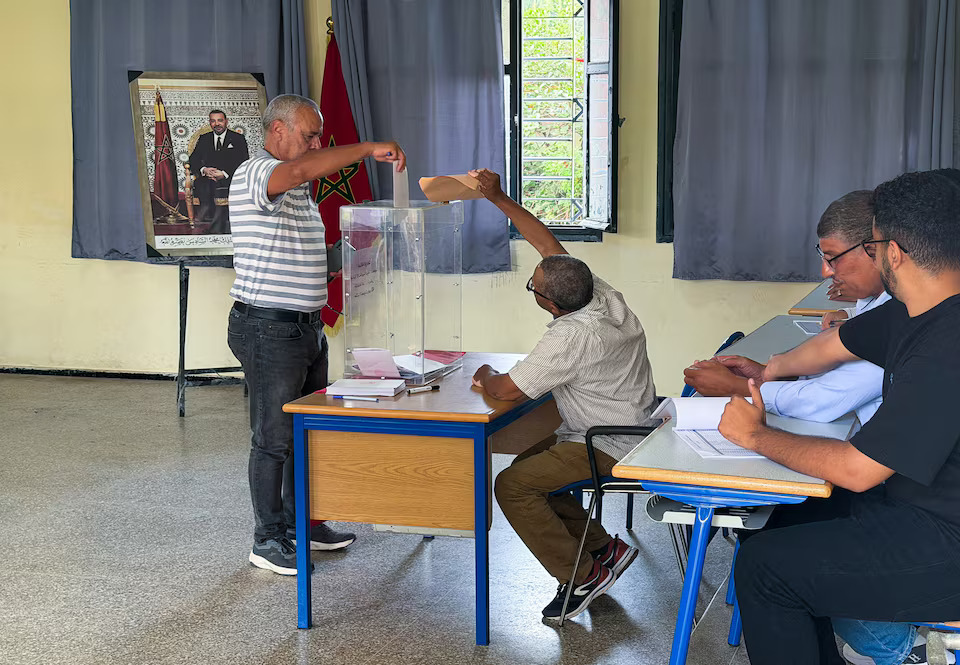
Moroccans are voting in parliamentary elections on Wednesday, with employment, rising living costs and inequality among the main concerns for voters.
Nearly 16 million people are registered to elect 395 members of Morocco’s House of Representatives. Polling stations are scheduled to open at 8 a.m. and close at 7 p.m., with preliminary results expected later in the evening.
Youth participation is being closely watched. Young Moroccans make up a significant part of the population but represent only a small share of registered voters, reflecting broader concerns about political engagement among younger people. Reuters reported that youth unemployment is around 27%, while many young people remain outside employment, education, or training.
The election comes less than two months after more than 70,000 people crossed from Morocco into the Spanish enclave of Ceuta during a mass border rush in July. Most later left the territory, although thousands remained in Ceuta weeks after the incident.
The migration episode has not been the main focus of the election campaign. However, analysts have linked the border rush to wider frustrations among young Moroccans over economic opportunities and their relationship with political institutions.
Morocco’s political parties have instead concentrated much of their campaigning on jobs, wages, housing and improving living standards.
The National Rally of Independents, or RNI, which currently leads the governing coalition, is among the major parties competing for seats. Prime Minister Aziz Akhannouch has defended the government’s record, pointing to reforms in areas including education, healthcare and social protection.
The party has also promised further measures to improve employment and living standards if it remains in government.
The Authenticity and Modernity Party, known as PAM, is another major force in the election. Its campaign has also placed young people and employment at the centre of its programme.
PAM has promoted higher wages and improved purchasing power, while highlighting the need to give young people greater economic opportunities.
The Istiqlal Party is also competing for seats, with its campaign focusing heavily on social issues.
The opposition Justice and Development Party has campaigned on tackling corruption and has also taken conservative positions on issues including inheritance and the decriminalisation of consensual relations outside marriage.
Under Morocco’s political system, the king appoints the prime minister from the party that wins the most seats. The prime minister then forms a government, while the monarchy retains significant authority over major areas of national policy.
That division of power has contributed to concerns among some young voters that parliamentary elections may not bring major changes to issues affecting their daily lives. Reuters reported that only about one-third of Moroccans aged 18 to 35 said they trusted parliament, the prime minister or political parties in a survey published earlier this year.
The recent events in Ceuta have added another dimension to those concerns. More than 72,000 people entered the Spanish enclave from Morocco on July 30, according to Spanish authorities, although the majority subsequently left. The episode has remained a major migration story in the region and has also generated political debate in both Morocco and Spain.
Morocco has rejected accusations that its authorities organised or deliberately facilitated the mass crossing. Spanish Prime Minister Pedro Sánchez has also said there is no solid evidence that Moroccan authorities planned the incident, although a Spanish police report raised questions about the response of Moroccan security forces during the crossing.
The election therefore takes place against a backdrop of economic pressure, youth dissatisfaction and continued debate over migration.
For many voters, however, the immediate priorities remain employment, purchasing power and access to public services as Morocco’s political parties compete for control of parliament.