
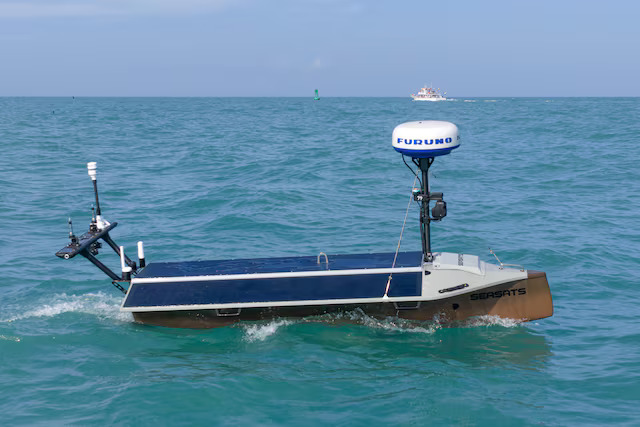
The US Pentagon is considering expanding its use of small autonomous boats to monitor parts of the southern border and deter migrant crossings and drug trafficking.
The unmanned vessels have been operating along the Rio Grande since a pilot programme began in January. US officials say the boats have helped detect attempted border crossings and have also supported operations against narcotics trafficking.
The vessels, produced by San Diego-based company Seasats, operate without crews and can remain in the water for extended periods. Defence officials are studying whether the technology could be deployed more widely along remote sections of the Rio Grande and potentially in the Gulf of Mexico.
The Pentagon currently has a test fleet of 10 vessels and is considering adding as many as 50 more. The proposed expansion is intended in part to reduce pressure on crewed aircraft and Coast Guard vessels involved in border surveillance.
Assistant Secretary of Defense for Homeland Defense and Americas Security Affairs M. Roosevelt Ditlevson described maritime drones as a cost-effective way to monitor areas increasingly used by drug traffickers.
The vessels are part of a wider expansion of autonomous technology across the US military and other security agencies, as officials look for systems that can provide continuous surveillance without requiring personnel to remain on board.
The Lightfish model used in the border programme is about 11 feet long and weighs roughly 340 pounds. It costs approximately $240,000 and can be launched from a boat ramp or transported in the back of a pickup truck.
Powered partly by solar energy, the vessel can reportedly remain operational for months, including in rough conditions. Its equipment includes electro-optical, infrared and sonar sensors that provide tracking information to security agencies.
According to Pentagon figures cited by Reuters, Lightfish vessels have contributed to an average of 452 detections, 350 apprehensions and 100 turnbacks each month. A turnback refers to an attempted crossing that is abandoned after people realise they have been detected. (Reuters)
The surveillance information can be transmitted to military and law-enforcement systems used by US Customs and Border Protection and the Coast Guard.
Defence officials are also considering deploying similar vessels in the Gulf of Mexico. A possible expansion could eventually include testing the technology in the Pacific Ocean near San Diego, where conditions would be more challenging.
The proposed expansion reflects the Pentagon’s broader interest in autonomous systems that can operate for long periods and cost less than traditional crewed surveillance platforms.
Seasats chief executive Mike Flanigan said unmanned vessels could provide continuous monitoring that aircraft and conventional ships cannot maintain for the same length of time.
Other companies, including Saronic, Saildrone and Splash, are also developing autonomous maritime systems for surveillance and security operations.
The Pentagon’s consideration of additional boats comes as the US government continues to increase border surveillance as part of President Donald Trump’s immigration policies. The proposed use of autonomous vessels would add another layer of technology to existing patrols along the US-Mexico border and surrounding waterways.