
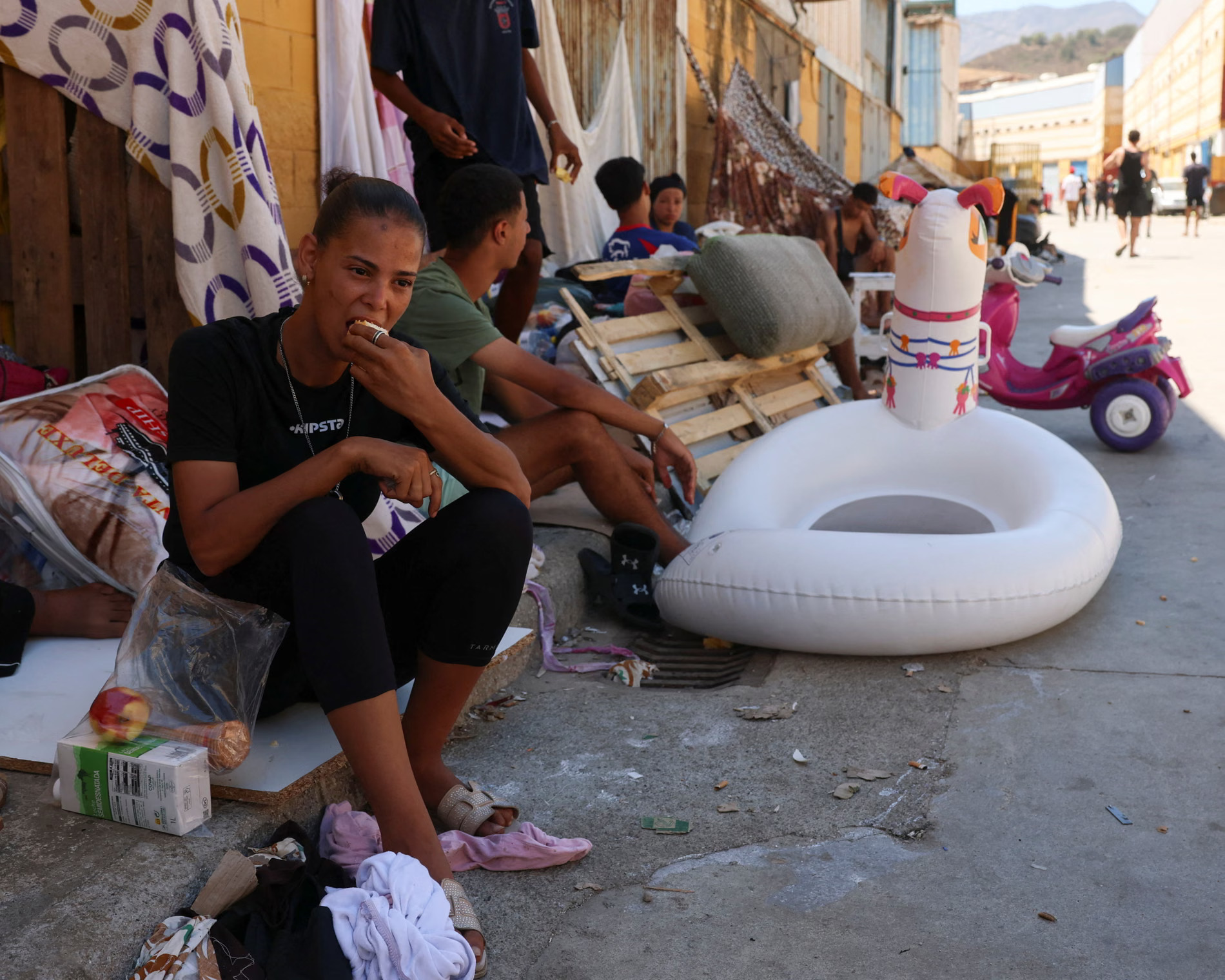
Migrants who remain in Spain’s North African enclave of Ceuta are struggling to find food, shelter and basic sanitation more than a week after tens of thousands of people crossed into the territory from Morocco in one of the largest migration emergencies seen at Europe’s borders in recent years.
At El Trampolín beach, several hundred migrants have been sleeping in the open without tents or blankets, exposed to intense daytime heat and cold temperatures at night. Some say they have little access to bathrooms, showers or other basic facilities, while others remain uncertain about whether they will be allowed to seek asylum or face return to Morocco.
“We’re sleeping here on the beach, out in the open, without tents or blankets,” said Imad, a 26-year-old Yemeni migrant who remains at the site. He said the nights were extremely cold near the sea while the daytime heat was difficult to endure.
“I barely manage two hours of sleep,” he said, describing conditions that have left him physically and psychologically exhausted.
The situation in the migrant areas contrasts sharply with the normality that has returned to much of central Ceuta. Shops, restaurants and markets have reopened, while many residents have resumed their daily activities after the extraordinary influx that overwhelmed the enclave.
Ceuta’s president, Juan Jesús Vivas, said the city remained deeply unsettled by the events. He warned that residents were still concerned about the possibility of another mass crossing, particularly after new social media posts reportedly called for another attempt to enter the territory later in August.
The precise scale of last week’s influx remains disputed. The Spanish government estimated that approximately 72,000 people crossed into Ceuta and that around 2,500 remained in the territory. Vivas has suggested that the number of arrivals may have been closer to 80,000, with between 3,000 and 5,000 people still in the enclave.
The number of deaths linked to the crossing also remains unclear. Some reports have placed the death toll as high as 141, while dozens of people are still reported missing. The uncertainty has raised concerns that the final number of people who died during the mass crossing could increase.
For the migrants who remain, however, the immediate concern is survival.
Imad said conditions were particularly desperate in the first days after the influx, when many businesses and facilities were closed, and thousands of migrants struggled to find food and drinking water.
“Everything was closed, and we were on the verge of dying of hunger and thirst,” he said, claiming that some migrants ate leaves from trees and drank dirty water.
Conditions have improved somewhat following the arrival of humanitarian organisations, including the Red Cross, which has provided food and other assistance. Spanish authorities have also begun installing additional toilets and showers at El Trampolín beach and announced plans to establish an information point for migrants.
Imad said he had spent eight hours swimming toward Ceuta using flippers after beginning his journey from Yemen several years earlier. He said he fled his country in 2019 after facing attempts by Houthi forces to recruit him to fight.
He believed reaching Spain would provide an opportunity to seek international protection because he was fleeing a country affected by war. Instead, he said he found the migrant reception centre closed and struggled to understand how he could formally request asylum.
The uncertainty has taken a heavy psychological toll.
“I have nightmares every day,” he said, describing dreams in which his family was killed in bombing attacks or he was deported to Morocco.
“I’m psychologically shattered,” he said.
Among those still in Ceuta are an estimated 1,300 unaccompanied children. Humanitarian organisations have warned that the actual number of vulnerable minors could be higher, with some children reportedly sleeping on the streets or hiding in isolated areas.
A 16-year-old girl who crossed into Ceuta said she went to a reception facility for minors after arriving but was told that it was already full. She subsequently slept on the streets and went for days without food.
She said that when food and clothing were distributed to migrants, men often reached the front of the queues first, leaving little or nothing for women and girls.
Despite the hardship, she decided not to return to Morocco. She said she hoped remaining in Ceuta could eventually give her an opportunity to find work and improve the living conditions of her family.
“I just want to be a normal girl,” she said, describing her hopes of having regular access to food, housing, education and employment while being able to support her relatives.
Concerns about the safety of women and children have also prompted residents in parts of Ceuta to organise their own emergency response.
In the Sidi Mbarek neighbourhood, residents have established a makeshift shelter for vulnerable migrants, including minors who are afraid of being discovered and returned to Morocco.
Abdullah Abdullah Mustafa, head of the local neighbourhood association, said some migrants were hiding in the surrounding hills because they feared being sent back.
He said the situation was particularly dangerous for minors who could find themselves living in close proximity to large groups of adult men without adequate protection.
Residents have erected tents in a courtyard and taken turns monitoring the area at night. The temporary shelter has no proper bathrooms, beds or other essential facilities, but local residents say they felt compelled to act because leaving vulnerable children without protection posed an even greater risk.
The emergency has also generated a wave of community solidarity across Ceuta.
Local volunteers have been preparing food for migrants, while the NGO Luna Blanca has organised a large-scale operation providing thousands of meals each day. Other residents have donated clothes, food and basic necessities.
One Ceuta resident, Aisha Ahmed Ammar, has been visiting El Trampolín beach with her children, bringing food and clothing to migrants. She has also used her mobile phone to provide an internet connection so people can communicate with relatives in their home countries.
Ammar said many of the migrants she encountered were seeking protection after fleeing conflict and instability in countries including Sudan, Egypt and Yemen.
She said she was struck by their behaviour despite the difficult circumstances, recalling that some migrants declined assistance and encouraged her to give supplies to people they believed needed them more.
But the scale of the humanitarian emergency has left many residents feeling overwhelmed.
Ammar said she wanted to do more but recognised that individual residents could not meet the needs of thousands of people facing homelessness and uncertainty.
The continuing crisis has placed Ceuta at the centre of a wider European debate over border control, asylum, migrant returns and cooperation between Spain, Morocco and the European Union.
While political leaders debate the circumstances that led to the mass crossing and how future incidents can be prevented, thousands of migrants remain caught between an uncertain future and deteriorating living conditions, with many still waiting for access to adequate shelter, food, sanitation and legal assistance.