
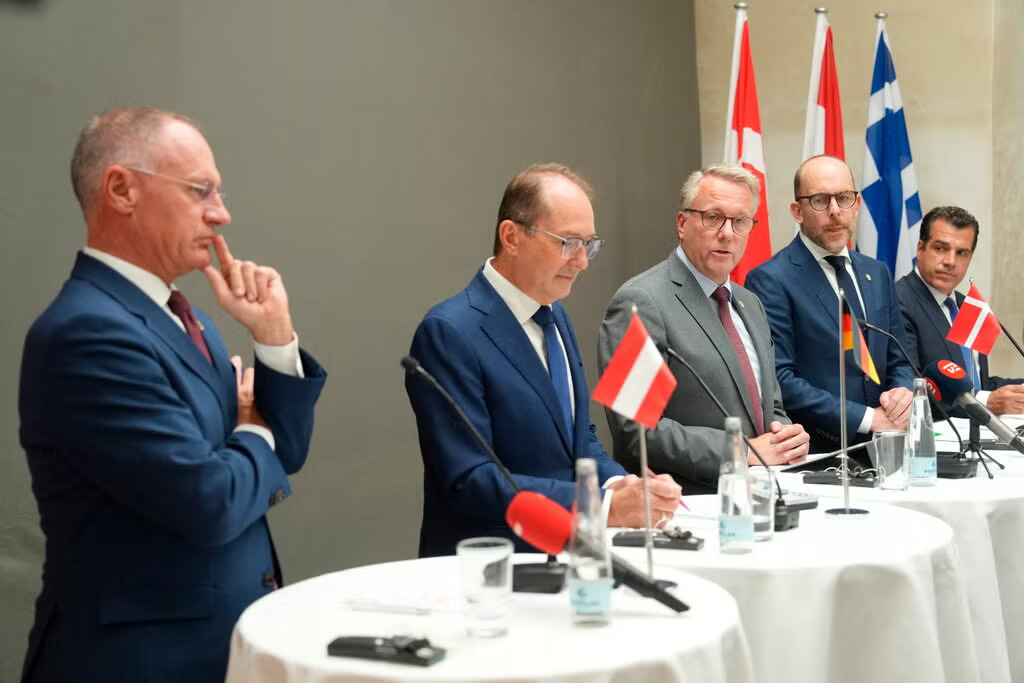
Five European countries have announced plans to establish a migration return hub in Rwanda to accommodate migrants whose asylum applications have been rejected and who cannot or will not return to their countries of origin.
Germany, Austria, Denmark, the Netherlands and Greece are working together on the proposed arrangement, which would allow them to transfer certain rejected asylum seekers to Rwanda after they have exhausted their legal options to remain in Europe.
The announcement, made on Monday, November 16, comes as several European governments introduce stricter immigration measures and explore ways to increase the number of people returned after unsuccessful asylum applications.
The proposed project is expected to begin on a limited scale, with an initial group of approximately 100 to 200 deportees. However, the arrangement has not yet been finalised.
Danish Prime Minister Mette Frederiksen described the initiative as an important step towards changing Europe’s migration system.
The five governments say the arrangement would address the situation of migrants who have no legal right to remain in European countries but cannot be returned to their home countries for various reasons.
The proposed return hub is expected to operate under the European Union’s emerging framework for third-country return arrangements, which provides a basis for sending certain migrants to countries outside the bloc.
Rwanda has previously entered into migration agreements with Western governments, making it a potential partner for the new initiative.
In 2022, the United Kingdom announced a plan to transfer some asylum seekers to Rwanda for their claims to be processed there. However, the British Supreme Court ruled the arrangement unlawful in 2023 over concerns about the safety of people sent to the country. The programme was subsequently abandoned before any compulsory deportations took place.
The British scheme reportedly cost the UK nearly $1 billion before it was scrapped.
Italy has also attempted to establish migrant processing facilities in Albania, but the initiative has encountered legal challenges.
The five European countries involved in the latest proposal argue that their Rwanda arrangement differs from previous agreements because it would target people whose legal options to remain in Europe have already been exhausted, rather than individuals who are only beginning the asylum application process.
However, the proposal has attracted criticism from human rights advocates and other observers concerned about the protection of migrants transferred to countries with which they have no personal or family connections.
Critics have questioned Rwanda’s human rights record, particularly concerns surrounding freedom of expression and the treatment of political opponents.
The country has also faced criticism and sanctions from Western governments over allegations of supporting the M23 armed group in the Democratic Republic of Congo.
Toni Haastrup, a professor and chair in global politics at the University of Manchester, raised concerns about Rwanda’s human rights record and its suitability as a destination for rejected asylum seekers.
European Parliament member Mélissa Camara also criticised the proposed return hub, arguing that such arrangements do not provide sufficient guarantees for protecting migrants’ fundamental rights.
She described the Rwanda proposal as an agreement of shame and a serious moral failure.
Despite the criticism, the governments involved have insisted that human rights protections will form part of the arrangement.
They also argue that transferring rejected asylum seekers to third countries could discourage future irregular migration by demonstrating that people who have no legal right to remain in Europe may be returned elsewhere.
Denmark’s Minister for Immigration and Integration, Morten Bødskov, defended the return hub approach, saying it offered a response to the challenge of dealing with people who no longer have legal grounds to stay in European countries.
The European Commission has also indicated support for the initiative. Its spokesperson, Markus Lammert, said the project followed preparatory work that included consideration of human rights protections.
The proposed agreement reflects a wider shift in European migration policy, as governments increasingly consider arrangements with countries outside Europe to manage the return of rejected asylum seekers.
However, questions remain over how the Rwanda hub will operate, what legal safeguards will apply, and how the participating countries will ensure that migrants transferred there receive adequate protection.