
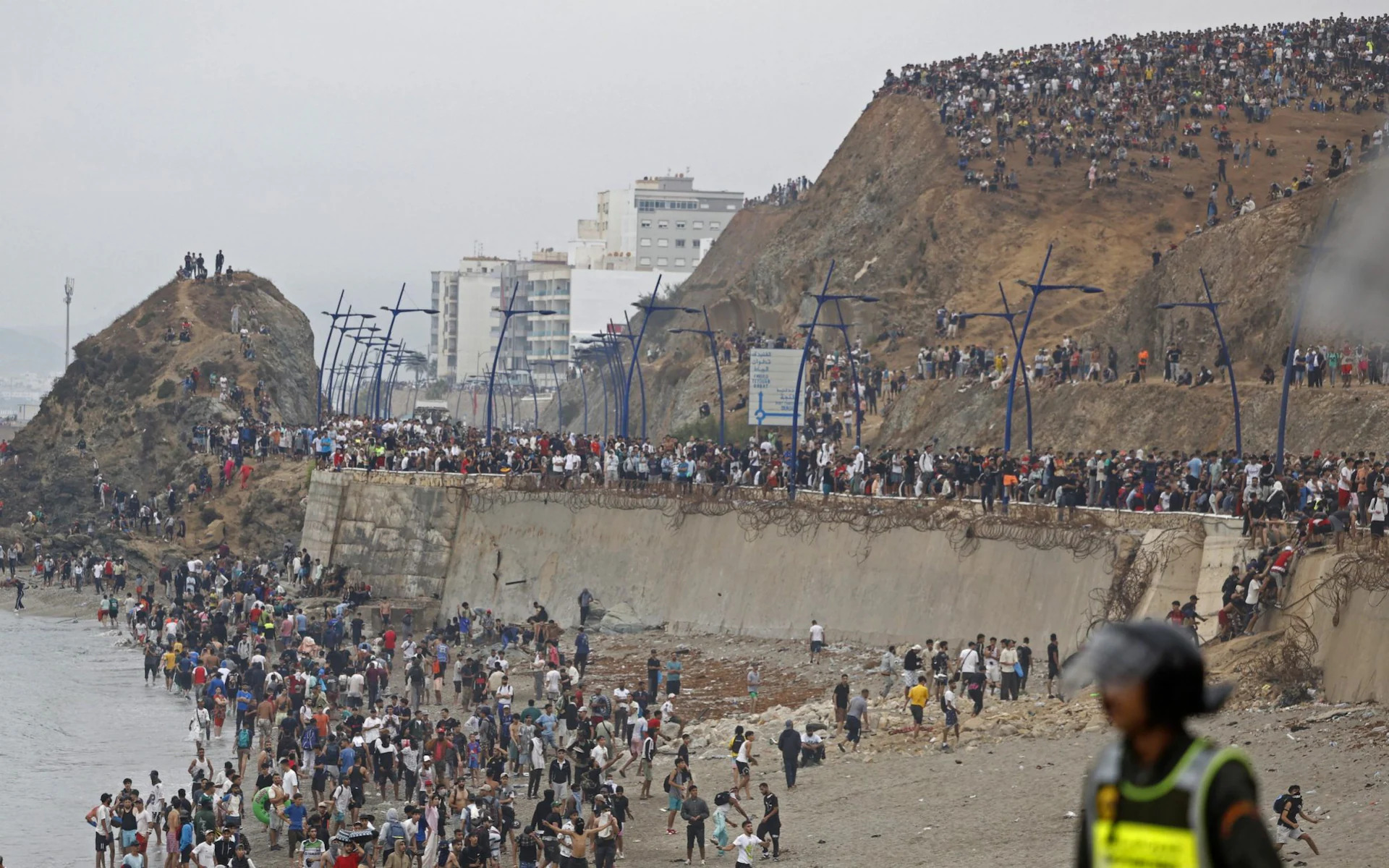
Morocco is suspected of facilitating the sudden mass movement of migrants into Spain’s North African enclave of Ceuta, according to Western intelligence sources, in what may have been an attempt to pressure Madrid amid growing diplomatic tensions between the two countries.
The claims emerged after approximately 60,000 migrants crossed into Ceuta during a chaotic 48-hour period, with thousands arriving by swimming from Morocco, crossing through overwhelmed border points and exploiting gaps in security infrastructure.
Western intelligence officials cited by The Telegraph believe Moroccan authorities may have been aware of the mass movement in advance or deliberately allowed it to take place. The allegations have not been publicly confirmed by the Moroccan government, while Spanish officials have played down suggestions that Rabat directly orchestrated the crossings.
The sudden influx has nevertheless raised fresh questions about Morocco’s role in migration flows towards Spain and the extent to which migration can be used as a diplomatic pressure tool.
The crisis unfolded as entire families and groups of young men attempted to enter Ceuta from the Moroccan town of Fnideq. Some migrants swam along the coastline using inflatable rings and other flotation devices, while others moved towards the land border and attempted to pass through overwhelmed security barriers.
At least 57 people were reported to have died, either through drowning or as a result of being crushed during the chaotic movement at the border.
The scale of the arrival was unprecedented. Reports suggested that as many as 60,000 people entered or attempted to enter the enclave, making it potentially one of the largest single-day migrant movements ever recorded in the European Union.
By Friday evening, approximately 48,000 people had reportedly returned to Morocco, raising questions about what had prompted such a large number of people to make the journey into Ceuta in such a short period.
Some migrants who reached the Spanish territory said they had been encouraged to make the journey by people they encountered along the route, including individuals they described as police officers. Others said they had followed information circulating on social media about a recent Spanish court ruling that could make immediate returns more difficult for people intercepted at sea.
Spanish authorities detected a significant increase in social media activity before the crossings began. Officials were reportedly investigating whether the online campaign had developed organically or whether it had been coordinated by state actors or organised criminal networks.
One possible explanation being examined by security officials is that misinformation about Spain’s migration rules may have encouraged thousands of people to attempt the journey.
The situation was particularly significant because of a recent ruling by Spain’s Supreme Court. The court determined that migrants intercepted at sea while attempting to reach Ceuta or the neighbouring Spanish enclave of Melilla could not automatically be subjected to the same rapid returns used for people attempting to cross the land border.
The ruling effectively created an important distinction between sea and land arrivals, potentially increasing the incentive for migrants to attempt the dangerous crossing by water.
Morocco has previously been accused of allowing migration pressure to increase during periods of tension with Spain.
In 2021, around 8,000 migrants entered Ceuta after Moroccan authorities appeared to relax controls along the border during a diplomatic dispute with Madrid. That episode was widely interpreted as an attempt by Rabat to pressure Spain over its position on Western Sahara.
Morocco does not recognise Ceuta as Spanish territory and has historically described the enclave, along with Melilla, as occupied territory.
Analysts have therefore raised the possibility that the latest influx could similarly have been connected to Morocco’s broader diplomatic interests.
Haizam Amirah Fernández, director of the Centre for Contemporary Arab Studies in Madrid, said that such a large movement of people from Morocco into Ceuta would have been extremely difficult to achieve without Moroccan authorities knowing about it or permitting it to happen.
Former US ambassador to the United Nations Zalmay Khalilzad also questioned whether Morocco could have facilitated the movement as a means of gaining leverage over Spain.
However, there has been no public evidence conclusively establishing that the Moroccan government ordered or organised the crossings.
Spanish Prime Minister Pedro Sánchez sought to avoid directly blaming Rabat and instead praised Morocco for its cooperation in combating irregular migration.
The incident nevertheless comes against a backdrop of diplomatic tensions between Madrid and Rabat, including disagreements over Spain’s relations with Algeria.
Morocco has been particularly sensitive to Spain’s dealings with Algeria, its regional rival, while Madrid has sought to strengthen energy cooperation with Algiers.
The migration crisis quickly developed into a wider European political dispute, with several European leaders accusing Spain of failing to adequately protect the external border of the Schengen area.
Italian Prime Minister Giorgia Meloni called for tougher measures and warned that uncontrolled migration posed a threat to European border security. She also raised the possibility of suspending Schengen cooperation with Spain.
Denmark, Sweden, the Czech Republic and Finland also expressed concern, with Danish Prime Minister Mette Frederiksen arguing that European countries should consider all available measures to protect the bloc’s external borders.
Finland’s interior minister, Mari Rantanen, similarly accused Spain of failing to protect the Schengen area’s external frontier and called on European countries to support stronger border controls.
France also warned that it could strengthen controls along its border with Spain if necessary to prevent migrants arriving in Ceuta from travelling onwards towards mainland Europe.
French President Emmanuel Macron said additional border measures could be introduced despite Ceuta not having direct freedom of movement to the wider Schengen area.
Germany’s Chancellor Friedrich Merz called on Morocco to immediately take back migrants who had entered Ceuta irregularly.
Polish Prime Minister Donald Tusk, whose government has invested heavily in securing Poland’s border with Belarus, said Spain needed to strengthen its border protection if the Schengen system was to remain sustainable.
European Commission President Ursula von der Leyen described the images coming from Ceuta as unacceptable and called for migrants who had entered illegally to be returned swiftly in accordance with European and national law.
The European Commission also emphasised that Ceuta and Melilla are unusual in the European migration system because they represent two of the European Union’s only land borders with Africa.
Despite the scale of the crisis, European officials said there had been no significant onward movement of migrants from Ceuta into mainland Europe or other EU member states.
The incident also attracted attention outside the European Union.
Former US President Donald Trump criticised the Spanish government over its migration policies, describing the situation as resembling an invasion and linking it to his broader criticism of European migration policies and Spain’s defence spending.
The Spanish government responded by increasing security in Ceuta, deploying additional soldiers, police officers, drones, boats and divers to reinforce the border and assist with rescue operations.
Prime Minister Sánchez travelled to Ceuta as the crisis intensified and faced angry protests from some residents who accused his government of failing to protect the territory.
The sudden influx disrupted everyday life in the enclave. Shops were forced to close, supplies of essential goods such as bread became limited and local celebrations were cancelled as authorities struggled to accommodate the large number of arrivals.
The crisis has once again highlighted the strategic importance of Ceuta in Europe’s migration debate and the complicated relationship between Spain and Morocco.
It has also renewed concerns that migration routes can become instruments of political pressure when neighbouring countries experience diplomatic disputes.
For Spain and the wider European Union, the immediate challenge will be to determine how the crossings occurred on such an extraordinary scale, whether Moroccan authorities deliberately facilitated them and how future mass movements can be prevented without compromising the legal protections available to migrants seeking international protection.
Until evidence establishes otherwise, however, allegations that Morocco deliberately orchestrated the crossings remain claims under investigation rather than proven fact.