
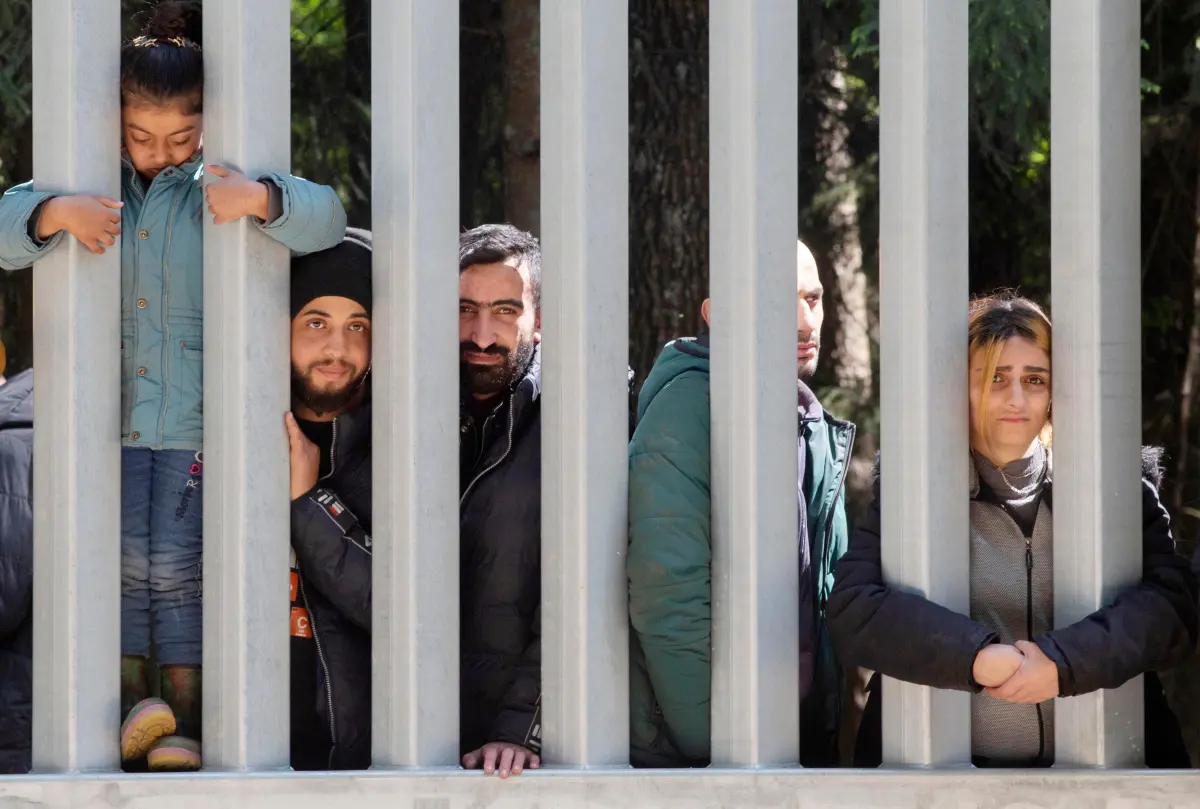
Poland is urging the European Union to consider allowing countries to temporarily restrict access to asylum procedures during exceptional periods of mass migration, following its own policy at the Belarus border.
Poland introduced the measure in March 2025, describing it as an emergency response to what its authorities said was Belarus and Russia using migration to pressure the country. The suspension was initially presented as temporary but has since been repeatedly extended. Human Rights Watch says the measure remained in effect after further extensions and raised concerns about border pushbacks.
The Polish-Belarusian border has been a major point of tension since 2021. European authorities have accused Belarusian President Alexander Lukashenko’s government of encouraging migrants to travel to Belarus and attempt to enter the EU, a situation European officials have described as the “instrumentalization” or “weaponization” of migration.
Warsaw now wants similar emergency measures to be available across the EU when governments believe migration movements are being deliberately organized or exploited.
The debate gained momentum after European Commission President Ursula von der Leyen announced on September 16 that the Commission would propose a new European Emergency Response Framework for situations in which large movements of people at EU external borders are considered engineered or weaponized.
According to the European Commission, the proposed framework would operate only under strictly defined conditions and would allow limited, temporary flexibility in standard procedures. The Commission has not yet provided all details of how the framework would work or what specific asylum procedures could be changed.
Poland’s deputy interior minister responsible for migration, Maciej Duszczyk, welcomed the announcement and described it as recognition of the approach Poland has been advocating.
However, human rights organizations and some European lawmakers have raised concerns about what such a system could mean for access to asylum.
Tineke Strik, a Dutch member of the European Parliament, warned that applying the Polish approach more broadly could weaken protections under European and international asylum law.
The principle of non-refoulement is particularly important in the debate. It generally prevents states from returning people to places where they could face persecution or serious harm. Human Rights Watch and Amnesty International have argued that Poland’s suspension has created serious risks for people seeking protection at the Belarus border.
Polish officials reject the claim that the policy violates international law. Duszczyk has said that vulnerable people, including children, pregnant women, people requiring urgent medical care and those at risk if returned to Belarus, are covered by exemptions under the law.
Rights groups, however, say safeguards have not always worked in practice. Human Rights Watch reported that people continued to face pushbacks at the border despite the exemptions included in the legislation.
The issue is also being debated in the context of the EU’s new Pact on Migration and Asylum, which entered into application in June 2026. The pact established common rules for screening, registering and processing irregular arrivals, while also providing mechanisms for countries facing serious migration pressure or crises.
Poland argues that the existing framework does not go far enough to deal with situations it considers exceptional. Its government has called for an additional EU mechanism that could allow countries to temporarily depart from normal procedures during severe border emergencies.
The European Commission is expected to provide further details of its proposed emergency framework as EU governments discuss how the bloc should respond to sudden and large-scale migration movements.
The proposal is still at an early stage, and its final form, legal safeguards, and implementation requirements have yet to be determined.