
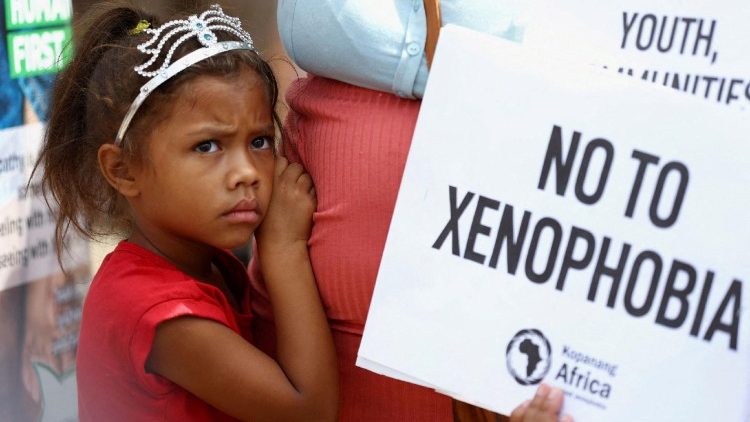
The Southern African Catholic Bishops’ Conference (SACBC) has strongly condemned the growing violence and intimidation targeting migrants and refugees in South Africa, warning that political leaders must not exploit the country’s migration crisis for electoral advantage ahead of upcoming local government elections.
In a Pastoral Letter released on Wednesday, 20 May, and signed by SACBC President Stephen Brislin, the bishops described the attacks against foreign nationals as a serious violation of human dignity and a betrayal of the values that should guide South African society.
“We unequivocally and without ambiguity condemn the acts of violence, intimidation, and displacement directed at migrants and refugees,” the bishops wrote. “Violence against migrants can never be justified, tolerated, or accepted.”
The statement comes as tensions continue to rise in several parts of South Africa, especially in KwaZulu-Natal and Gauteng provinces, where anti-immigrant campaigns and vigilante-style actions have intensified in recent weeks. Reports indicate that groups of protesters have been targeting foreign nationals, accusing them of taking jobs, contributing to crime, and living in the country illegally.
According to reports, dozens of migrants, including women and children, sought shelter outside the Durban Central Police Station on 19 May after allegedly receiving threats from community members in the areas where they live and work. Some families reportedly spent the night outside in cold weather because they feared being attacked if they returned home.
The bishops acknowledged that the growing tensions are linked to wider social and economic challenges facing the country. In the letter, they pointed to unemployment, poverty, inequality, poor public service delivery, corruption, and weaknesses in immigration management as factors contributing to frustration and anger within struggling communities.
“We wish to speak plainly: failures in governance, accountability, and leadership lie at the heart of the current crisis,” the bishops stated. “For too long, the cries of the poor have gone unheard.”
The Catholic leaders also recognised concerns surrounding porous borders, corruption within the Department of Home Affairs, exploitation of migrant labour, and criminal activities involving some migrants. However, they stressed that these concerns can never be used to justify violence, hatred, or collective punishment against innocent people.
“While these concerns and frustrations are real and must be addressed honestly, they can never justify violence against another human being,” the letter added.
The bishops warned that South Africa is facing a critical moral and political moment, particularly with local government elections approaching. They urged political parties and candidates seeking public office not to use fear, division, or anti-migrant rhetoric to win political support.
“In light of the upcoming local government elections, we offer a particular and urgent appeal to political parties and all those seeking public office: do not exploit the migration situation or the suffering of communities for political gain,” the bishops said.
“The instrumentalisation of fear, division, and human vulnerability for electoral advantage is morally unacceptable and risks further destabilising an already fragile social context.”
Referring to the teachings of the late Pope Francis and his encyclical Fratelli Tutti, the bishops reaffirmed the Christian belief that every human being is created in the image of God and deserves dignity, protection, and respect regardless of nationality or immigration status.
“As people of faith, we return to the foundational truth that every person is created in the image and likeness of God,” the letter stated. “We cannot build a peaceful society through hatred, scapegoating, or violence.”
The bishops concluded by calling for justice, ethical leadership, solidarity, and social responsibility across South Africa. They warned that without compassion, accountability, and respect for human dignity, the country risks deeper social divisions and continued unrest.
Human rights groups and religious organisations across Africa have increasingly raised concerns about the rise of xenophobia and anti-migrant violence in several countries, warning that misinformation, economic hardship, and political tensions are fuelling hostility against vulnerable migrant communities.