
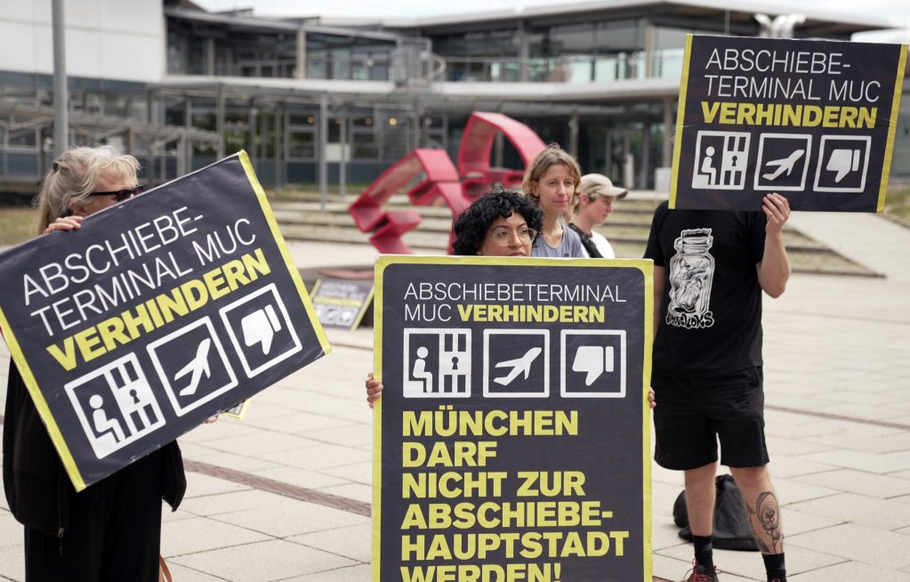
Munich Airport will build a dedicated migrant deportation terminal that will be leased to the German federal government and used exclusively by the Federal Police to facilitate deportation flights.
The airport’s Supervisory Board has approved plans for the new facility, allowing construction to move forward despite opposition from Munich’s mayor, trade unions and migrant rights organisations.
According to airport officials, the terminal will be used to process rejected asylum seekers and other individuals ordered to leave Germany before their deportation. Once completed, the building will be owned by Munich Airport but rented to the federal government, while all deportation operations will remain under the responsibility of the Federal Police.
Airport operator Flughafen München said it would provide only the infrastructure and would not be involved in carrying out deportation flights.
German authorities believe the dedicated facility will help significantly increase the number of migrant deportations, with the specialised terminal expected to improve the organisation and efficiency of removal operations.
The project received majority backing from the airport’s Supervisory Board, supported by the federal government and the state of Bavaria, which together hold a controlling stake in Munich Airport.
However, the decision has sparked criticism from refugee organisations, civil society groups and the Verdi trade union, all of which oppose expanding deportation infrastructure.
Munich Mayor Dominik Krause, a member of the Green Party, voted against the proposal, arguing that “large-scale deportations should not be part of Munich Airport’s business model.” The two Verdi representatives on the airport’s supervisory board also opposed the project.
The development comes as Germany continues to tighten its migration policies amid growing political pressure to increase deportations of people whose asylum applications have been rejected.
In the eastern state of Saxony-Anhalt, the far-right Alternative for Germany (AfD) has pledged to accelerate deportations if it wins the state election scheduled for September 6.
AfD’s candidate, Ulrich Siegmund, said his party would use all available legal measures, including detention pending deportation, to remove irregular migrants as quickly as possible.
Meanwhile, several state interior ministers have supported the federal government’s decision to resume deportations of individual criminal offenders to Syria. Despite the policy shift, no deportations to Syria have taken place since January, contributing to continued political debate over Germany’s immigration enforcement.
The planned deportation terminal reflects Germany’s broader efforts to strengthen the implementation of return policies while balancing legal obligations and ongoing public debate over migration.