
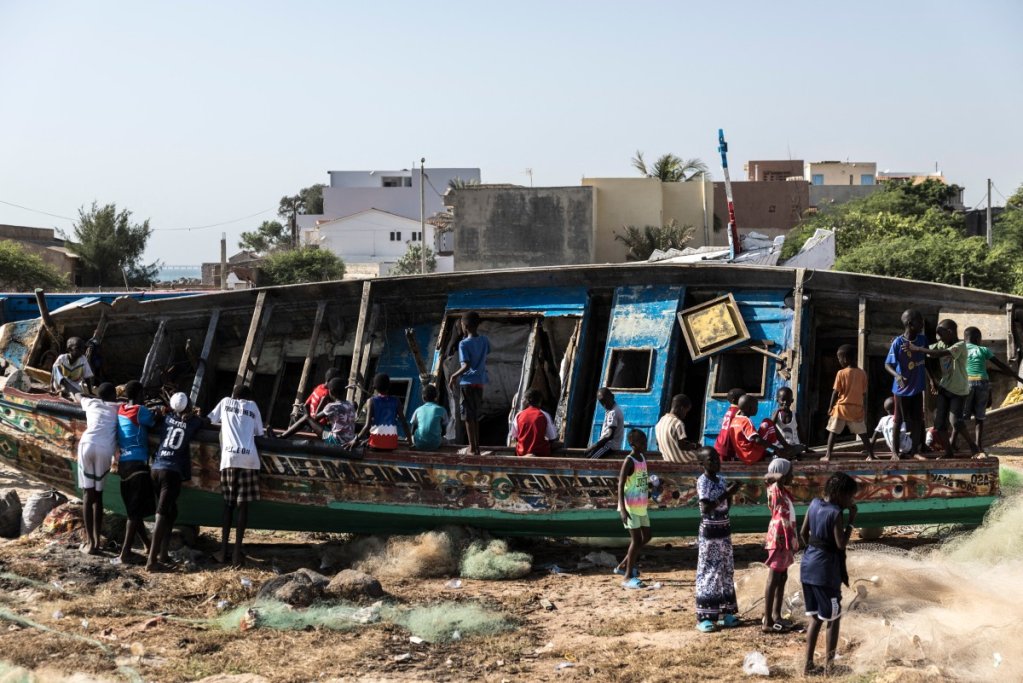
At least one person has died, and dozens remain missing after a boat carrying migrants towards Europe capsized off the coast of Senegal, triggering search operations amid a series of deadly shipwrecks along the Atlantic migration route.
The incident occurred off Yenne, south of the capital, Dakar, after the overcrowded boat reportedly struck rocks and overturned during the night.
The accident was initially reported on Thursday, November 19, although accounts from local officials and witnesses indicated that it happened at around 2 a.m. on Wednesday, November 18.
According to Reuters, Adama Mbengue, president of the local organisation Action for Human Rights and Friendship, said a survivor reported that approximately 50 people were aboard the vessel.
However, another survivor questioned by police suggested that the boat may have been carrying as many as 100 people, including five women.
Reports on the death toll differed. The mayor of Yenne, Mbengue, and local fire officials confirmed that at least one body had been recovered. Other local sources told AFP that two bodies had been found.
Rescue teams, including police officers, firefighters and specialised divers, launched search operations around the accident site to locate missing passengers and recover bodies.
Oumar Sow, who represents the village chief, said the accident happened during the early hours of Wednesday. He recalled hearing desperate cries from the boat, which could be heard from the nearby beach.
Fire department teams deployed two inflatable rescue boats to search the surrounding waters, with operations continuing on Thursday as authorities looked for additional victims.
The latest disaster comes just days after another migrant boat tragedy off Kebemer, north of Dakar, which left at least 43 people dead.
Senegal has experienced several deadly shipwrecks involving migrants attempting to reach Europe through the Atlantic Ocean. In July 2023, at least 16 migrants drowned after their boat struck a rock near Dakar while attempting to evade navy patrols.
The Atlantic route from West Africa to Spain’s Canary Islands remains one of the most dangerous migration journeys in the world. Migrants often travel for several days in overcrowded and poorly maintained wooden boats, facing strong ocean currents, rough seas and limited access to food and water.
Despite the dangers, the route has recently experienced a significant increase in arrivals. According to figures from the United Nations refugee agency, UNHCR, nearly 11,037 migrants reached the Canary Islands during the first two weeks of November 2026, based on data updated on November 15.
Frontex data also indicate that Senegalese nationals make up the majority of migrants using the Atlantic route.
UNHCR recorded 598 people dead or missing along the route between January and November 15, 2026. This compares with approximately 1,200 deaths and disappearances recorded throughout 2025.
Humanitarian organisations warn that the actual death toll could be considerably higher because many shipwrecks go unreported, particularly when entire boats disappear without survivors.
Following the latest disasters, Senegalese President Bassirou Diomaye Faye has requested a comprehensive report on possible solutions to irregular migration.
The president has called for greater investment in agriculture and fishing, alongside stronger policies targeting youth unemployment, education, vocational training and entrepreneurship.
He also highlighted the need to improve economic opportunities for women as part of broader efforts to address the factors pushing people to undertake dangerous journeys abroad.
The latest tragedy has renewed concerns about the risks facing migrants departing from West Africa as they attempt to reach Europe, often relying on smugglers and unsafe vessels to cross the Atlantic.