
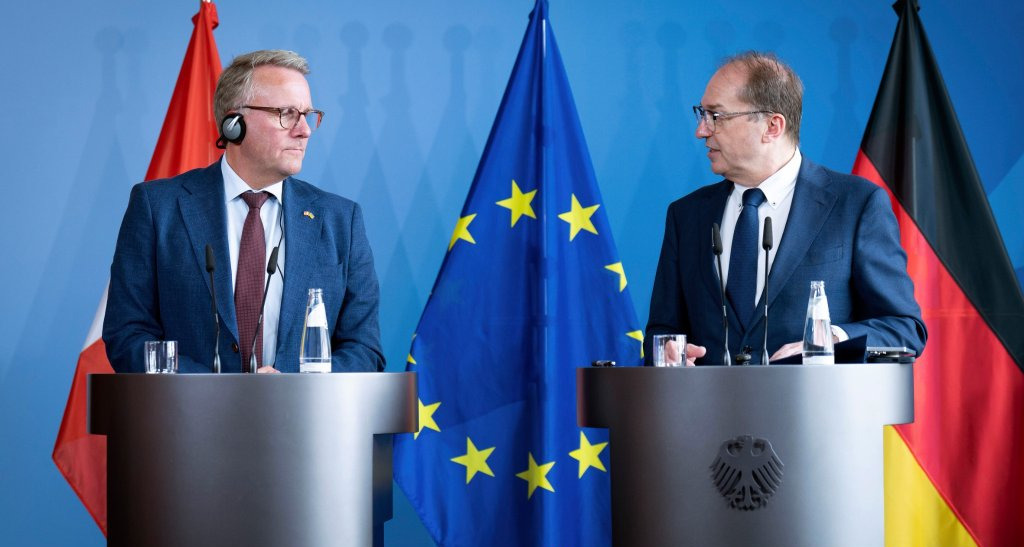
Five European Union countries are moving ahead with plans to establish migrant return centres outside the bloc, with the governments involved aiming to secure their first agreement with a non-EU country before the end of this year.
Denmark, Germany, Austria, the Netherlands and Greece agreed on a common framework for the proposed facilities during a meeting of their migration and interior ministers in Copenhagen on September 4.
Under the plan, rejected asylum seekers who cannot be returned directly to their countries of origin could be transferred to facilities in third countries while arrangements for their removal are completed.
Danish Migration Minister Morten Bødskov said his country expected to be in a position to make its first transfers by the end of 2027. German Interior Minister Alexander Dobrindt said the five governments hoped to agree with a partner country before the end of 2026, allowing the centres to begin operating the following year.
The governments have described the proposed facilities as part of a broader effort to increase the number of rejected asylum seekers who can be effectively returned. They have stressed that the centres would operate under agreements with partner countries and would comply with European and international legal obligations.
The five countries say they would finance the facilities themselves and could provide host countries with additional financial support, commercial cooperation and other incentives. They have also said they intend to work with international organisations, including the International Organization for Migration and the UN Refugee Agency.
However, UNHCR has indicated that it had not been presented with detailed proposals and was therefore unable to comment on the arrangements under discussion.
The location of the proposed centres remains undecided. Greek Migration Minister Thanos Plevris said talks with potential partner countries were progressing, while the five ministers are expected to meet again in Munich later this month to assess developments.
Uganda and Rwanda have emerged in reports as possible destinations, although none of the five governments has officially identified a host country.
Uganda already accommodates one of Africa’s largest refugee populations and has historically operated an open-door refugee policy. At the same time, international rights organisations have raised concerns about the country’s human rights record, including restrictions on political opposition, journalists and protesters.
Questions have also been raised about the treatment of vulnerable groups, conditions in refugee settlements and the country’s capacity to guarantee due process and protection against arbitrary detention.
Rwanda has likewise attracted attention because of its existing cooperation with European governments on migration and development. But the country’s suitability as a destination for asylum-related transfers remains controversial.
The UK’s attempt to send asylum seekers to Rwanda was rejected by the British Supreme Court in 2023 after judges found substantial grounds for believing that people transferred there could face a risk of being sent to countries where they might suffer persecution or other serious harm.
That principle, known as non-refoulement, is a central protection under international refugee law. It prevents states from returning asylum seekers or refugees to places where they could face persecution, torture or other grave violations.
Human rights organisations have warned that similar concerns could arise if Rwanda or Uganda were selected for the EU scheme. They have called for strong and independently enforceable safeguards to ensure that people transferred to the centres are not subjected to unlawful detention, mistreatment or onward removal.
The governments involved have sought to distinguish the proposed facilities from conventional detention camps. Officials have described them as “open” centres, with Dutch Migration Minister Bart van den Brink presenting the concept as an opportunity for irregular migrants to establish their lives in a partner country.
The proposed system is linked to the EU’s new Return Regulation, which provides a legal framework for member states to establish return arrangements with non-EU countries.
Any agreement must respect international human rights standards, including the principle of non-refoulement. People transferred under such arrangements would also retain rights including access to legal assistance, language support and communication with their families and relevant authorities.
Despite these provisions, important questions remain about how the system would operate in practice. These include who would be legally responsible for people inside the centres, how long individuals could remain there, what legal remedies would be available and how independent oversight would be guaranteed.
Such questions could become the focus of legal challenges in national courts and before the European Court of Justice. Any arrangement involving detention or the transfer of asylum-related responsibilities to a third country could also face scrutiny under the European Convention on Human Rights.
Previous European efforts to establish similar arrangements have added to concerns over the proposal.
The UK’s Rwanda policy was eventually abandoned after the Supreme Court ruling, while Denmark ended its own bilateral Rwanda initiative in 2023 and shifted towards a wider European approach.
Israel also previously pursued an arrangement under which asylum seekers were transferred to Rwanda, but the programme was ultimately abandoned after legal disputes and limited participation.
Italy’s agreement with Albania has provided another recent example of an EU government attempting to process or manage migrants outside its territory. However, the number of people transferred to the Albanian facilities has remained considerably below the capacity originally envisaged.
The centres, designed to accommodate thousands of people, have also generated significant costs. Reports indicate that hundreds of millions of euros have been spent on the arrangement, prompting debate over whether offshore migration facilities can provide a financially efficient alternative to managing migrants within EU territory.
Studies have similarly raised questions about whether detention in the Albanian facilities could ultimately cost more than accommodating migrants in Italy.
For critics of the EU proposal, these experiences demonstrate the practical difficulties of transferring migration management abroad. They argue that the facilities could require extensive spending on security, administration, legal services and monitoring while handling relatively small numbers of people.
Human rights groups have been particularly concerned about the possibility of prolonged detention and legal uncertainty. Organisations including Amnesty International and several humanitarian groups have warned that vulnerable migrants, including children, could face serious risks if adequate safeguards are not established.
The Council of Europe has also expressed concern about the proposal. Its Commissioner for Human Rights, Michael O’Flaherty, has warned that Europe could create “human rights black holes” if return centres are established without enforceable protections.
He has called for four key safeguards: detailed human rights risk assessments before any agreement is implemented; continuous independent monitoring with the ability to suspend operations when violations occur; legally binding agreements containing enforceable human rights provisions; and public disclosure of risk assessments, monitoring findings and agreements.
O’Flaherty has urged Austria, Denmark, Germany, Greece and the Netherlands to establish these protections before the proposed centres become operational.
Critics also question whether the scheme would have a significant effect on irregular migration. Danish Refugee Council Secretary General Charlotte Slente has argued that return hubs would affect only a limited number of people and would not necessarily discourage migrants from attempting dangerous journeys.
Supporters, however, see the initiative as another tool for increasing the effectiveness of European return policies at a time when governments across the bloc are under pressure to reduce irregular migration and increase deportations.
The proposal has also exposed differences between EU member states. While the five participating governments are pursuing the idea, countries such as France and Spain have expressed reservations about offshore return arrangements. Members of the European Parliament have also raised concerns about transparency and access to facilities connected to existing migration agreements.
For now, the five governments are working towards two major deadlines: securing a partnership with a non-EU country around the end of 2026 and beginning transfers by the end of 2027.
Whether those targets can be met will depend on negotiations with potential host countries, the final legal framework and the ability of the participating states to address concerns over detention, human rights protections, judicial oversight and costs.
Any agreement is also likely to face legal scrutiny from NGOs, affected migrants and other rights bodies. Challenges could reach national courts, the European Court of Justice or the European Court of Human Rights, particularly if individuals argue that the arrangements expose them to unlawful detention, inadequate legal protection or the risk of refoulement.
The debate therefore goes beyond whether the five countries can establish the centres on schedule. It will also test how far EU governments can move migration enforcement outside European territory while continuing to meet their obligations under European and international human rights law.