
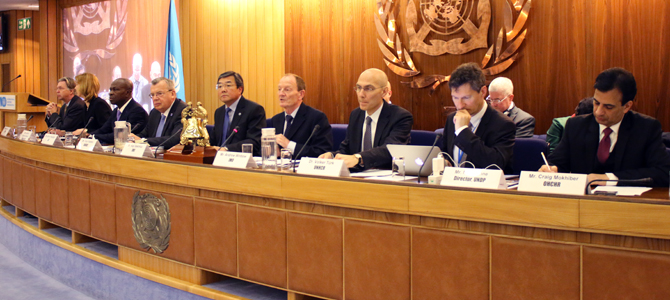
The International Maritime Organization (IMO), the United Nations High Commissioner for Refugees (UNHCR), and the International Chamber of Shipping (ICS) have released a revised edition of their Rescue Guide aimed at strengthening the rescue and protection of refugees and migrants in distress at sea.
The updated publication, titled Rescue at Sea: A guide to principles and practice in the context of refugee and migrant movements, is designed to support governments, shipmasters, rescue agencies, and humanitarian groups in carrying out their legal and humanitarian responsibilities during maritime rescue operations.
The revised guide comes as deadly shipwrecks involving migrants and refugees continue to occur across several major migration routes around the world. International organisations say the new version provides clearer legal guidance and practical procedures to help ensure that people rescued at sea are brought to safety quickly and treated in accordance with international law.
The organisations behind the guide stressed that the seas must remain a humanitarian space and that all people in distress at sea should be rescued without discrimination, regardless of nationality or migration status.
Arsenio Dominguez said the updated guide is necessary because many people continue to lose their lives while attempting dangerous sea journeys in search of safety or better opportunities.
“There is an ongoing human tragedy of lives lost at sea during unsafe, dangerous journeys,” Dominguez said. He praised the efforts of coast guards, navies, rescue agencies, and merchant vessels that continue to save lives at sea, often under difficult conditions.
According to the IMO chief, the revised guide helps transform existing legal obligations into practical action by providing clearer instructions for governments, ship captains, and rescue crews responding to emergencies at sea.
Elizabeth Tan also stressed that many migrants and refugees risk dangerous journeys only because they lack safe and legal pathways to protection and stability.
“Nobody risks their life at sea, or that of their family, unless desperate to find safety and stability in the absence of safer pathways,” she said. Tan added that the repeated shipwrecks involving migrants are preventable and should never be accepted as normal.
The guide highlights the responsibility of states and maritime actors to rescue people in distress and ensure safe disembarkation in places where they will not face persecution, violence, or forced return to danger, a principle known under international law as protection against refoulement.
The updated Rescue Guide builds on the original 2015 edition but now provides more detailed explanations of legal standards, rescue coordination, and disembarkation procedures. It is available in six languages, including Arabic, Chinese, English, French, Russian, and Spanish.
According to data from UNHCR and humanitarian partners, migration routes across the Mediterranean, Asia, and Africa remain among the deadliest in the world. In 2025 alone, about 1,953 people were reported dead or missing in the Mediterranean Sea.
The South and South-East Asia route also recorded extremely high risks, with 892 people reported dead or missing among more than 6,500 Rohingya refugees who attempted dangerous sea crossings during the year. Humanitarian organisations described this route as having the world’s highest mortality rate for refugee and migrant sea journeys.
Around Africa, the Western Africa Atlantic migration route also remained highly dangerous, with at least 424 reported deaths last year as migrants attempted risky journeys towards Europe.
Thomas A. Kazakos said the global shipping industry often becomes the first responder during migrant rescue operations.
“The global shipping industry is often the first responder when people are in distress at sea,” Kazakos said, adding that many ship crews go beyond their commercial duties to save lives.
He explained that the revised guide offers practical support to ensure rescues are carried out safely and according to international law while also encouraging governments and international partners to share responsibility for timely disembarkation and humanitarian protection.
The release of the revised Rescue Guide comes as migration by sea continues to increase globally, with humanitarian organisations repeatedly calling for stronger international cooperation, safer migration pathways, and improved protection systems to prevent further loss of life on dangerous maritime routes.