
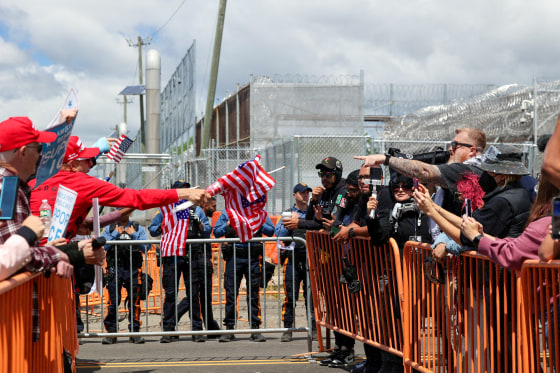
The government of the U.S. state of New Jersey has ordered state police to take control of security operations outside a migrant detention centre in Newark after days of escalating tensions between protesters and federal immigration officers.
Governor Mikie Sherrill announced the decision on Friday, saying the move was necessary to reduce conflict and ensure both public safety and the right to peaceful protest outside the Delaney Hall detention facility.
Delaney Hall, a 1,000-bed immigration detention centre operated by GEO Group on behalf of U.S. Immigration and Customs Enforcement (ICE), has become the centre of growing demonstrations over the treatment of migrant detainees.
Sherrill, who has repeatedly called for the closure of the facility, said she wanted to prevent further unrest while protecting the rights of people to assemble peacefully.
“I will not give ICE the pretext to expand operations in our state,” the governor said during a press conference alongside state officials.
Under the new arrangement, New Jersey State Police established designated protest areas outside the facility and introduced vehicle checkpoints to manage traffic and separate opposing groups of demonstrators.
Officials said anti-ICE and pro-ICE protesters would be assigned to different gathering zones to reduce the risk of confrontations.
According to state police, federal immigration officers agreed to withdraw from the immediate protest area, allowing local law enforcement to oversee crowd management.
The decision was welcomed by U.S. Homeland Security Secretary Markwayne Mullin, who described the move as a victory for law and order. He thanked the governor for allowing state police to cooperate with federal immigration authorities after several days of unrest.
The protests began after detainees inside Delaney Hall reportedly contacted family members and supporters to announce a hunger strike and labour protest. The detainees demanded their release and raised concerns about conditions inside the facility.
Among the complaints were allegations of spoiled food, poor sanitation, inadequate ventilation, and the spread of flu-like illnesses among detainees.
Federal officials have strongly denied the accusations. Mullin stated that detainees receive adequate food and sanitation services, although he acknowledged the detention centre is not intended to function as a hotel.
Data from the Deportation Data Project suggests that more than 850 migrants have been held at Delaney Hall, with only about 100 reportedly having criminal convictions.
The detention centre has also attracted national political attention. During a recent White House Cabinet meeting, U.S. President Donald Trump described Delaney Hall as a “nice facility” and praised its operations.
Trump also claimed, without providing evidence, that some individuals participating in demonstrations outside the facility were being paid to protest.
Over the past week, clashes between protesters and immigration officers have intensified. Authorities reported that ICE agents used batons and pepper spray during some confrontations, while several demonstrators were arrested.
Among those affected was Andy Kim, who was reportedly pepper-sprayed while attending a protest in support of detainees.
Governor Sherrill also joined demonstrators during a Memorial Day event and attempted to visit the detention centre. However, immigration officials denied her entry. Instead, she spoke with a detainee by telephone from outside the facility.
Sherrill later emphasised that detainees should be treated with dignity and respect regardless of their immigration status.
“The people inside Delaney Hall are fathers and mothers, sons and daughters, and members of our community,” she said. “In New Jersey, we believe in the rule of law and that everyone deserves to be treated with basic dignity.”
Meanwhile, officials from the New Jersey Department of Health visited the facility on Thursday to inspect food service operations and kitchen facilities. Their findings had not yet been released as of Friday.
The situation at Delaney Hall highlights the growing national debate over immigration detention, migrant rights, and enforcement policies in the United States as protests continue to draw attention to conditions inside detention facilities across the country.