
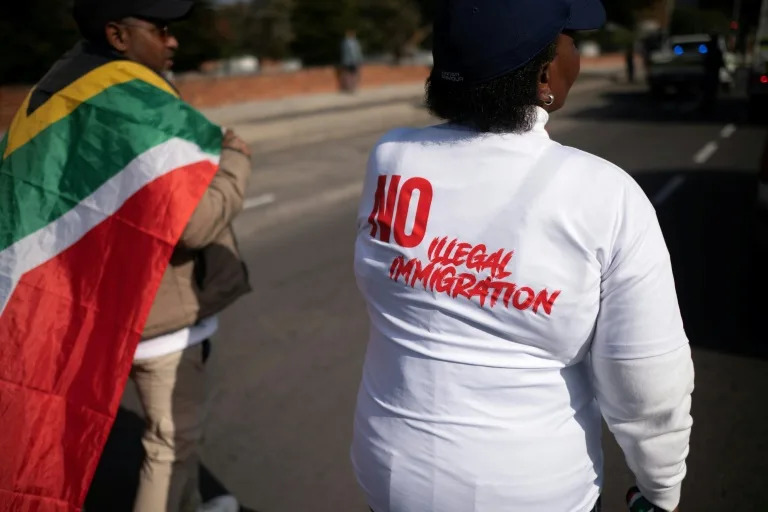
The government of South Africa has held urgent discussions to address rising anti-migrant tensions as protests against undocumented foreign nationals continue to spread across different parts of the country.
Government ministers responsible for justice, defence, and crime prevention met on Monday to develop strategies aimed at tackling xenophobia, racism, and growing hostility towards migrants. The emergency meeting comes after increasing demonstrations by citizen-led groups demanding that undocumented migrants leave the country before June 30.
Although the ultimatum has no official government support, it has raised serious concerns among migrant communities and human rights organisations, who fear the protests could trigger violence similar to previous xenophobic attacks in South Africa.
In a statement, the government said officials were working on a national plan to combat “racism, racial discrimination, xenophobia and related intolerance.” Authorities also confirmed plans to meet political parties and protest groups involved in the anti-migrant demonstrations.
The protests have intensified in recent months, with some groups accusing undocumented migrants of contributing to crime, unemployment, and pressure on public services. Similar tensions in 2008 resulted in deadly xenophobic violence that killed 62 people, including South African citizens.
Last week, several hundred foreign nationals reportedly sought protection in the eastern port city of Durban after claiming that local residents were moving door-to-door warning migrants to leave by the end of June.
Many of those seeking protection came from countries including the Democratic Republic of the Congo, Rwanda, and Somalia.
The situation has also alarmed other African governments. Ghana has announced plans to repatriate hundreds of its nationals living in South Africa. Ghana’s High Commissioner, Benjamin Quashie, acknowledged that many affected migrants had expired work permits.
Fresh protests were also reported on Monday in Katlehong township near Johannesburg, where hundreds of residents demanded that police verify the immigration documents of foreign nationals operating local businesses.
Another protest in a low-income suburb of Bloemfontein reportedly targeted migrants alongside complaints over poor public services and economic hardship.
The South African government has repeatedly stated that migration pressures cannot be addressed by South Africa alone. Officials argue that economic instability, unemployment, and governance problems in several African countries continue to drive migration into South Africa, which remains one of the continent’s most industrialised economies.
Ronald Lamola said African nations must work together to address the root causes forcing people to migrate in search of safety and economic opportunities.
“This is a shared responsibility,” Lamola said while attending a meeting of the Southern African Development Community (SADC).
Human rights organisations and religious groups have continued to warn against hate speech and violence directed at migrants, stressing that economic frustration should not be used to justify xenophobia or attacks on vulnerable communities.
The growing tensions have once again highlighted the difficult balance South Africa faces between managing immigration, addressing unemployment, and maintaining social stability amid ongoing economic challenges.