
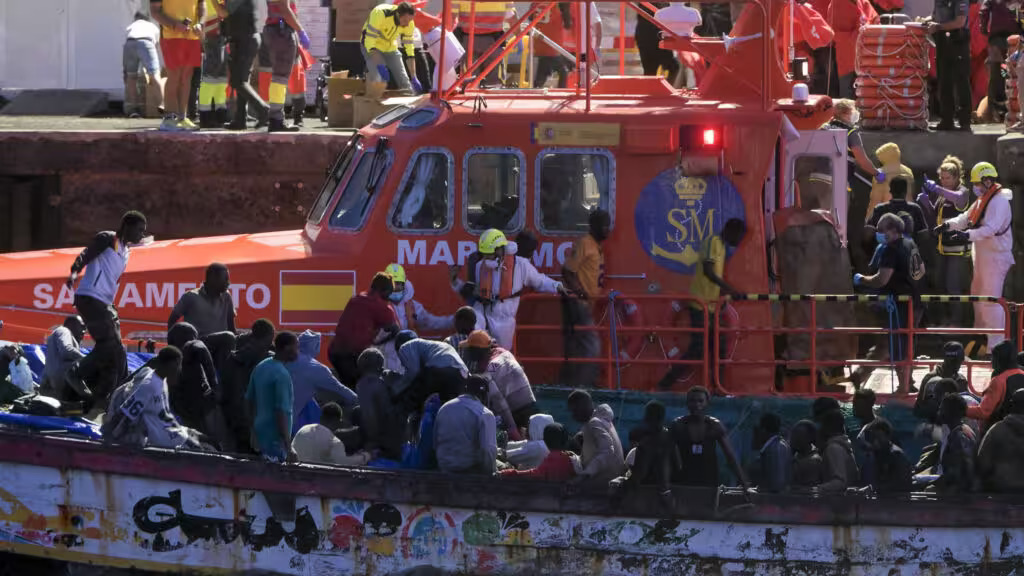
Spain’s Canary Island of El Hierro recorded its highest-ever daily number of migrant arrivals on Tuesday, November 24, after 1,971 people reached the island aboard 14 boats crossing the Atlantic Ocean from West Africa. One person was found dead, according to emergency services figures reported by Spanish news agency EFE.
The arrivals included at least 203 women and 137 children. Among the children was a four-day-old baby girl who was born during the dangerous Atlantic crossing.
The daily total is the highest recorded in Spanish maritime rescue records. It also exceeded the previous record of 1,580 migrants rescued across El Hierro, Gran Canaria and Tenerife on November 14.
Arrivals continued on Wednesday, November 25, when another 190 migrants reached El Hierro aboard two boats early in the morning, according to regional broadcaster RTVC.
El Hierro, which has a population of approximately 12,000 people, has been facing increasing pressure on its healthcare and emergency services. Authorities have opened a temporary field hospital to help manage the growing number of arrivals and reduce the burden on local medical facilities.
Canary Islands President Fernando Clavijo described the situation as a major humanitarian and migration challenge facing the archipelago.
“Days like today show us the human dimension of the migration challenge facing the Canary Islands and El Hierro,” Clavijo wrote on X.
He also criticised the results of Spain’s diplomatic efforts in Senegal and Gambia, saying they were not achieving the expected results because migrant boats continued departing from West African shores and arriving in the Canary Islands.
Clavijo called on Spain’s central government and the European Union to strengthen border controls and increase their involvement in addressing the situation.
According to the regional government, nearly 14,000 migrants had arrived in the Canary Islands aboard 139 boats during November as of Tuesday. El Hierro accounted for 83.5 per cent of the boats reaching the archipelago during that period.
The growing arrivals have also increased pressure on the Canary Islands’ child protection system. The regional government was caring for 3,325 unaccompanied migrant children, with Clavijo warning that the number could exceed 4,000 by the end of the year if arrivals continued and transfers to other Spanish regions remained at their current pace.
Support is being organised from other parts of Spain. The Basque government announced that it would send medical equipment and medicines to El Hierro. It had previously pledged to deploy two doctors and four nurses to help local healthcare services.
Meanwhile, the CGT union, which represents maritime rescue workers, called for additional staff and resources. The union warned that existing staff shortages were placing increasing pressure on rescue crews and affecting their health.
Beyond the situation in the Canary Islands, concerns are growing among families in Senegal over people attempting the dangerous Atlantic crossing.
Senegal’s public news agency APS reported that families were seeking help to locate 172 people who departed aboard a boat on November 9 and have not been heard from since.
Many of those missing were young fishermen from communities around Dakar. Community leaders said declining fish stocks, competition from large fishing vessels and worsening economic conditions were contributing to the growing number of young people willing to risk their lives attempting to reach Europe.
The latest arrivals highlight the continuing pressure on Spain’s Canary Islands migration route, where dangerous sea crossings, missing migrants and increasing demands on local reception and emergency services remain major concerns.