
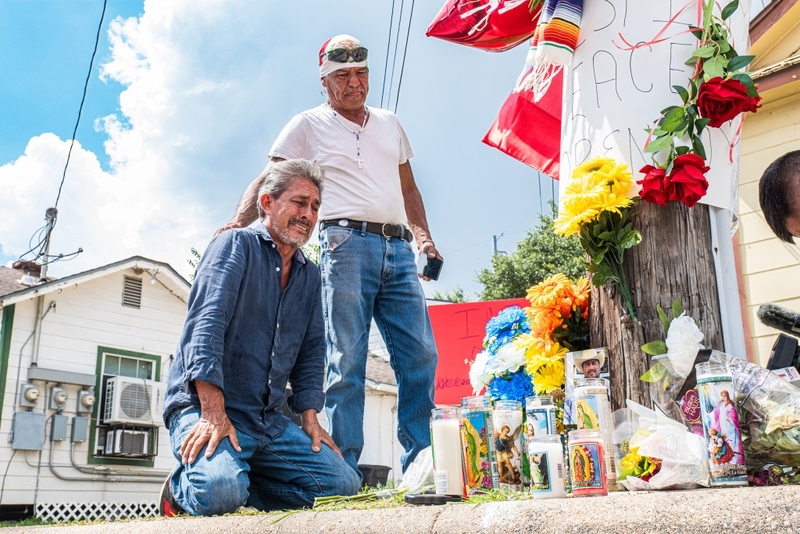
The fatal shooting of a Mexican national by U.S. Immigration and Customs Enforcement (ICE) agents in Houston has intensified concerns over the treatment of migrants during immigration enforcement operations in Texas.
Lorenzo Salgado Araujo, whom ICE identified as an undocumented migrant from Mexico, died on Tuesday after being shot during an attempted arrest in Houston’s East End. According to the Department of Homeland Security, federal agents were carrying out a targeted immigration enforcement operation when they attempted to stop his vehicle.
ICE said Salgado Araujo tried to evade arrest and allegedly attempted to run over a federal officer, prompting agents to open fire. He suffered a gunshot wound to the abdomen and later died in hospital.
However, relatives have disputed the official account. Speaking at a news conference, Salgado Araujo’s son, Ronaldo Salgado, said his father had been driving to work in the construction industry and may not have realized the people attempting to stop him were law enforcement officers. He also said his father had lived in the United States for nearly 35 years and was in the process of applying for a work permit.
The shooting has prompted calls for an independent investigation from local elected officials, including U.S. Representatives Sylvia Garcia and Christian Menefee, as well as the League of United Latin American Citizens (LULAC). Critics argue that previous ICE shootings have raised questions about the accuracy of initial official accounts.
The Houston incident is the second fatal shooting involving ICE agents in Texas since President Donald Trump returned to office in 2025.
In March 2025, 23-year-old Ruben Ray Martinez, a U.S. citizen from San Antonio, was fatally shot by an ICE agent in South Padre Island after officers claimed he struck an agent with his vehicle. Video footage later released by Texas authorities did not clearly confirm that account, and a Cameron County grand jury ultimately declined to indict the officers involved.
The latest shooting also comes amid broader concerns about deaths in immigration detention facilities across Texas. According to federal detainee death notifications, at least 14 people have died while in ICE custody in Texas since January 2025. The reported causes include natural illnesses, medical complications, suspected suicide, homicide, and deaths that remain under investigation.
Texas operates the largest network of ICE detention facilities in the United States, holding more than 18,700 immigration detainees, according to federal data. Several of the deaths have drawn public attention after relatives and advocacy groups questioned the medical care provided to detainees or the circumstances surrounding their deaths.
Immigration enforcement has expanded significantly since President Donald Trump returned to office, following campaign promises to increase deportations and strengthen border security. Federal data analysed by the Texas Tribune indicate that ICE’s average daily arrests in Texas more than doubled during the first six months of the new administration compared with the previous administration. The analysis also found that a larger proportion of those arrested had no criminal convictions than under the previous administration.
The report also highlights several attacks targeting immigration facilities and federal officers in Texas. In September 2025, a gunman opened fire at an ICE detention facility in Dallas, killing one detainee and injuring two others before taking his own life. Another armed attack occurred outside the Prairieland Detention Center in North Texas in July 2025, where multiple suspects were arrested after a confrontation that left a police officer injured.
Legal experts emphasize that immigrants in the United States have constitutional protections regardless of their immigration status. These include the right to remain silent beyond providing basic identifying information required by state law, the right to refuse entry into a home without a valid judicial search or arrest warrant, the right to consult an attorney, the right to request an interpreter during immigration proceedings, and the right to ask officers for their names, agency affiliation and badge numbers while, in many circumstances, recording interactions with law enforcement from a safe distance.
Experts also encourage immigrants to keep important identification documents accessible, maintain emergency contact information and prepare a family plan in case of detention or arrest.